




Sciographies is a radio show and podcast about the people who make science happen, presented by the Faculty of Science and campus-community radio station CKDU 88.1 FM.
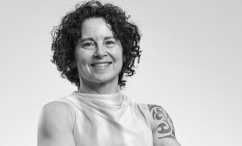
In this special alumni episode of Sciographies, we sit down with Tina Simpkin (BSc’94, DMet’95), a familiar voice to many Nova Scotians as a meteorologist with CBC.
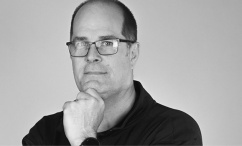
Host Dr. David Barclay speaks with Tina about her upbringing in Spryfield, where she was raised by her grandparents and shaped by their lasting influence—including nurturing her early fascination with weather and her certainty that she was destined to become a meteorologist.
Tina also shares her perspective on Nova Scotia’s ever-changing weather, her experiences chasing tornadoes in the United States, and what ultimately drew her back to her Halifax roots. Along the way, she reflects on what continues to inspire her today, including her work as a tutor at the Halifax Scottish Rite Learning Centre for Children.
Below are some excerpts from the episode, edited for clarity and length.
David: So you’re local. You grew up here in Halifax?
Tina: I did. I grew up here in Spryfield.
David: What schools did you go to?
Tina: I went to an elementary school called G.K. Butler, which is not there anymore. It's the Spryfield Wave Pool now. Then I went to Central Spryfield and J.L. Ilsley High.
David: What were your parents doing in Spryfield?
Tina: I was raised by my grandparents. They saw quite the change in their lifetime. Both my grandmothers lived to be over 90. My Simpkin grandmother lived to be 104. She just passed this spring. Both women were very instrumental to forming my thoughts and being the person that I am today.
David: When did your love affair with weather start?
Tina: That started when I was very young. I think that’s the case for a lot of meteorologists. There was either an event or something that was mystical about something that they saw or something that inspired them. I always enjoyed being outside. I was never indoors. I loved looking at clouds and the weather. My grandfather was a farmer and my great-grandfather lived with us growing up too. He would always tell me about the weather and what it was going to be just by looking at the clouds. I thought, “Wow, that's kind of magical to be able to do that.”
But then there were thunderstorms and wild storms and that always intrigued me. I always had a fascination with weather. I always knew I was going to be a meteorologist, always.
David: You’ve seen a large change in technology, but do you still go outside and look at the weather?
Tina: Every day. I'm drawn to the sky and to nature. That's in my DNA. I think that's where I came from somehow, some way. And we all are a stardust, right? We're all part of the stars.
David: Carl Sagan. He shows up in all sorts of places.
Tina: He does, right? I can't help it. The physics background.
David: Tell me how did you get into going to Dal for physics?
Tina: Dalhousie has a program called the Diploma in Meteorology. To get into the program, you need a physics degree. That kind of dictated that I really needed to take physics.

David: I'm sure there's a great amount of overlap between your career here and some of the teachers.
Tina: Well, there's always a mentor. There's always somebody that kind of changes your path. There was a professor from Dalhousie’s Department of Oceanography, Dr. Owen Hertzman, who taught a course called Weather Briefing.
There was no saying no to Dr. Hertzman. He told me that I was going to go into media and radio and television and that's the way it was going to be. “And here, Simpkin, look at this. There's this thing that came in from the American Meteorological Society with television internships. You're going to apply and you're going to do this.” And I thought, are you nuts? But again, you just didn't say no. I will say that my whole path I always wanted to be a meteorologist, but then never the thought of doing television or radio.
I did my first television job in Texas. I really knew nothing about severe weather. I knew about marine and public forecasting because that was my background, but I didn't know a lot about severe weather or the power of tornadoes. I saw the power of thunderstorms here in Nova Scotia, but never really the power of tornadic thunderstorms.
David: Tornadoes are a different scale than a nor'easter or something that would dramatically impact here. I assume the training at Dal would have been focused on looking at the North Atlantic?
Tina: Yeah, absolutely. My first job in television was in Midland, Odessa, Texas. I contacted the National Weather Service. I said, “Hi, I'm from Nova Scotia. I know very little about severe weather and severe weather forecasting.” They invited me in and I ended up training with them as a journeyman. After I got off my air shift, I was working for NBC, News West 9 in Midland, Odessa, Texas.
David: I'm very curious to know how long it took you to go chasing a tornado?
Tina: Oh, it didn't take long.
David: And when did you see your first one? What was that like?
Tina: I was in awe. It was like the heavens were opening. It was amazing to see something that you only see in textbooks. But I didn't go willy-nilly out in the field saying, "I'm going to find me a tornado today!" I went with people who were trained and I learned from them.
Listen to Tina Simpkin’s full episode of Sciographies at 10 a.m. on Thursday, April 2 on CKDU 88.1 FM in Halifax or find it on Apple Podcasts, Spotify, and other popular podcasting platforms. You can also listen to previous Sciographies episodes on the same platforms and at dal.ca/sciographies
Also in this series...
- Meet John Batt, manager of Dalhousie’s Aquatron
- Meet Dr. Rob Lennox, scientific director of Dal‑based Ocean Tracking Network
- Meet Dina Rogers, PhD candidate & biochemist
- Meet Dr. Sarah Chisholm, educator & mathematician
- Meet Dr. Simon Gadbois, canid & animal behaviour specialist
- Meet Maxine Westhead, marine biologist
- Meet Dr. Leanne Stevens, University Teaching Fellow and associate dean academic in Science