

Sciographies is a radio show and podcast about the people who make science happen, presented by the Faculty of Science and campus-community radio station CKDU 88.1 FM. This is the first article in a series featuring excerpts from each new episode released this winter.
In the second episode of season seven, we talk to Dr. Rob Lennox (BSc’13), scientific director of the Ocean Tracking Network (OTN), a global aquatic research, data management and partnership organization headquartered at Dalhousie University in Halifax.
Host Dr. David Barclay explores Lennox’s early curiosity of marine species and how it fueled a passion to study marine biology at Dalhousie. They also dig into his global adventures, including studying Atlantic salmon in Norway and what led him to be the scientific director at the Ocean Tracking Network.
Below are some excerpts from the episode, edited for clarity and length.
David (host): So, you put tags on the animals. How do they work and how do you track them?
Rob: Great questions. Of course it differs depending on the species. Our research includes Atlantic mackerel and halibut that we tag here in Nova Scotia. We're tracking them moving from the tip of Nova Scotia, Bay of Fundy into the Bras d'Or Lake into the Gulf of St. Lawrence. We haven't detected any in Newfoundland, but we have the ability to do localized studies.
We're also doing a research project with the province of Nova Scotia tracking anadromous brook trout that go out to sea and then come back and spawn. We're really focusing on that one river.
David: Can we talk a little bit about how you got into this field?
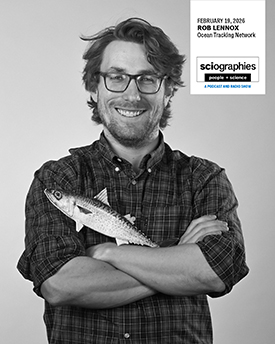 Rob: I mean, it was my whole childhood. I spent time on the river with my aunt and uncle in Alberta, at my grandma's cottage on the Bonnechere River in Ontario and at a family cottage in near Perth on Black Lake in Ontario.
I loved the ocean. I liked collecting shells and thinking about why these different species of shell exist. It made no sense to my small childhood brain. As much as I like fishing, I loved snorkeling and being like “What can I see? There’s a bass over here under the log, but I don't see any catfish.” Where are the catfish? Why are they not living under the log? They must do different things. At the time I didn't really put it together why I was interested in these things. It wasn’t until I came to Dal and studied marine biology.
In my undergrad, I started taking a lot of the third-and fourth-year classes. Dr. Pinder's vertebrate design evolution and function class was incredibly mind-blowing, as was Dr. Jeff Hutchings's class on fish ecology and evolution and some of the seaside courses. I was thinking, “Wow, this is answering a lot of the questions that I have.”
David: Growing up were you playing sports?
Rob: Yeah. Growing up, I loved playing hockey. It was like my favorite thing in the whole world.
David: What do your parents do?
Rob: My mom works in finance and my dad's a landscape architect.
I really had no idea what I wanted to do. I think it would be fair to say that I was very lost and confused about what I was good at. I loved to write, I always did well in English, and I did very well in math. Then I really plummeted in high school. I really struggled in math.
Pretty much every university in Canada required you to have advanced functions and calculus to get into a science program. I took advanced functions, and I dropped it in the first semester of grade 12. Then I found out that they offered it again. So, I took it again. Dalhousie was the only university in the country that would let you in a science program with only advanced functions. It was the only school I wanted to go to. It was very fateful and serendipitous indeed.
David: During your undergrad at Dal did you get a chance to get experience outside of the coursework? What were you doing in the summers?
Rob: Yeah, I did the co-op program. I did two co-op terms at Public Works and Government Services Canada. I was doing environmental assessments.
David: Were you driving down and getting on a boat and taking water samples?
Rob: All desk-based assessments. Once you get the hang of it, it’s very repetitive. If endangered species are observed while the small craft harbor dredging is being conducted, work should be paused.
David: Right.
Rob: I remember after doing it once thinking, “This is not how I'm going to spend the rest of my days.”
David: Did you think that was marine biology or were you like this is just one subset?
Rob: I didn’t really know. What I really enjoy about my job now, which is probably a good segue, is that I can expose marine biology students to a path that I found very difficult to navigate myself.
David: So, the Ocean Tracking Network serves the research interests of people all around the world?
Rob: Right. The Ocean Tracking Network is a Major Science Initiative funded by the Canada Foundation for Innovation and will be transitioning to a Major Research Facility. It's one of the few research infrastructures in Canada that has long-term sustainable funding to support both operations and infrastructure. We have our fleet of marine autonomous vehicles (gliders) across the harbour at COVE, and we also loan acoustic tracking receivers to researchers in Canada and across the globe. We use infrastructure to support a diverse network of researchers both nationally and in the global community.
Listen to Rob Lennox’s full episode of Sciographies at 10 a.m. on Thursday, Feb. 19 on CKDU 88.1 FM in Halifax or find it on Apple Podcasts, Spotify, and other popular podcasting platforms. You can also listen to previous Sciographies episodes on the same platforms and at dal.ca/sciographies.