
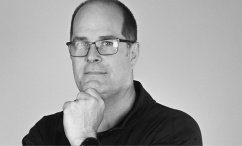
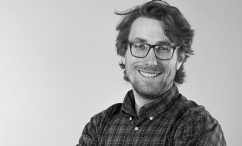
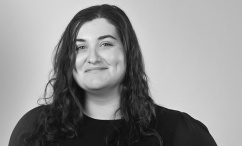

Sciographies is a radio show and podcast about the people who make science happen, presented by the Faculty of Science and campus-community radio station CKDU 88.1 FM.
In this episode of Sciographies, we talk to Dr. Sarah Chisholm, educator, mathematician and Chair of Dalhousie’s Department of Mathematics and Statistics.
Host Dr. David Barclay sits down with Dr. Chisholm to growing up in Sackville, Nova Scotia with an early love of numbers to pursuing graduate studies at the University of Calgary and later teaching at Harvard University’s Department of Mathematics.
Dr. Chisholm’s career reflects a deep commitment to mathematical discovery and student success, earning her a 2025 Early Career Faculty Award of Teaching Excellence from Dalhousie University.
Below are some excerpts from the episode, edited for clarity and length.
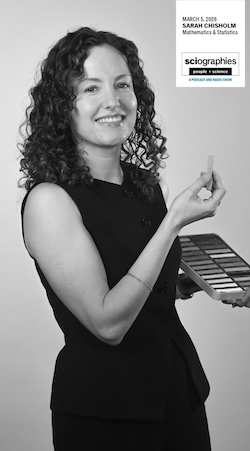
David (host). Did you grow up in Halifax?
Sarah: Yes, technically Sackville. Yeah, in the burbs.
David: And you went to Dalhousie?
Sarah: Yes, I did.
David: Did you move into the city to go to Dal or did you commute?
Sarah: No, I commuted.
David: Were you set on Dal?
Sarah: Yeah. I knew I wanted to stay local. I knew I wanted to stick with science. The obvious place for me was go to the school with lots of options.
David: So not directly into math?
Sarah: I did like math. I had a few contenders, math, biology and chemistry were sort of like equal three.
David: And then you realized that they were all just applied math.
Sarah: Right.
David: How did you narrow down your interests?
Sarah: Well, I sort of had a career plan in mind to teach. I wanted to teach, but I wasn't sure what exactly do I want to teach? At the time I was thinking high school and I knew that meant two subject areas. I was thinking probably math and something else. So math and chemistry or math and biology. And in the end, I just was more interested in math. It seemed like something that people more generally struggled with. There was sort of more joy attached to helping people.
David: Now as for being a teacher, was that running in the family? How did you get that idea?
Sarah: I sort of remember when I was younger working my way through math problems and seeing other students struggle and it. It just felt good to jump in and help them. And that sort of joy felt like something I wanted to funnel into a career.
David: I mean, it does feel good to help people.
Sarah: Totally. It is incredible. After taking a collection of intro level courses, I seemed to lean more heavily into math. And at that point I sort of picked up on a couple of things. One was that the math content at the university level generally seemed more interesting. Students studying in universities seemed more committed to learning.
At that point, I pivoted to wanting to teach at the university level.
David: So not only did you choose math, but you chose the PhD route?
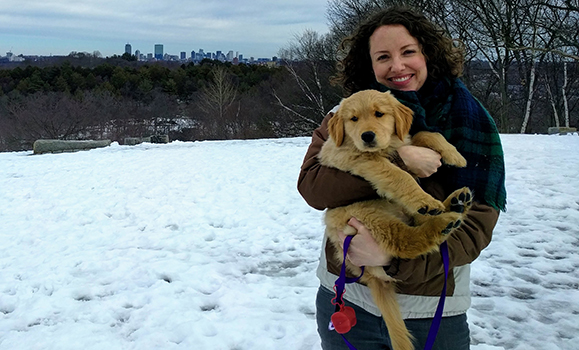
Dr. Sarah Chisolm outside the Arnold Arboretum of Harvard University. (Submitted photo)
Sarah: Right. With the hopes of teaching.
David. So you're studying and you've not only decided you want to become a teacher, but 'I want to go to graduate school.' So, you went off to Calgary? Did you have any research experience in mathematics? What does research in mathematics even look like?
Sarah: At the PhD level and beyond, it's about solving new problems. That can be hard to do within an honors project or a master's degree time-period. Sometimes a survey of a particular area is sufficient. I had a bit of math research experience in my undergraduate degree with my honors’ project. That was a survey of an area in number theory and cryptography, which I thought was interesting. This is really old classical mathematics with applications.
When I was thinking about graduate school, I wanted to stay in Canada. I sort of hit up half a dozen places that had a group of people working in these fields. I didn't have a connection with a particular person to work with. In the end, the place that sort of had the biggest group was where I went and that happened to be at University of Calgary.
David: Okay. And that's in cryptography and in number theory?
Sarah: Yeah.
David: Can you tell us a little bit about what your thesis was on or in general, where does number theory begin?
Sarah: More generally, number theory is a very classical area of mathematics. The sort of quirk about it is the problems can often be stated rather simply, but the solutions are very complicated.
An example is Fermat’s Last Theorem. If you think of a right-angle triangle and the properties of the sides. Thanks to Pythagorean theorem, A squared plus B squared equals C squared. The relationship between the sides for Fermat’s Last Theorem, the statement was that if you change the power to higher degrees, so three or some higher integer, that there are no solutions. If those values of A, C and C are positive integers.
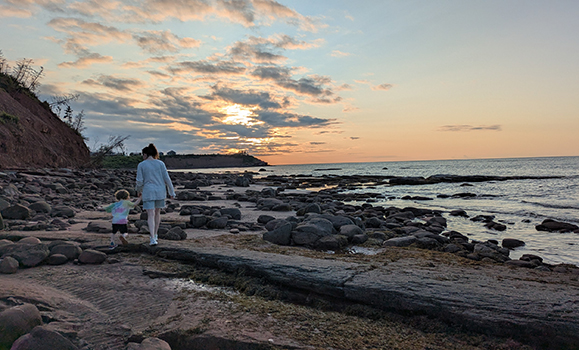
Walking along the Northumberland Straight's Nova Scotian shore line. (Submitted photo)
David: So you’re basically saying A to the power of N, plus B to the power of N equals C to the power of N. Never if A, B and C are positive integers?
Sarah: That's right. And N is three or larger.
David: Okay. And that took like over 300 years to show?
Sarah: Right. So, you could write that down in one line yet to show the work took centuries.
David: What are the great applications to come from this type of work?
Sarah: It has interesting applications to areas of cryptography. For my dissertation for my PhD, it was algorithmic enumeration of quaternionic lattices. So that was basically counting or listing these objects with specific properties.
David: You're interested in quaternions, but are those used to rotate things?
Sarah: Yes. They're used in aerospace, robotics.
Listen to Dr.Sarah Chisholm’s full episode of Sciographies at 10 a.m. on Thursday, March 5 on CKDU 88.1 FM in Halifax or find it on Apple Podcasts, Spotify, and other popular podcasting platforms. You can also listen to previous Sciographies episodes on the same platforms and at dal.ca/sciographies