

Sciographies is a radio show and podcast about the people who make science happen, presented by the Faculty of Science and campus-community radio station CKDU 88.1 FM.
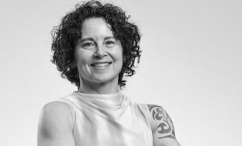
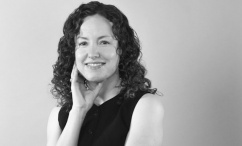
In this episode of Sciographies, we talk to Dr. Leanne Stevens (MSc’09, PhD’13), an educator and university teaching fellow in Dalhousie’s Department of Psychology and Neuroscience, and associate dean, academic in the Faculty of Science.
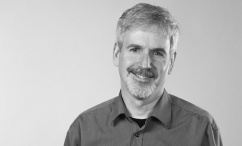
Host Dr. David Barclay speaks with Dr. Stevens about her path into science, from her graduate studies to her career at Dalhousie, and how she discovered a passion for teaching along the way. She shares her commitment to experiential learning and science communication, and how these approaches are shaping student experiences today.
Dr. Stevens also reflects on growing up in Springhill, Nova Scotia, and the pivotal moment that sparked her interest in science — attending a Dalhousie Science and Engineering Week and Dalhousie Math Camp while still in high school.
Below are some excerpts from the episode, edited for clarity and length.
David: Where did you grow up?
Leanne: I grew up in Springhill. I moved there when I was five. I went through all of grade school in Springhill.
David: What did your parents do?
Leanne: My dad was a pharmacist, and my mom started as a teacher and then worked for the school board.
David: Are they from Springhill?
Leanne: My mom's family is from Parrsboro and then my dad's family is from Springhill. My grandmother lived across the road from us. So we had that connection.
David: What does school look like there?
Leanne: Yeah, so it's small. I think at that time Springhill was probably three thousand or thirty-five hundred people total. There were two elementary schools and one junior / high school. I think there were maybe three hundred students. We had the largest graduating class, and I think we had 70 students.
David: What was your favourite class?
Leanne: My favorite thing going through high school was shop class. I wanted to go in and make things, maybe go into architecture. Turns out physics was not my thing.
A path to science
David: Growing up were there family pressures to attend university?
Leanne: My family was great and they encouraged us to explore whatever you want. My dad was good at just kind of showing us science and doing all kinds of stuff. We would forage in the backyard and do little experiments. His mom (my grandmother) was really good at this too; like doing all kinds of little things in the kitchen. The expectation I think was that I would go to university, but they kind of let me sort it out. There was no pressure to go in either direction.
David: Okay, so choosing a university. What was that process like for you?
Leanne: I found it really difficult. When I came to Dal for science and engineering week, Jen Stamp and Heather Schellinck, who has since retired and whose position oddly I ended up moving into, did the psychology and neuroscience session. That was my first exposure to psychology and neuroscience. It was like everything came together. I had never heard or talked about it. I remember talking about how our brain works and understanding learning. I called my parents as soon as I got home and said, “This is what I'm doing.”
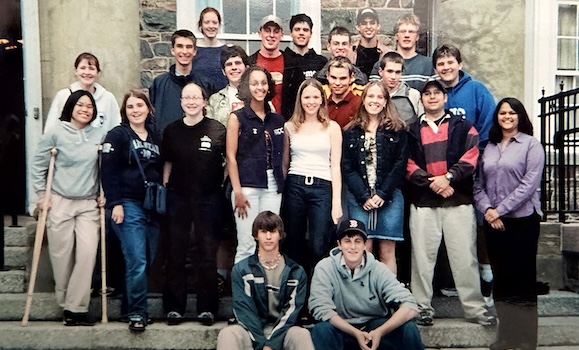
Dalhousie Math Camp (photo provided by Dr. Leanne Stevens)
Even though I was inspired by the Dalhousie campus, the idea of coming somewhere that was bigger than my entire town was terrifying. I didn't think I could do it. I ended up at Acadia. I don't really remember the full rationale behind it, but I didn't want to go to Mount Allison because it was too close to home and Acadia was cutting-edge at the time with their laptop program and technology on campus.
David: How did you get interested in research?
Leanne: At Acadia, I liked psychology. They didn't have a neuroscience program at the time. I majored in psychology with minor in biology. I tried to take every single psychology class. I was one of those people that almost violated the rule around taking too many classes in the same subject. I took every single psych course that I could find. I really liked it. I think because I liked it, I did well in it. I became known by some of the professors.
In my third year I was asked to be a teaching assistant (TA). Through that I got to know professors quite well. When we were moving through third year I was pulled in and asked, “Are you going to do honours next year?” I didn't know what an honours was. I had never thought about it. Dr. Peter McLeod was my supervisor for my honours project; he and Karen Bliley taught the research methods class I was a TA for.
Moving to the big city for grad studies
David: And graduate school?
Leanne: My honour’s supervisor Dr. McLeod said, “I think you should go on and do grad school. You'd really like it.” He put me in that line of thinking so I started looking into what grad programs existed and where I might want to go. That connected me to Dr. Richard Brown at Dalhousie who ended up being my supervisor for my Master's and PhD.
When I was defending my PhD in May 2013, Dr. Heather Schellinck coincidentally decided to retire. Her position was running the whole first year psychology program and teaching a really cool 3000 level class where the students get to teach and interact with the labs in the introductory psychology class. I interviewed for that the same month that I defended my PhD. I ended up getting a one-year limited-term contract to fill in for her.
Leadership in Science
David: Being in the Dean's Office as associate dean academic is not just making things run status quo, but it's also having some plans for the future. What visions do you have?
Leanne: It's a challenging time in higher education, but there are a lot of opportunities in some of these spaces and some of this pressure is kind of forcing us to look at what it is that we're doing and how we're doing it. I think we have a lot of opportunities to better connect with our community, help students to communicate the skills and knowledge they’re developing during their programs, and supporting them as they move towards their eventual careers. We’re working on some exciting projects focused on work-integrated learning, science communication, and pathways to professional programs.
Additional advice for students
Following her Sciographies interview, Dr. Stevens highlighted Dalhousie’s Truro Start Program as a valuable option for students interested in Dalhousie but seeking a smaller, more close-knit learning environment. Opportunities like this, she noted, were not available when she was growing up in a rural Nova Scotia community.
“The Truro Start Program is a great option for students considering Dal but wanting to experience it in a small-town setting rather than a full city environment,” she says. “I wish programs like this existed when I was in undergrad.”
Dr. Stevens emphasized that a consistent theme throughout her journey in science has been the importance of academic mentorship. She encourages students to connect regularly with academic advisors, including those at Dalhousie’s Bissett Student Success Centre and faculty advisors in their departments, to help guide their path.
Listen to Dr. Leanne Stevens full episode of Sciographies at 10 a.m. on Thursday, March 25 on CKDU 88.1 FM in Halifax or find it on Apple Podcasts, Spotify, and other popular podcasting platforms. You can also listen to previous Sciographies episodes on the same platforms and at dal.ca/sciographies
Also in this series...
- Meet John Batt, manager of Dalhousie’s Aquatron
- Meet Dr. Rob Lennox, scientific director of Dal‑based Ocean Tracking Network
- Meet Dina Rogers, PhD candidate & biochemist
- Meet Dr. Sarah Chisholm, educator & mathematician
- Meet Dr. Simon Gadbois, canid & animal behaviour specialist
- Meet Maxine Westhead, marine biologist