Programs
Check this out . . .
New course offerings have been added to the MELP course list!
* REVISED REQUIREMENTS FOR MELP CERTIFICATES
Environmental Law Placement
Apply in writing to the MELP Director at MELP@dal.ca for consideration for this placement.
Contact:
MELP Director
Marine & Environmental Law Program
Email: melp@dal.ca
RECENTLY ADDED:
NEW MELP PRIZE FOR 2025-2026
The Donald A Kerr Award in Maritime Law and Law of the Sea
Awarded to a graduating student enrolled in the Marine Law Specialization Certificate program who has demonstrated academic excellence and a potential for future leadership in marine law. This is a discretionary award – faculty and/or students can nominate students to receive this award.
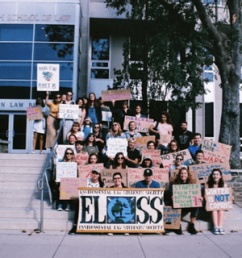
Environmental Law Students' Society (ELSS)
ELSS is a student-run society that focuses on environmental issues as they relate to the law. They are very active within the law school, the greater university, and the broader Halifax community. They frequently partner with East Coast Environmental Law to update the public on environmental law issues, assist with research on environmental law cases, and examine and critique government policy with respect to the environment. They also organize guest lectures, environmental outings, and social events throughout the year.
To learn more, contact elss@dal.ca
Specialize in maritime law or environmental law... or both!
A global centre of excellence for research, education and outreach in oceans and environment law and policy, the Marine & Environmental Law Institute, and the Marine & Environmental Law Program (MELP) offer some of the world's most extensive course offerings in marine and environmental law taught by faculty whose leading-edge research and scholarship are widely cited internationally.
Marine & Environmental Law Program (MELP)
JD MELP certificate program
With 17 full and part-time faculty members currently teaching in the program, students have a unique opportunity to learn about public and private law practice in marine (including shipping) and environmental law taught from domestic and international perspectives. Students wishing to specialize in these fields have the option of obtaining a certificate of specialization in either Marine Law or Environmental Law or both, while completing the three-year JD degree.
Specialization Courses & Program Requirements
JD students may specialize in Marine Law and/or Environmental Law and the specialization will be recognized on their transcript.
Environmental Law Specialization
Required Courses:
LAWS 2051.03: International Environmental Law
LAWS 2104.03: Environmental Law I
Elective Courses:
LAWS 2005.04: Private International Law
LAWS 2012.03: International Law
LAWS 2015.03: Planning Law
LAWS 2020.02: Fisheries Law
LAWS 2041.03: Coastal Zone Management *
LAWS 2056.03: International Trade Law
LAWS 2074.03: International Human Rights Law
LAWS 2079.03: Oil and Gas Law
LAWS 2115.03: Health Care Ethics and the Law
LAWS 2125.03: Law of Marine Environmental Protection
LAWS 2133.03: Climate Change Law and Policy
LAWS 2153.03: Business and Environmental Law
LAWS 2159.03: Health Systems: Law and Policy
LAWS 2191.03: Animals and the Law
LAWS 2198.03: Critical Perspectives on Law
LAWS 2203.03: Intellectual Property Law II
LAWS 2213.02:/LAWS 2214.03: Energy Law
LAWS 2219.03: Regulatory Systems in Environment and Health
LAWS 2225.03: Environmental Law Placement
LAWS 2250.03: Willms & Shier Environmental Law Moot
LAWS 2270.03: Indigenous Governance
LAWS 2280.03: Aboriginal Peoples and The Law
LAWS 2283.03: Cultural Property and Heritage Law in a Transnational Context
LAWS 2287.03: Revitalizing Indigenous Feminist Governance
LAWS 2309.03: Stetson International Environmental Moot Court Competition
Marine Law Specialization
Required Courses:
LAWS 2001.03: Maritime Law & Practice
LAWS 2022.03: Law of the Sea
Elective Courses:
LAWS 2005.04: Private International Law
LAWS 2012.03: International Law
LAWS 2020.02: Fisheries Law
LAWS 2041.03: Coastal Zone Management *
LAWS 2056.03: International Trade Law
LAWS 2068.03: Ocean Law and Policy
LAWS 2074.03: International Human Rights Law
LAWS 2079.02: Oil and Gas Law
LAWS 2125.03: Law of Marine Environmental Protection
LAWS 2211.02/LAWS 2212.03: Law of International Trade and Shipping
LAWS 2280.03: Aboriginal Peoples and the Law
LAWS 2283.03: Cultural Property and Heritage Law in a Transnational Context
Note: Not all electives are offered each year
*Coastal Zone Management is offered by the Marine Affairs Program and is cross listed with the Schulich School of Law
New Requirements for MELP Specialization Certificates:
Effective Fall 2025, the updated requirements apply to incoming first-year JD law students pursuing the MELP Specialization Certificate
•Students must complete the two required courses for their chosen specialization certificate (either the environmental law specialization or marine law specialization) and must complete a total of 15 specialization course credits from the corresponding list above.
•All courses counted towards satisfying the environmental law specialization and/or the marine law specialization must be completed with no grade below C, and with a weighted average in those courses of at least B (e.g., 70).
•MELP specialization certificate students are required to attend (in person) at least one of the Marine & Environmental Law Institute’s (MELAW) annual events — either the Douglas M. Johnston Lecture or the Meinhard Doelle Legacy Lecture.
•For all paper courses, students MUST have their paper topic approved by the MELP Director PRIOR to writing the paper. Maximum three paper courses per academic year.
•Students may take one additional paper course in law, not listed as a MELP course, as an elective toward the MELP certificate. The paper topic must be approved by the MELP Director PRIOR to writing the paper.
•Students may seek special permission from the MELP Director to take one non-law course as an elective to be credited towards the MELP specialization.
•Students participating in an exchange program can request that one law course from that exchange be credited towards the specialization certificate. The content of this course cannot duplicate and should be substantially different from the course content of courses the student has previously or will pursue to satisfy the requirements of the specialization. It is the student’s responsibility to demonstrate that the substance and quality of the course fits within the parameters of the specialization, for example, by providing the course description, syllabus, etc. The course, if approved by the MELP Director, can serve as one of the electives; it cannot replace a required course in the specialization. The student must have the course approved by the MELP Director prior to taking the course. The MELP Director has the final authority to approve the request.
•Students may graduate with a maximum of two law certificates.
•Students seeking to complete a third certificate may be considered in exceptional cases and must obtain approval from both the MELP Director and the Associate Dean, Academic.
•A maximum of two individual courses in law may be applied toward the requirements of two different certificates.
Students are encouraged to contact the MELP Director at melp@dal.ca, prior to the last day to drop/add classes, with any additional questions regarding course selection or the MELP requirements.
Additional Information:
We encourage you to submit the MELP certificate registration form early in the year to ensure you are added to our email list. The email list is used throughout the year to send information on upcoming lectures, events, research positions, summer jobs, internships and opportunities related to marine and environmental fields. Contact MELP@dal.ca to find out how you can join the MELP program or drop by the Marine & Environmental Law Institute located in room 413 or visit our website at www.dal.ca/law/melaw.
It is the students’ responsibility to ensure that they complete all the requirements of the specialization they enrol in. Subject to the exception outlined in the next paragraph, only those courses pursued at the Schulich School of Law during the student’s JD studies which lead to successful completion of a Dalhousie University JD degree will be recognized. Students are not permitted to count a course towards more than one certificate within the Law School.
On completion of all requirements, including registration for the certificate program, the specialization will be recognized on the students' academic transcript. Students will also receive a separate certificate on graduation attesting to the satisfactory completion of a marine and/or environmental specialization.
For more information on these courses, please check out the Dalhousie Academic Calendar
How to register for the MELP specialization certificate
We encourage you to submit the MELP Certificate registration form early in the year to ensure you are added to our email list. The email list is used throughout the year to send information on upcoming lectures, events, summer research assistant positions, internships and opportunities related to marine and environmental fields.
The MELP Form is fillable, just complete the form electronically and email it back to melp@dal.ca.
Environmental Law Placement
LAWS 2225.03
The Environmental Law Placement provides students with the opportunity to work with environmental law practitioners in Halifax during the Winter term. Students will take part in the work of their host organization assisting with research, and other tasks as requested, on a specific pre-selected project. Students will be required to spend nine hours a week on placement work. Placements can either be directly with the East Coast Environmental Law Association (ECEL), or, on request, with another suitable host organization, including government, non-governmental organizations, or in-house council in the private sector. Students will be evaluated based on performance in the placement including assessment of memoranda written for the placement supervisor as well as the major paper to be written on a related topic. Students will be assigned a project that is suitable as a major paper topic and are encouraged to write a major paper that is closely related to the placement project. While the overall evaluation of the placement will be conducted by the faculty supervisor; the placement supervisor will be consulted with respect to the student's performance in the placement as appropriate. This course fulfils the major paper requirement. Students will be selected by the Director of the Marine & Environmental Law Program (MELP) (in consultation with ECEL when the placement will be carried out with ECEL) based on academic standing, demonstrated interest in the field of environmental law and policy, and supervisor availability. Applicants who have already secured a placement with an external host organization will be required to submit a statement outlining the host’s capacity to supervise the placement (contact MELP for additional information).
Supervision:
Faculty Supervisor: MELP Director
Placement Supervisor(s): ECEL Executive Director / Staff Lawyer and/or Supervisor, Host Organization
Assessment Method: Major Paper 60%; Placement Feedback 40%
Enrollment: Limited to 3 students
Prerequisite: Only students who will have taken Environmental Law I before the start of the placement will be considered for the placement.
Credit hours: 3
Weekly Hours: Students will be required to spend nine hours a week on placement work for the duration of the semester. Semester dates (for classes) are outlined in the academic calendar.
Application Requirements:
Students must submit a written statement confirming their experience and/or interest in environmental law, and a copy of law school grades to date. Interested students should apply in writing to the Marine & Environmental Law Program at melp@dal.ca in the academic year prior to the year in which they wish to participate in the placement program. Applicants who have already secured a placement with an external host organization must also submit the below Host Organization and Supervisor Agreement outlining the host’s capacity to supervise the placement.
Exchange opportunities
Study abroad in 2nd or 3rd year
There are a number of opportunities for our JD students to study abroad during one of the terms in second or third year. We have exchange programs with universities around the world. For more information, visit the Schulich School of Law International Exchanges page.
Here are a few institutions that may be of particular interest to marine and environmental law students, as these Universities have strong programs in this area:
![]() |
New Zealand |
![]() |
Australia |
![]() |
Singapore |
Mooting opportunities
Willms & Shier Environmental Law Moot
LAWS 2250.03
Canada's first and only national moot court competition devoted to environmental law. This moot is held biennially, alternating with the Stetson International Environmental Moot.
The competition takes the form of an appeal before a Canadian court of last resort. Each team files a factum for one party. At the oral hearing, teams argue one side of the appeal in their first match and the other side in their second.
This moot is open to 2nd and 3rd year students in recognition of the fact that this moot is offered biennially. The moot counts as a major paper course. Academic credit is given at the end of the winter term.
Learn more about this opportunity.
How to apply
Students interested in being considered for this moot are requested to write a letter (hardcopy or email) addressed to MELP Director by second last Monday in March, indicating:
- year of studies (second or third year);
- statement of interest and commitment to doing the moot during the fall and winter terms;
- completion or enrolment in Environmental Law I (NB: this is a pre/co-requisite);
- whether there is intention to complete the environmental law certificate; and
- mooting and debating experience (including summary of academic feedback received).
The letter should be accompanied by a short cv and law school transcript. An interview may also be required. The selection committee will be composed of the coach and MELP faculty. Applicants will be informed of the selection by 31 March.
![]() |
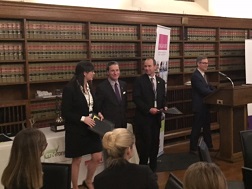
Willms & Shier Environmental Law Moot Professor Aldo Chircop (coach); students, Aaron Lemkow and Kristen Vandenberg (Distinguished Oralist)
|
Stetson International Environmental Moot Court Competition
LAWS 2309.03
This course provides enrolled students to participate as a member of Dalhousie’s team for the Stetson International Environmental Moot Court Competition, hosted by Stetson University’s Faculty of Law (the “Stetson”). The Stetson is the foremost international moot focused on global environmental challenges such as conservation, sustainability, and climate change. The Official Moot Package is sent to participants in late July and teams of two or three submit their memorial in November. The competition requires teams to present arguments both as applicant and as respondent. Teams participate in February in a regional competition, which may be held in person or online. The top 15% of teams from the regional competition are invited to participate in the international finals, usually held in April. Teams may include 2 or 3 members. Members of the team are encouraged to enrol in both Environmental Law and International Environmental Law.
This moot competition is open to second and third year students in the JD and combined JD degrees. This moot can count as a major paper course if needed. The moot is held every year, but Schulich Law students participate only every second year, alternating with the Willms & Shier Environmental Law Moot.

Stetson International Environmental Moot Court Competition, February 2025. JD students from left to right: Emma Peckham, Ann Nightingale and Hannah Arsenault-Gallant


Graduate programs
Graduate students in the marine and environmental field join a vibrant group of MELAW Fellows who meet regularly to share their research and eat local freshly baked pies.
LLM program
The Master's degree allows students to pursue research in marine and environmental law by course work and thesis, or by coursework alone. The LLM program ordinarily takes a year of full-time study but it may also be completed on a part-time basis.
PhD program
The primary requirement for the Doctoral degree, aside from one year of residency, is the completion of a substantial dissertation in marine or environmental law. Opportunities for teaching and research may also be available.
Graduate students in the marine and environmental fields become MELAW Fellows.
Learn more about graduate admissions and scholarships at the Schulich School of Law.


