

Technology has changed dramatically in the decades since Dalhousie created the Faculty of Computer Science in 1997.
In the late 90s and early 2000s, e-commerce arose as a defining trend. Cloud computing and data-driven services emerged as a major force in the following decade. And in recent years, the commercialization of artificial intelligence (AI) has reshaped almost every aspect of computing and its connection to people’s lives.
Those shifts have driven increased specialization in the discipline, informing Dal’s decision to launch six new majors in computer science this year.
As AI, cybersecurity and other fields have reshaped what it means to work in computing, a single, general degree can no longer cover the discipline in depth.
“Computer science is not just coding," says Dr. Nur Zincir-Heywood, dean in the Faculty.
Computer science is not just coding.
Dal's six new majors respond directly, giving students focused expertise in the areas where the field is moving fastest:
- Algorithms & Scientific Computing
- Artificial Intelligence
- Cybersecurity
- Digital Innovation
- Human-Computer Interaction
- Software Development
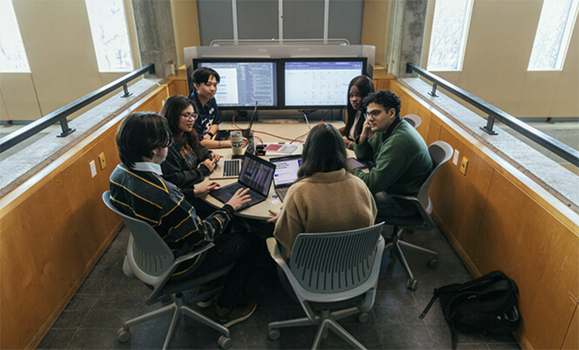
Built for a changing field
The seeds of the new academic structure were planted a few years ago when students, industry partners, and government began telling the Faculty they needed more specialization.
"Technology continues to evolve at an ever-increasing pace," says Dr. Zincir-Heywood. "As these changes happen in the discipline, what we are seeing is more and more focus areas."
At the same time, softer skills such as creativity, problem solving, and communications have become increasingly important as technologies such as AI transform the field.
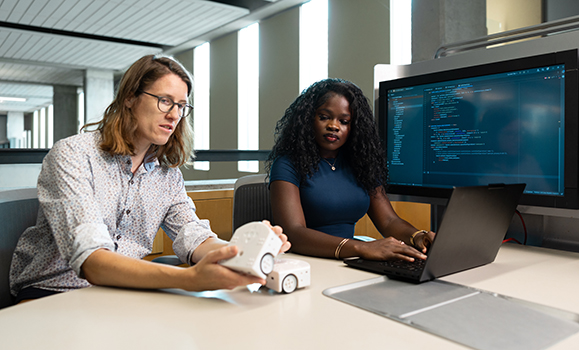
The new majors align technical, workplace and professional skills with industry needs.
Coding remains a key component of Dal's computer science curriculum, but Dr. Zincir-Heywood says the new majors offer students three benefits. First, they help learners understand the breadth of computer science today as the discipline and job market continue to evolve. Second, they provide greater depth in a chosen area, so students can build more specialized expertise over four years.
Third, the majors allow the Faculty to more closely align technical training, workplace experience, communications skills, creativity, and problem-solving with industry needs.
The result is a stronger connection between students’ education and emerging career opportunities: “These focus areas are where more graduates are finding jobs and where more companies are looking for graduates,” she says.
Preparing for emerging careers
A long-standing advantage of studying computer science at Dal has been its robust approach to work-integrated learning. All students are eligible for up to 12 months of paid co-op and internship opportunities and benefit from Dal’s broad network of industry partners.
Today’s computer science graduates can pursue a far wider variety of career opportunities than in the past. Demand for AI and machine-learning innovators has exploded in recent years, as has the need for more cybersecurity and digital defence leaders. Computer science training also equips graduates to lead and innovate in other fields being reshaped by technology, including health, business, science, entertainment, government and more.
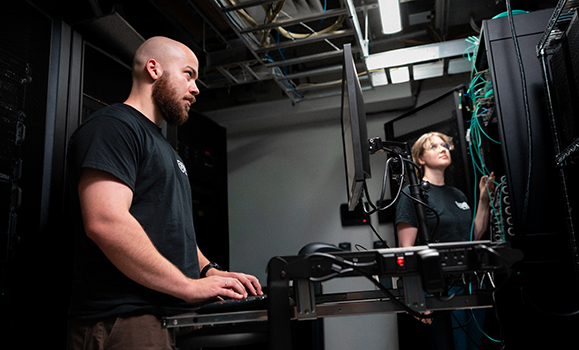
Today’s computer science graduates can pursue a far wider variety of career opportunities than in the past.
Meanwhile, the growth of technology entrepreneurship is creating new opportunities for students to build and launch ventures.
Dr. Zincir-Heywood says new majors could be added as the discipline continues to evolve.
“What the market demands of computer science graduates will evolve further. Five years down the road, we might find ourselves adding more majors,” she says.
Amid rapid change in the field, she says Dal’s approach remains grounded in a people-first vision of computer science.
Yes, we study the technology. Yes, we create and develop the technology. But all of that is for people.
“Whatever we do in computer science, it is for people. It is for community,” she says. “That’s important because when we work with technology, sometimes people’s focus is all about the technology. Yes, we study the technology. Yes, we create and develop the technology. But all of that is for people.”
Learn more about each new major below, with excerpts from the Faculty’s program site and video promos:
Algorithms & Scientific Computing
Why Algorithms & Scientific Computing?
Dal's pitch: Data is everywhere. Master the advanced logic used to tackle the world’s biggest climate and scientific mysteries. Learn more.
"We really want to instead leverage the power and creativity of the human mind to say, how can we solve problems uniquely, efficiently, how do we construct algorithms to provide solutions to those problems we're trying to solve,” says Dr. Alexander Brandt, an assistant professor.
"Instead of being just an implementer, you actually get to be someone who thinks about these solutions. You get to be someone who comes up with their own solutions instead of just looking them up and implementing them," says Nour Allam, a student in the major.
Artificial Intelligence
Why Artificial Intelligence?
Dal's pitch: AI is rewriting every industry. Don’t just watch it happen. Master the advanced skills to build, train, and deploy the tech that solves real-world challenges. Learn more.
"Artificial intelligence is important in society because it's integrating into almost every avenue of life and every discipline," says Dr. Frank Rudzicz, a professor in the Faculty and chair of Dal’s AI Institute. "What we want to provide students is really a deep understanding of artificial intelligence so that when they build the systems and evaluate and deploy them, they can do so responsibly and also understand how they actually work under the hood."
“Seeing the impact of my work made really made me consider AI as a future career pathway after graduation," says Ekin Yurekli, a third-year student.
Cybersecurity
Why Cybersecurity?
Dal's pitch: As the digital world grows, so do the threats. Learn to defend the systems we can't live without. Learn more.
"This is an area where the demand exceeds supply. It's estimated that Canada alone needs at least 25,000 cyber-security professionals. So we need to train the students with the right skill set and a strong foundation in cyber security. That is what this major is designed to do” says Dr. Srini Sampalli, a professor in the Faculty.
Aryaman Pandey, a student majoring in cybersecurity, was drawn to the field by the opportunity to make the world a better place by helping ensure software systems are more secure. It also captured his imagination in another way, too. "It felt like I was a private detective trying to find out clues inside websites and trying to figure out vulnerabilities."
Digital Innovation
Why Digital Innovation?
Dal's pitch: Tech changes fast. Master the leadership and startup skills to turn change into meaningful innovation. Learn more.
"Employers are expecting more. They are expecting more critical thinking skills, more project-management skills and just generally how to deal with the more complex and rapidly changing environment,” says Dr. Fe Bodeleau, an assistant professor in the Faculties of Computer Science and Management.
Shruti Chaturvedi, a student majoring in Digital Innovation, explains the appeal: "I was more curious about how technology could be used to solve real problems and improve people's experiences. And that's what drew me to digital innovation."
Human-Computer Interaction
Why Human-Computer Interaction (HCI)?
Dal's pitch: Every system needs a screen, but great technology requires psychology. Master the design skills that shape how people interact with the future. Learn more.
"Having a human-centered approach is really important and is increasingly relevant in ensuring that the systems that we develop are ethical, accessible, and beneficial to humans,” says Dr. Hanieh Shakeri, an assistant professor in the Faculty.
For Atrina Farzane, the major helps address some of the bigger questions society is facing: "Usually people think that AI is going to take over and technology is going to take over humans but when I think of HCI, it reminds me of the fact that computer and technology is there to serve humans."
Software Development
Why Software Development?
Dal's pitch: Basic coding is yesterday. Master the system architecture that keeps global platforms from crashing. Learn more.
"Companies at present don't really want to hire people who can code but they want to hire people who can design systems, who can build with a bigger team, who can critically evaluate artifacts both generated by human colleagues and digital co-workers. And this is precisely what we teach in this major," says Dr. Tushar Sharma, an associate professor in the Faculty.
For Ola Ayeni, a student majoring in software development, the specialization offered a path to merge her other interests, including fashion. "Software development made me realize that I can also apply my knowledge and my passion for fashion with technology."