
Undergraduate Summer Research Awards
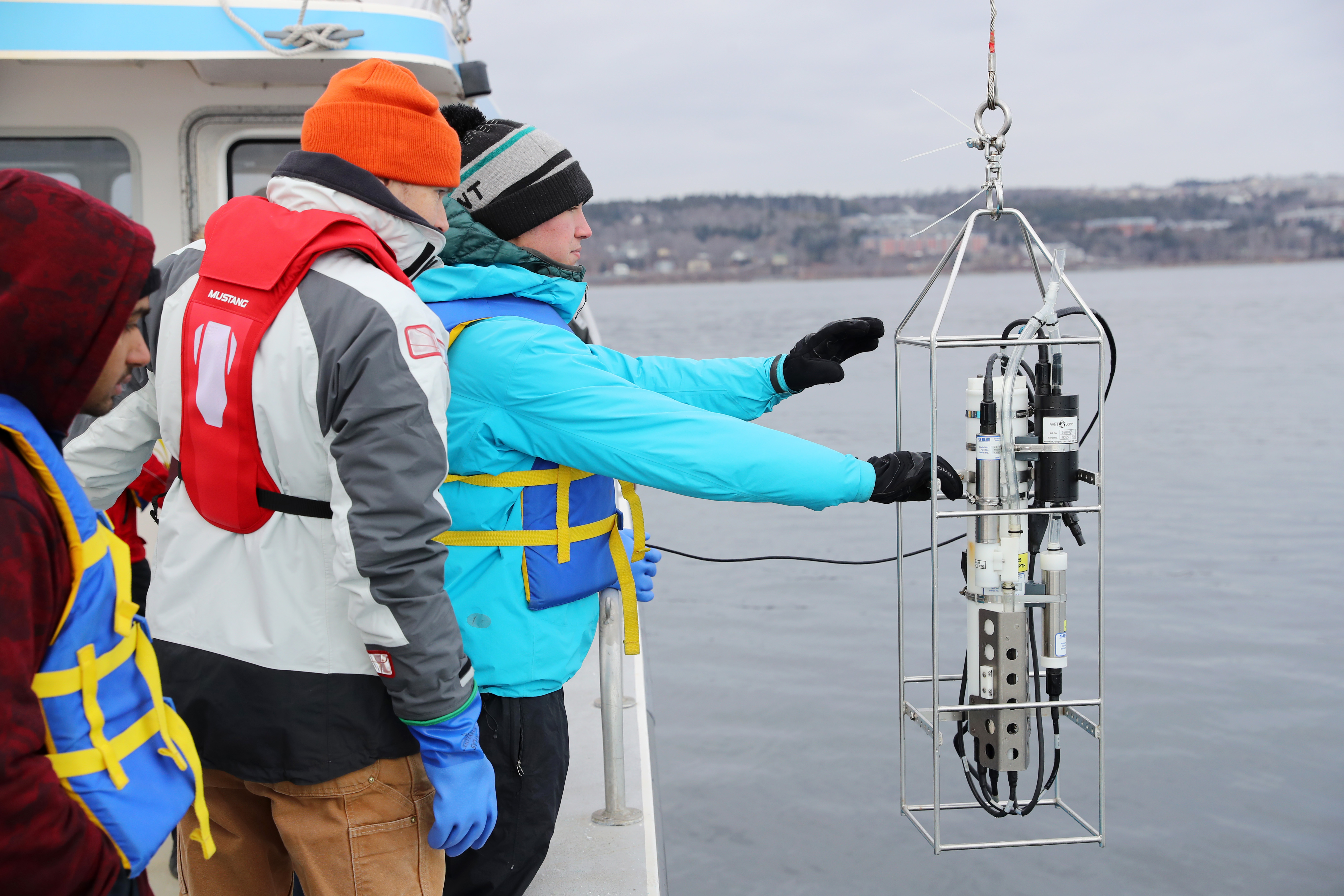
Summer research awards provide paid employment opportunities for students to participate in scientific research at Dalhousie during the summer. If you would like to gain research experience in an academic setting, these awards can provide you with financial support.
The USRA application deadline is January 19, 2026.
Learn more about the Summer Research Awards on the Faculty of Science myDal site (login required).
You may also contact:
USRA Coordinator: Carly Buchwald
E-mail: cbuchwald@dal.ca
NSERC USRA Projects in Oceanography for Summer 2026:
________________________________________________________________________________
Supervisor: Ruth Musgrave (rmusgrave@dal.ca)
Project Title: Exploring the physical oceanography of Nova Scotia's coasts
Project Description: Student will work with researchers at Dalhousie and the Center for Marine Applied Research (CMAR) to examine timeseries measurements of temperature at numerous locations around Nova Scotia. By comparing concurrent months-year long observations across sites, the student will separate regional- and small-scale signals at each location, with an eye towards identifying the underlying physical phenomena that drive variability in the coastal waters of Nova Scotia.
___________________________________________________________________________________
Supervisor: Dr. Eric Oliver (eric.oliver@dal.ca)
Project Title: Characterizing recent sea ice seasons and climate change in Nunatsiavut using local Inuit observations
Project Description: Labrador Inuit have deep knowledge of the coastal ocean and sea ice environment in Nunatsiavut. The Nunatsiavut Sea Ice Observer Program (NSIOP) supports a network of expert knowledge holders to document ice and environmental conditions throughout the winter and spring in their own words, from their own perspectives. Their observations are preserved in the NSIOP database with data going back to 2022. This project will characterize patterns in the observations across the 5 communities represented and across time (different parts of the ice season, different years) including any documented local adaptations to climate change. The observations are in the form of text, maps, images and videos focusing on the coastal ocean and sea ice and so the student will acquire skills and knowledge in qualitative data analysis, sea ice physics and coastal oceanography, and how to read and understand the relevant scientific literature.
___________________________________________________________________________________
Supervisor: Dr. Carolyn Buchwald (cbuchwald@dal.ca)
Project title: Tracking nitrogen in Arctic Fjords
Project Description: Over the past three summers, multiple field campaigns have been conducted in a range of coastal fjord systems spanning a broad latitudinal gradient, from the high Arctic to the Gulf of Saint Lawrence. During these campaigns, water samples were collected to measure nutrient concentrations and the natural-abundance stable isotope composition of nitrate. While the samples have been preserved, they have not yet been fully analyzed. The summer research assistant will be responsible for processing and analyzing these samples in the laboratory to determine both nutrient concentrations and nitrate isotopic signatures. This work will involve learning and applying multiple laboratory techniques, including sample preparation, chemical analysis, and isotope ratio measurements using specialized instrumentation. Emphasis will be placed on proper laboratory practices, quality control, and data management. In addition to laboratory work, the assistant will develop skills in data analysis and interpretation. They will learn to visualize spatial and environmental patterns in the data using graphs and maps, and to compare results across different fjord systems and regions. The project will also introduce the assistant to simple modeling approaches that integrate concentration and isotopic data to help identify and interpret potential nutrient sources and biogeochemical processes influencing each study area.