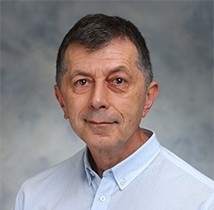
Djordje Grujic
Professor, Carnegie Chair in Geology
- CV (PDF-218 KB)
- Google Scholar
- Research Gate
Email: Djordje.Grujic@Dal.Ca
Phone: +1 902 494 2208
Mailing Address:
6287 Alumni Cres
PO BOX 15000
Halifax NS B3H 4R2
CANADA
Office:
Life Sciences Centre
3rd floor, BIO/EES Wing
Rm. 3045
Current Projects
From shortening to extension of the Tethyan Himalaya: Reconstructing the northern Indian passive margin
The Himalayan orogeny, initiated by the collision of the Indian and Eurasian plates approximately 50 million years ago, represents a key example of continental collision and large-scale crustal shortening. Within this system, the Tethyan Himalaya fold-and-thrust belt plays a critical structural role; however, the amount of crustal shortening it accommodates remains poorly constrained. Existing estimates vary widely—from ~100 km to ~250 km—due to the scarcity and outdated nature of balanced geological cross-sections. This uncertainty hampers the testing of tectonic models for the India–Asia collision and complicates efforts to reconcile geological shortening with paleomagnetic reconstructions, which suggest up to 4,000 km of plate convergence since 60 Ma.
This study refines shortening estimates across the Tethyan Himalaya fold-and-thrust belt and constrains the geometry of the basal detachment, offering new insights into the early structural evolution of the orogen. Balanced and restored cross-sections were developed using 3DMOVE© software, integrating geological mapping, field observations, and subsurface data.
PE Limited (the Licensor) has donated the 3DMOVE software, valued at £1,928,348.01, to Djordje Grujic (the Licensee), as per Agreement 250301.
Team members:
| Djordje Grujic, PI, Department of Earth and Environmental Sciences, Dalhousie University | |
| Matteo Pedini, PhD Student, School of Science and Technology, Geology Division, University of Camerino, Camerino, Italy |  |
| Stefano Mazzoli, School of Science and Technology, Geology Division, University of Camerino, Camerino, Italy | |
| Gyorgy Hetényi, Institute of Earth Sciences, University of Lausanne, Lausanne, Switzerland | |
| Julien Moreau, The NW Edge, Carloway, Scotland, United Kingdom | |
| Taija Torvela, School of Earth and Environment, University of Leeds, United Kingdom |