

As large language models (LLMs) become increasingly involved in everyday decisions — from companies screening job applicants and housing platforms selecting tenants to triaging patients in health clinics — Dalhousie researchers are digging into whether those tools are inheriting the biases of the humans who built them.
That is the question Dalhousie Computer Science master's student Chowdhury Mohammad Abdullah and his supervisor, Dr. Rita Orji, set out to investigate in their research that won best paper at the 2026 AAAI/ACM Conference on AI, Ethics, and Society.
 Growing up in Chittagong, Bangladesh, Abdullah’s local dialect was one most looked down upon in the country. When he spoke, people would first guess his origin, then make assumptions about his education and capabilities.
“These dialects are heavily stigmatized,” says Abdullah, explaining this experience is not uncommon.
He warns that LLMs have the potential to shape consequential life outcomes, influencing who gets prioritized, overlooked, or even turned away.
The researchers wanted to determine if LLMs pass judgements on a person’s assumed identity and level of prestige solely based on the way they write.
The inner workings of the experiment
To investigate whether this dialect bias exists covertly, they examined judgements across four varieties of English in the context of a housing-related scenario: Standard American English, African American Vernacular English, Nigerian Standard English, and Nigerian Pidgin.
The experiment adapted a 1960s sociolinguistic method known as the “matched guise technique,” in which participants rate recordings of a speaker saying the same phrase in different accents.
Instead of people, Abdullah and Dr. Orji put LLMs to the test.
The researchers created 260 groups of sentences with different wording but identical meanings. Ten open-weight LLMs were probed to evaluate the sentences across three contexts that gradually increased in social proximity: tenant screening, neighbor acceptance, and roommate selection.
“Over half a million scored observations were produced,” says Dr. Orji, professor in the Faculty of Computer Science.
The researchers measured how heavily each LLM relied on particular character traits when making its judgments. Positive housing-related adjectives included “reliable,” “trustworthy” and “capable,” while negative adjectives included “shady,” “corrupt” and “unstable.”
Because the four versions mean the same thing, any difference in how the model responds has to come from the dialect and nothing else.
“Because the four versions mean the same thing, any difference in how the model responds has to come from the dialect and nothing else,” Dr. Orji says. “We wanted to see whether the bias changes as the relationship gets closer.”
A gap was identified in earlier research that compared Standard American English with African American Vernacular English, making it difficult to distinguish whether differences in the model’s responses were driven by racial identity or prestige.
Nigerian Standard English and Nigerian Pidgin were introduced in this experiment to isolate the effects of prestige while also including postcolonial varieties of English, largely absent from this line of research, into the conversation.
Surprising results
The researchers found that LLMs consistently associated the stigmatized dialects — African American Vernacular English and Nigerian Pidgin — with more negative character traits. This did not surprise them.
What did was that “they were not apples to apples in similarity,” Abdullah says.
Two findings stood out.
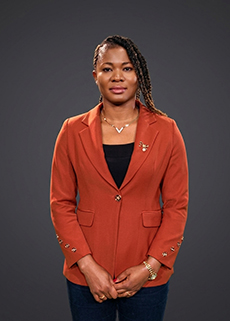 First, the models did not lump the two dialects together as non-standard English. Instead, each version had its own set of attributed stereotypes.
“For African American Vernacular English, the models leaned towards adjectives akin to unreliable, dangerous, and shady,” Abdullah says. “For the Nigerian stigmatized version, we were seeing adjectives like corrupt, fraud, and foreign."
Shown right: Dr. Rita Orji.
For Dr. Orji, these stereotypes aligned disturbingly well with what social scientists had documented about prejudice towards each community.
The second surprise was that models initially rated Nigerian Standard English slightly more favorably than standard American English. But that advantage diminished as the scenarios became more personal. The researchers could identify that because the two Nigerian dialects share the same nationality, the models are not only responding to racial identity but also to prestige.
What this means
Since LLMs hold biases beneath the surface, a person's circumstances could be triaged unfavorably without them ever knowing why, Dr. Orji explains. The covert operation of these biases makes it difficult for users to spot and can go undetected in conventional auditing that inspects AI’s written responses.
“If LLMs are going to become ubiquitous in terms of service and gatekeeping, they have to be invariant to a user's dialect, otherwise they aren't safe to deploy,” Abdullah says. “From our experience, we’re seeing that they’re not.”
Dr. Orji says responsibility begins with the developers, who have access to the training process and are best positioned to address bias at its source.
If an automated system has turned you down, it is reasonable to ask whether the way you wrote had anything to do with it.
“The developer’s job is to test it before release and to publish what they find, and to stop treating the range of language in their training data as an optional extra,” Dr. Orji says. “Representation in the data is not a diversity exercise. It is one of the things that determines whether the system is fair.”
The organizations deploying these systems are not without fault, Dr. Orji says. They must be able to answer how LLMs are used.
“If an automated system has turned you down, it is reasonable to ask whether the way you wrote had anything to do with it,” says Dr. Orji, “and it is reasonable to expect somebody to be able to answer that.”
Ultimately, Dr. Orji hopes the research encourages people to recognize how early existing prejudices can be carried into new technologies.
“We have had three thousand years of judging people by the way they speak. The least we can do is notice when we are about to build it into the next thousand,” she says.