

Over the past 40 years, more than 600 students have graduated from Dalhousie's Marine Affairs Program (MAP), going on to build careers in marine policy, ocean governance, conservation and management in more than 60 countries.
“From our first students in 1986 to the new cohorts that we just welcomed last month, MAP is about training the next generation of marine managers," says Maxine Westhead, MAP's director.
MAP invited alumni, current students, faculty and retired staff to reflect on four decades of learning, leadership and connection at a 40th-anniversary celebration last month.
The program has offered the Master of Marine Management degree to 40 student cohorts since its inception, preparing students to navigate the complex challenges facing the world’s ocean and coastal environments.
The program’s 40th year marks another milestone as it welcomed the very first cohort of Master of Fisheries Science students, a program delivered by MAP in partnership with Biology and Mathematics and Statistics.
The people behind MAP
The anniversary celebration began with a social gathering and open house at the Beaty Centre for Marine Biodiversity, followed by a formal event on Dalhousie’s Halifax campus.
Former directors and staff took to the stage to share stories from their time with the program, tracing its history, evolution and highlighting the people and milestones that have shaped the program over the past four decades. Alumni then reflected on where their MAP experience has taken them since graduation, sharing the diverse paths their careers have followed around the world.
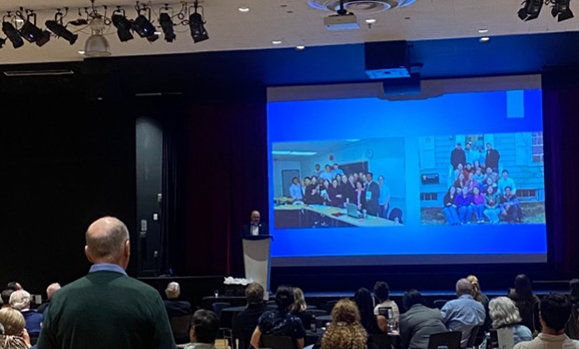
Former MAP director Aldo Chircop provided a historical snapshot of the program at last month's anniversary event.
Over its 40-year history, MAP has been housed in the Faculties of Law, Management, and Graduate Studies before finding its permanent home in the Faculty of Science in 2015, under the leadership of Dr. Lucia Fanning and former Dean Dr. Chris Moore.
While the program has evolved over the decades, one thing has remained constant: its strong sense of community.
Becky Field, a former program administrator, described the MAP community as “a family,” while others have affectionately called it “small but mighty.”
Together, these sentiments capture the spirit of a program whose impact extends far beyond the classroom. Its strength lies not only in the quality and interdisciplinarity of its education, but in the enduring relationships and connections formed among students, faculty, staff and alumni.
As we look ahead to the next 40 years, we will hold onto the onto the same spirit we came from.
Says Westhead looking to the future: "As we look ahead to the next 40 years, we will hold onto the onto the same spirit we came from: our interdisciplinary roots, our international outlook, our close connections to practitioners in the field, and our approach of being an honest broker and recognizing the value of bringing different perspectives together. I’m very proud be part of MAP’s story.”