

For students looking to become fisheries (or resource) managers, conservation specialists, policy advisors, or fisheries analysts, a new course-based master’s program at Dalhousie promises the technical skills and professional connections needed for success in a complex, challenging field.
All in less than a year and a half.
“The Master of Fisheries Science (MFSc) is designed to give students more exposure to the real world,” says Maxine Westhead, director of Dal’s affiliate Marine Affairs Program.
That means connecting them with fisheries managers and monitors and the professionals analyzing biological, ecological, and fishery-dependent data to assess stock status, evaluate management options, and support sustainable fisheries.
“It’s also meaningful for them to go out into the field to see how data are actually collected on a vessel that’s rolling around in the ocean,” she says.
The 16-month Master of Fisheries Science (MFSc), developed by Dal researchers Dr. Aaron MacNeil and Dr. Joanna Mills Flemming in partnership with research scientists from Fisheries and Oceans Canada (DFO), is unique in that it is course-based rather than thesis-based.
It’s part of Dalhousie’s growing range of professional master’s programs that are designed to get graduates on track to enter their chosen career in a short time.
Combining coursework, field work, and a two-term capstone project conducted in groups, the MFSc prepares students to work with government agencies, Indigenous, local, or international fisheries organizations, and non-governmental organizations (NGOs).
Canada's fisheries future

Graduate & Professional Program Fair
Explore your options. Meet experts. Get answers.
Friday, January 23, 2026 | 12:00 p.m.–3:00 p.m. Student Union Building, Halifax, N.S. Virtual sessions also available.
Register now to join the fair.
Dr. Mills Flemming sees the program as a continuation of Dalhousie’s long tradition of fisheries science.
“Canada was one of the world leaders in fisheries science and management, making major advances that are still foundational today, and Dalhousie has long been recognized internationally for its strength in fisheries and marine science,” she says. “Our goal with this program is to expand Canadian fisheries science capacity by training a new generation of fisheries professionals in cutting-edge methods that can meet the challenges faced by fisheries in Canada and beyond.”
Dalhousie has long been recognized internationally for its strength in fisheries and marine science.
Dr. MacNeil agrees that the MSFc program fits within a larger ambition for Dalhousie to meet the needs of Nova Scotian fishers.
“Building lasting fisheries science capacity requires investment in teaching combined with new investment in research. Our hope is that the MSFc program will build capacity across stakeholder groups here in Nova Scotia, helping elevate the level of expertise in industry, governmental, and non-governmental organizations.”
The program is centred around data, encouraging students to develop the analytical skills they’ll need to pursue a career in the field, says Westhead.
“Our vision for our graduates is that they are proficient in coding and statistical modeling for stock assessment, with their expertise extending to designing and leading field surveys and sampling programs,” she says. “They also excel in communicating complex scientific information, which is essential for explaining evidence, defining risks, and framing options for decision-makers.”
Getting career-ready
Structured to include courses in data analysis, fisheries science, and a weekly fisheries management seminar series during the fall and winter, the program’s summer months offer an opportunity to get outside of the classroom.
The cohort will first head to Cape Breton to learn from an Indigenous community about cultural connections to fish and moderate livelihood fisheries before taking part in a weeklong field course at the Huntsman Marine Science Centre in St. Andrews, NB.
A capstone group project focused on stock evaluation will reinforce the collaborative skills that are essential for success in fisheries science and management. Students will work in multidisciplinary teams to integrate data preparation, modelling, uncertainty analysis, and communication of results, mirroring the way stock assessments are conducted in practice.
Master of Fisheries Science (MFSc) at a glance:
Offered by: Marine Affairs Program (Faculty of Science)
Type: Course-based, professional master’s
Length: 16 months, with a September start
Cohort size: 15-20 students
Take your next step and learn more about all of Dalhousie Professional Master’s Programs.
“Stock assessment is a team sport, right?” says Westhead. “One individual can’t do everything. You rely on a team.” Through this experience, students will learn not only the technical components of assessment, but also how to coordinate roles, negotiate analytical choices, and collectively deliver advice that can support real-world management decisions.
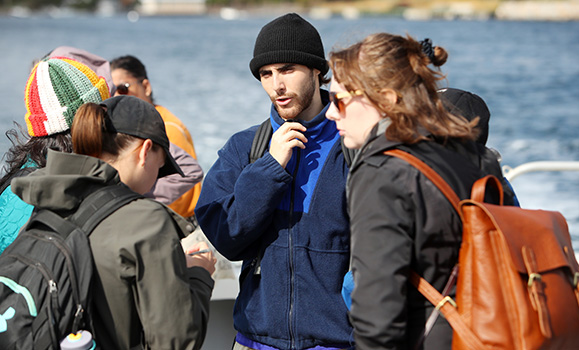
MFSc students will learn in a close-knit cohort with strong mentorship from faculty and practitioners.
Students will also receive guidance from Indigenous and fisheries industry partners throughout the program, helping them build their professional network.
“Having a professional network is such a big part of getting students ready to launch a career post-graduation,” says Westhead.
The MFSc was approved by the Maritime Provinces Higher Education Commission this spring. Applications for the program’s initial cohort are due by June 1, 2026.
Learn more about the MFSc and see how to apply on the Marine Affairs Program website. Any questions can be directed to mfsc@dal.ca.