

Food often conjures up feelings of togetherness and indulgence, but what about those who aren't invited to the table?
Culinary historian Michael W. Twitty encouraged attendees at Dalhousie’s 2026 Irving Glovin Lecture last week to dig a little deeper into understanding how people cultivate, cook, and share food.
He challenged the idea that food automatically brings people together. For that to happen, he said people have to actively make space for one another. That means inviting people who might otherwise be excluded and making accessibility key.
“We’ve been taught that food talk is all about pleasure, all about making us feel good,” Twitty said. “Everything gets brought to the table. [But] you can’t sit at the table if not everyone can get to it.”
We’ve been taught that food talk is all about pleasure, all about making us feel good.
Twitty argued instead that we have responsibility for the task of using the table to create sustainable positive change and healing.
Dal's Centre for Jewish Studies, Black and African Diaspora Studies, and International Development Studies welcomed Twitty to Dalhousie on Oct. 6 for this year’s lecture, part of a series established by the Oskar Schindler Humanities Foundation to bring speakers to Dalhousie to share insights on themes of good human conduct, diversity, and inclusiveness.
Earlier that afternoon, Twitty joined current students, alumni, and staff in the Howe Dining Hall kitchen to cook recipes from his 2023 cookbook, KosherSoul: The Faith and Food Journey of an African American Jew.
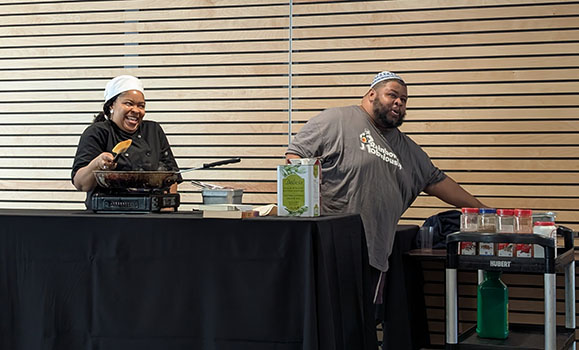
Twitty, right, cooks up some food in Howe Hall. (Percy O'Neil-Doak photo)
The stories in food
At the heart of Twitty's work as a scholar and chef is the concept of ‘food literacy,’ which means to really know where things come from, what they are, and to hear about the trauma that they came from.
Twitty connected the idea of food literacy to the often-overlooked people behind the foods that make up familiar dishes. He said understanding the history behind an ingredient means recognizing the food as more than just a combination of flavours. Rice, black-eyed peas, and hummus each carry histories of migration, culture, survival, and identity.
“Food is not just food,” said Twitty, emphasizing that ingredients can act as vehicles for values, history, and tradition.
Food is not just food.
His underlying message was clear: knowing where our food comes from means knowing something about where we come from too. And if food can teach us about our shared history, maybe it can teach us about understanding one another, too.
Twitty explained that rice, for instance, relied on the expertise of enslaved black women, who understood how to grow and fertilize the crop and whose agricultural knowledge helped make cultivation profitable for wealthy plantation owners. Their knowledge was crucial to an industry that generated enormous wealth for others, even as the women themselves were denied fair treatment and freedom.
Black-eyed peas, meanwhile, he described as an ancient food that represents fertility and resilience, noting that the crop can grow in conditions where other food struggle. He also pushed back against the idea that hummus can be described as a “stolen” food, pointing to the long and complicated histories of Jewish communities whose origins remain deeply connected to the Middle East and Africa.
Finding common ground
Lucas Hadley, a first-year Dal student, said Twitty's metaphor for the dinner table as a space for common ground between you and someone who you have a disagreement with, whether that be different political belief, or gender, or race.
“I think that the dinner table, being a common ground, is such a meaningful way to have adult and mature conversations, talk about your differences and see the perspective of the other person,” said Lucas.
For Twitty, coming to the table is also personal. He told the audience that one of his ancestors had made it “all the way to Nova Scotia,” giving him another reason to return and understand the part of his history that exists here.
“I have to come back,” he said. “There's a part of me that's here, and I have to understand that.”
As the lecture came to a close, Twitty became emotional and teary eyed. He spoke about the difficulties of confronting painful histories while still finding ways to recognize one another as connected.
“It's easy to be hateful, to be racist,” he said. “It's a lot harder to come to table and accept that we are family.”