
As Canada increases its focus on defence, security, sovereignty and Arctic capability, it is turning to the talent and expertise developed at universities such as Dalhousie for help.
President Kim Brooks sent a message this week that Dalhousie stands ready to answer the call.
“At Dalhousie, our goal is to help build a transatlantic innovation ecosystem that connects partners around shared challenges, moves promising research into testing and application, and strengthens collective capacity in oceans, Arctic sovereignty, defence, security, and resilience,” she told attendees at the Dalhousie Defence Academic Showcase on campus Tuesday (Oct. 6).
President Brooks said Dalhousie is particularly well positioned to play this role.
For starters, the university sits in the middle of one of the most concentrated defence ecosystems in Canada, with key naval, ocean, and security players all located nearby within a "remarkably small geography.”
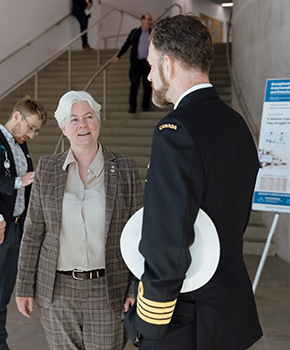
Dal President Kim Brooks, left, greets guests at this week's event.
And within Dalhousie, researchers are already working across fields such as oceans, the Arctic, artificial intelligence, advanced manufacturing, sensing, human-machine teaming, quantum, and space.
The opportunity before us is to explore what becomes possible if we connect them deliberately.
“The opportunity before us is to explore what becomes possible if we connect them deliberately,” she told attendees at this week’s event, which included leaders from academia, industry, government and defence.
“What if researchers understand Canada's operational challenges earlier? What happens if government and industry see emerging university capabilities earlier? What happens if we create better pathways from a good idea to testing to application?”
Bridging research and readiness
It's the same sort of thinking driving Jean-François Morel, director general of R&D Science and Engineering at Defence Research and Development Canada (DRDC), and his colleagues in their work.
As new threats have emerged, he said Canada needs innovation faster to better support the Canadian Armed Forces.
The new DRDC-led Bureau of Research, Engineering and Advanced Leadership in Innovation and Science — BOREALIS for short — was created specifically for this purpose, he said.
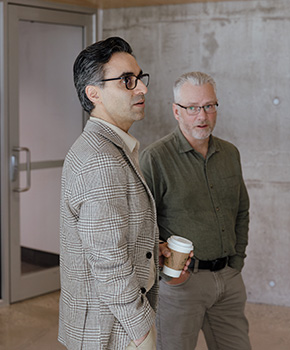
"We want to use it as a way of coordinating innovation across the entire system. And that starts first and foremost with our relationship with academia," said Morel, shown left. "We want to be able to work more efficiently and at a different level with academia, including colleagues at Dalhousie University."
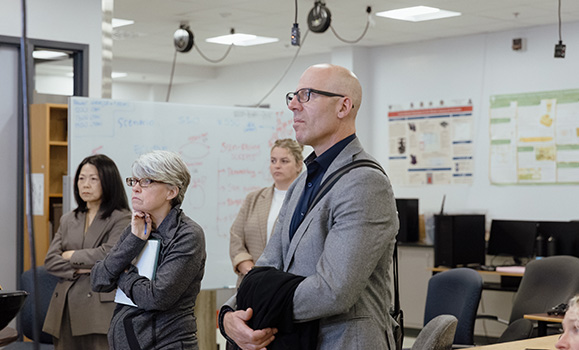
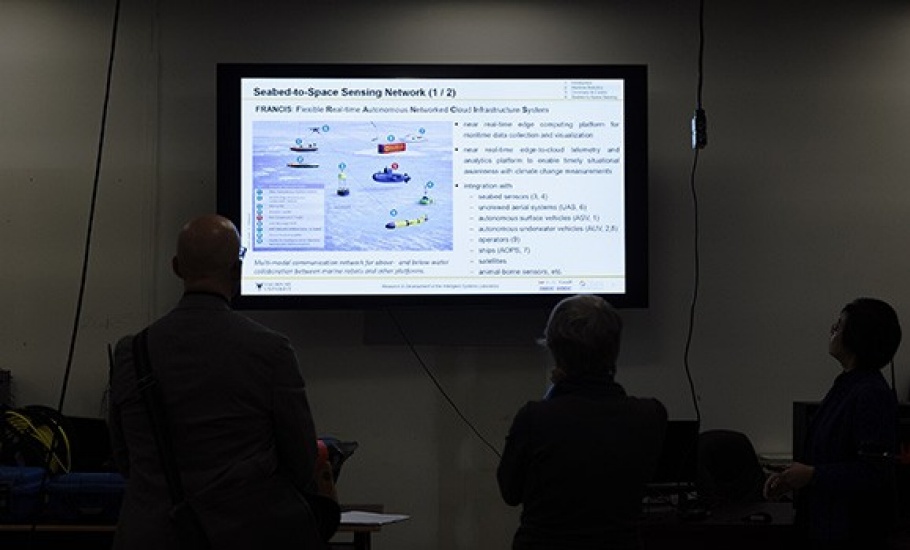
Attendees learn about Dr. Mae Seto's research in her Dalhousie lab.
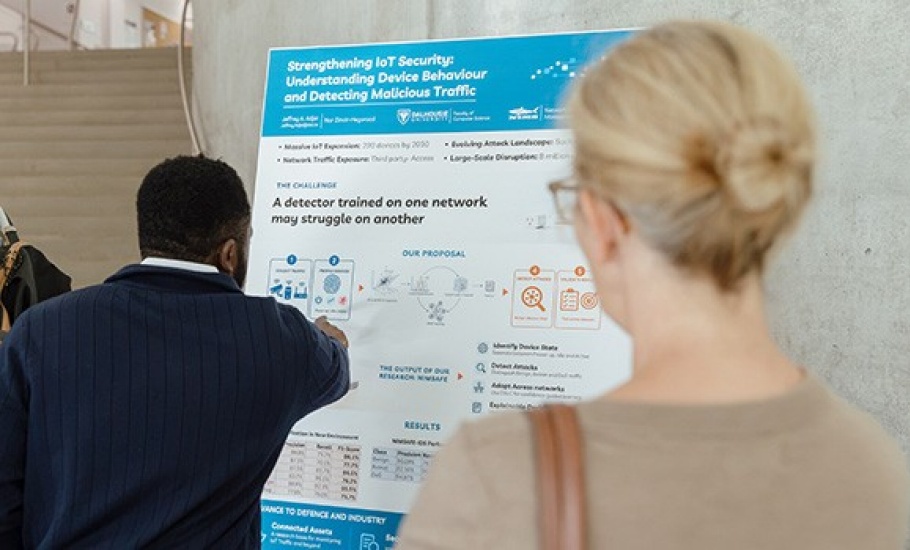
Tuesday's event included two panel discussions — one on the ocean domain moderated by Morel and another on space, moderated by Dr. Graham Gagnon, Dal's vice-president research and innovation — a series of fast talks by Dal researchers, student poster presentations, lab tours, and networking.
The showcase was held ahead of DEFSEC Atlantic, an important expo event for the defence sector in Atlantic Canada that draws a broad range of defence companies, service members and government representatives to Halifax. Dal sent its largest-ever delegation of faculty, students and leaders to the conference and hosted representatives from the air force, National Research Council and industry on campus for lab tours.
Ideas with real-world impact
What emerged over the course of the afternoon was a picture of a university brimming with potential for future partnerships.
Dr. David Barclay, a professor in the Department of Oceanography who specializes in underwater acoustics, said his lab routinely works on contracts with local companies like JASCO Applied Sciences or GeoSpectrum Technologies — projects that could become operationally useful in security applications.
Dr. Barclay described studies his team has undertaken to measure the distance sound can be detected underwater in areas of the Arctic.
"If I'm here in the Beaufort Sea, how far away can I hear something?" he shared by way of example. "That's a question that can now be answered using tools that grew out of small contracts that started six or seven years ago."
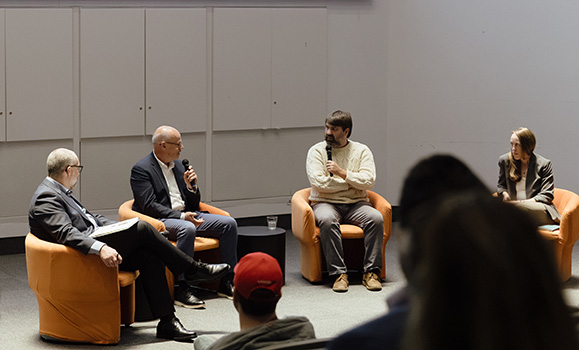
L-R: DRDC's Jean-François Morel, JASCO's Dr. Bruce Martin, Dal Professor Dr. David Barclay, and OTN Executive Director Evelien Vanderkloet.
Elsewhere at Dal, researchers with the Ocean Tracking Network (OTN) have at their disposal a huge infrastructure that includes the largest fleet of long-range autonomous gliders at a university in Canada, 5,000 listening stations equipped with advanced sensors, and other tech.
While the research group is primarily interested in understanding marine life and environmental conditions in the ocean, there are many potential dual-use applications, said Evelien Vanderkloet, executive director with OTN.
She mentioned the group's work with Transport Canada monitoring North Atlantic right whales that sometimes show up in shipping lanes in the Gulf of St. Lawrence, creating collision risks for the whales and vessels. OTN has developed glider systems capable of detecting the whales in near real time, information that supports rapid decision-making, including temporary vessel slowdowns when whales are present.
So many of the things OTN does clearly have dual-use applications.
Those same gliders also collect scientific data to help improve the understanding of whale ecology or oceanographic conditions and could be equipped with any manner of sensors and tech.
"So many of the things OTN does clearly have dual-use applications," she said. "I think those opportunities could be leveraged even more moving forward."

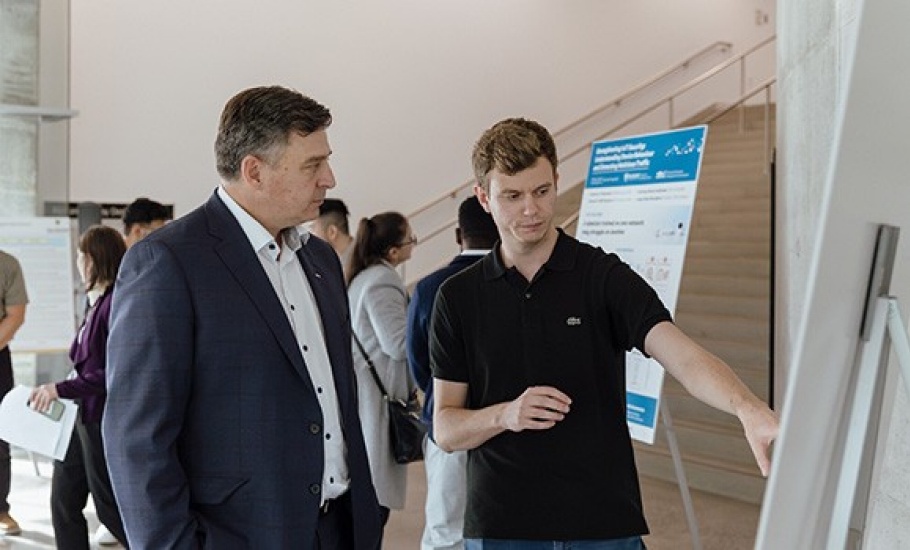
A student researcher greets a guest.
Trust in the loop
Meanwhile, Dr. Heather Neyedli’s research team in the Faculty of Health explores how humans and AI can work effectively together in high-stakes environments.
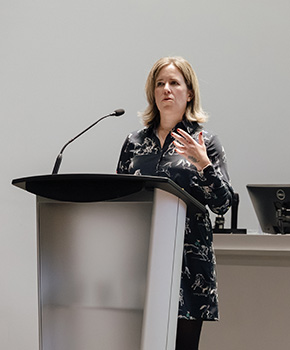 She described the “information paradox” facing human decision-makers in command-and-control settings as sensor networks grow. “They have an unprecedented amount of information, but this is causing unprecedented complexity in their decision making,” she said during her fast talk.
As AI becomes increasingly integrated into command-and-control systems to ease this cognitive load, success will depend not just on advances in the technology itself but also the ability to build effective human-AI partnerships rooted in trust. Dr. Nedley’s research uses controlled experiments with realistic operational simulations — for example, a situation involving an infiltration during a search-and-rescue mission — to identify and validate the human factors that affect these partnerships.
“Ultimately, this work supports the development of AI systems that enhance decision making in command and control, while keeping humans firmly on the loop,” she said.
Training the next generation
Universities also play an important role in workforce development by training people equipped to meet future needs, security-related and beyond.
Dr. Barclay described how a student working on underwater acoustics in the Arctic learned how to deploy hydrophones through sea ice, how to make equipment function in extremely cold temperatures, and how to prepare for field work in challenging environments.
“Those are skills you only gain through experience,” he said.
Those are skills you only gain through experience.
Similarly, at OTN, interns, co-op students, and technicians learn mission logistics and techniques for collecting and analyzing meaningful data to solve real-world problems.
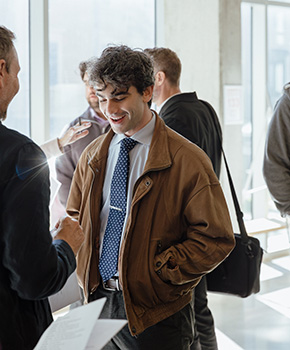
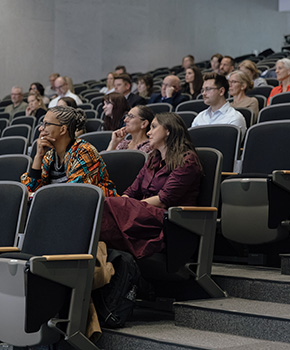
The group also supports the training of hundreds of master’s and PhD students.
“They're getting hands-on exposure to advanced technology and real-world fieldwork,” all buoyed by Halifax’s combination of maritime industrial history, a growing ocean technology sector, and strong research and academic institutions, said OTN’s Vanderkloet.
Growing a space workforce
Over in Canso, N.S., Canadian-owned company Maritime Launch Services is developing Spaceport Nova Scotia — a dual-use spaceport designed to support both civil and defence-related space missions.
There, new talent is needed to help develop Canada’s capacity to launch satellites — a sector still in its early days regionally.
Dal’s Dr. Mae Seto, a robotics researcher, says many students working to build CubeSats (mini satellites) in the Space Systems Lab at Dal — for which she is an academic advisor — go into the industry, but often in bigger centres like Montreal and Toronto.
Galaxia Space Systems is one local company stepping in to build capacity regionally. The firm — founded by Dal Engineering alum Arad Gharagozli — frequently hires Dalhousie graduates for work-integrated learning and full-time positions.
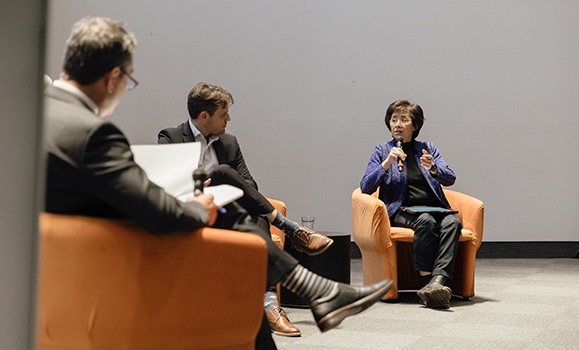
Dr. Mae Seto, right, and Galaxia's Kristian Lethbridge-Hall, centre, during a panel discussion on the future of the space sector in Atlantic Canada.
One of those grads, Kristian Lethbridge-Hall, is now Galaxia’s vice-president, engineering.
“We're definitely very proud of the fact we do hire out of Dalhousie a lot,” he said during a panel chat. “A lot of our new engineers come from Dalhousie.”
But both Lethbridge-Hall and Melissa Quinn, vice-president spaceport operations with Maritime Launch, said there’s room for growth in the industry regionally — and Dal can play a big role.
Industry already faces talent shortages, said Quinn, noting Canadian space companies have "employed as many people as we can from Canada" and need more workers.
At the university level, Dr. Seto emphasized that "workforce development is part of what the university is here for."
If there was a common theme running through the day, it was that Canada's future capabilities will depend not only on new technology, but on the networks of researchers, students, companies, and public institutions working together to develop it.