
As people navigate an increasingly complex information landscape shaped by artificial intelligence and the rapid spread of misinformation, one digital resource remains central to how knowledge is shared freely online: Wikipedia.
This June, in recognition of National Indigenous History Month, Dal Libraries teams up with the Department of Information Science and the Master of Information program to host a Wikipedia Edit-a-thon focused on improving the representation of L'nu (Mi'kmaw) arts and culture online.
The event, open to all, will bring participants together to strengthen the accuracy, depth, and integrity of Indigenous content on one of the world’s most widely used information platforms. The work will contribute directly to improving the representation of Indigenous histories and cultures online.
Where: In the Ko'jua Okuom at the Killam Library (6225 University Avenue)
When: June 3, 11:30 a.m. - 3:30 p.m.
Register now
Why Wikipedia matters more than ever
With millions of daily users worldwide, Wikipedia plays a major role in how people learn, teach, and make decisions.
Over the past 25 years, what started as an experimental project has become the world’s most widely used reference resource grounded in collaborative editing, transparency, and reliable, accurate sourcing practices. Wikipedia articles are required to be supported by trustworthy, published sources, and content must follow strict guidelines on verifiability and neutrality.
Dr. Stacy Allison-Cassin, assistant professor in the Faculty of Management, will lead an instruction session during the event. She is an active member of the Wikipedia community and has contributed to articles on land defenders and biographical articles on Cathy Ellliott, Alan Sylliboy, and Lee Creemo. She has also written articles on Autumn Pelltier and Jesse Wente.
“Wikipedia is an amazing, community-driven open and free resource supported by hundreds of language communities and knowledge activists all over the world,” she says. “As a non-commercial resource, Wikipedia plays a critical role in education and shapes the way we encounter information online.”
As a non-commercial resource, Wikipedia plays a critical role in education and shapes the way we encounter information online.
The reliability of foundational information sources has taken on new importance in an era of generative AI and algorithm-driven content. These newer systems are often trained on or informed by publicly available online content, including Wikipedia. As a result, gaps, inaccuracies, and systemic biases in online information can be reproduced and amplified at scale.
Wikipedia has become part of the infrastructure of modern knowledge. Ensuring its content is accurate, representative, and responsibly sourced has impacts far beyond the platform itself.
Closing knowledge gaps
Wikipedia is built from existing published knowledge, which means it also reflects longstanding gaps and biases in whose stories are documented, shared, and prioritized.
Topics related to Indigenous histories, cultures, and contributions are often excluded, underdeveloped, or missing important perspectives. Edit-a-thons offer a practical way to address these gaps by bringing people together to create, expand, and improve content.
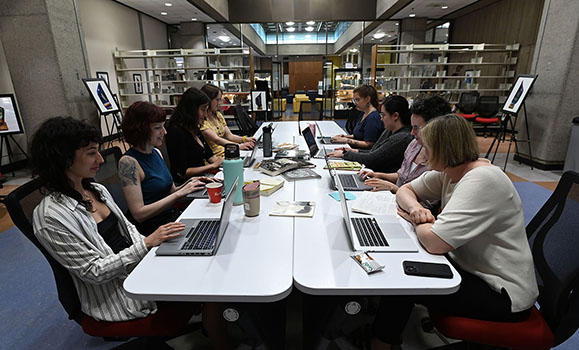
Dalhousie’s upcoming event will focus on Indigenous arts and culture, with participants working to improve coverage of Mi’kmaw artists, authors, musicians, filmmakers, and cultural organizations.
By creating new articles and improving existing ones, participants help shape a more inclusive public knowledge landscape, one that better reflects Indigenous voices, histories, and cultural contributions. Even small changes, such as improving citations can have a large impact.
Edit-a-thons help improve the breadth, quality, and accessibility of information.
“Edit-a-thons help improve the breadth, quality, and accessibility of information,” says Philippe Mongeon, chair of Dalhousie’s Department of Information Science.
Culturally responsible representation
Expanding coverage is only part of the work. Indigenous knowledge is not always fully represented within conventional academic or publishing systems, nor should it be. Contributing content requires care, respect, and cultural awareness.
“Contributing to open knowledge requires care and attentiveness to respectful practices for writing on Indigenous topics, understanding of what kind of information should not be made public,” says Dr. Allison-Cassin. “Not all topics are appropriate for Wikipedia. There is lots of room for collaborative work, including careful attention to citation and the terminology and language used, and to looking to correct colonial and disrespectful bias in existing content.”
Improving Indigenous representation on Wikipedia is not simply about adding more articles. It is about ensuring content is accurate and respectful. It is an opportunity to learn more about L’nu culture, collaborate in a project with local and global impact.
Get involved
Edit-a-thons are social and engaging events, offering a chance to connect with others, share knowledge, and collaborate in a supportive environment while making a meaningful contribution.
The event will include an introductory editing session starting at 12:00 p.m. followed by guided editing time. Beginners are encouraged and welcome, and support will be available throughout the event.
To register or learn more, visit: Wikipedia Edit-a-thon Registration