
Meet our associate dean, equity and inclusion
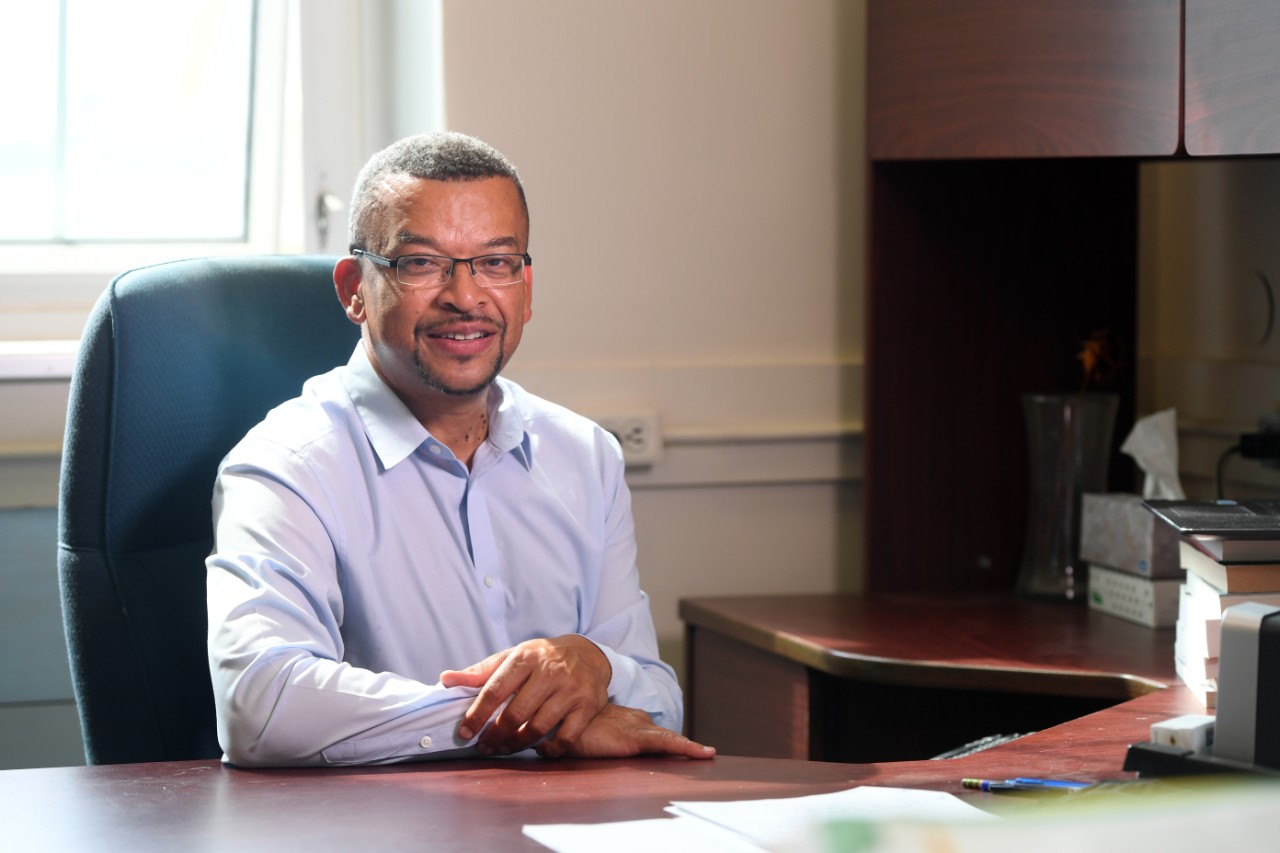
Dr. Kevin Hewitt was appointed as the Faculty of Science's first associate dean, equity and inclusion on September 1, 2022.
A professor in the Department of Physics & Atmospheric Science, Dr. Hewitt is the co-founder of the Imhotep’s Legacy Academy (ILA) and a former Chair of the Dalhousie Senate. In September 2023, he was announced as one of three inaugural Atlantic Chairs for Inclusion in Science and Engineering, an NSERC-established team tasked with creating greater inclusion in science, technology, engineering and math (STEM) fields in Atlantic Canada. He can be contacted at ADEI.Science@Dal.ca.
Listen to Dr. Hewitt on season five of the Sciographies podcast.
Definitions of Equity, Diversity and Inclusion:
We are using the definition of Equity, Diversity and Inclusion adopted by the Dalhousie Senate on Feb. 8, 2021 and further modified by the U15 Canada and German U15 universities in their draft joint paper of Equity, Diversity and Inclusion:
Equity is understood as a process ensuring just outcomes in the treatment of individuals, particularly by identifying and addressing historical and ongoing systems of exclusion and barriers that prevent equity-deserving groups from accessing opportunities and resources on an equal basis. At universities, it involves recognizing and valuing the diverse backgrounds, experiences, and identities of members of the academic community, with a commitment to building systems that provide equitable access to education, employment, and advancement opportunities and the flourishing of communities that have been denied such opportunities.
Diversity is a condition referring to the range of identities, perspectives, and experiences that characterize individuals within communities, including (but not limited to) differences in age, care responsibilities, nationality, disability (disabled by the system), ethnicity, impairment of health, gender, race, religion and belief, sexual orientation, and social class. In this context, there is a particular need and challenge to recognize the genuine quality of the intersectionality (i.e., interconnected nature) of discrimination experiences and structures of inequality.
Inclusion is an outcome involving the creation of environments where individuals are valued and respected as equals by being empowered (to eliminate any existing power imbalance) to fully participate and contribute to their communities including their academic communities.
Our collective approach to equity and inclusion
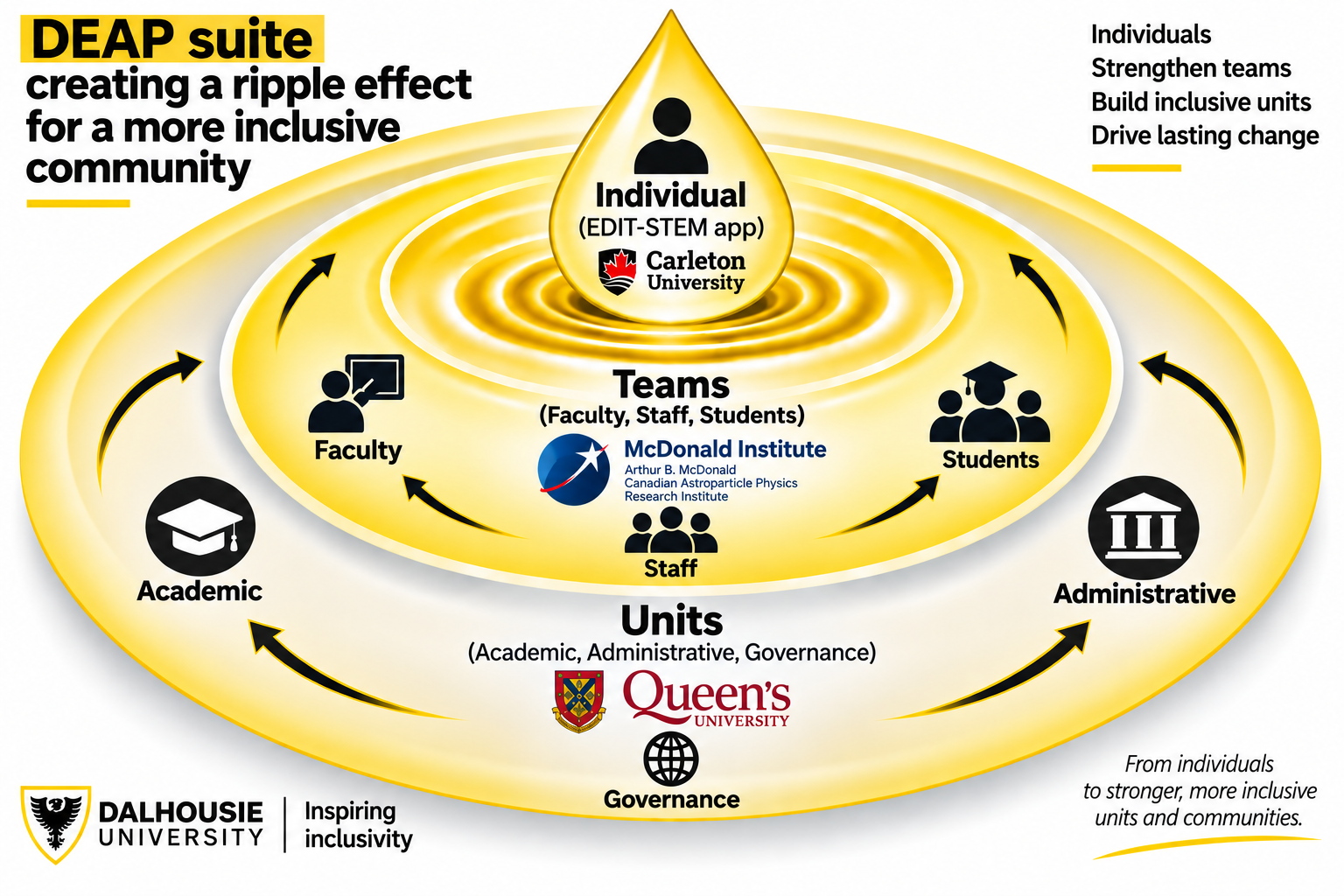
Image (above) – Faculty of Science Equity Planning Framework
We created the Faculty of Science Equity Planning framework through an iterative and organic process; identifying promising practices and customizing these to our needs.
With Carleton University (EDIT-STEM Collaborative Project) we are developing an app that uses the psychology of behavior change and persuasive/serious games theory to provide ongoing support to individuals on their learning journey.
With the McDonald Canadian Astroparticle Physics Research Institute we adapted their Diversity, Equity Assessment Planning (DEAP) tool for researchers, to support teams operating in Academic unit including staff, faculty and students (DEAP for Staff, Students, Researchers & Instructors).
Following Queen’s University, we adapted their DEAP for Academic, Administrative and Governance Units to the Dalhousie context, creating a platform to support Academic units in their pursuit of inclusion.
These tools aid our journey towards being a truly inclusive Faculty, like a drop rippling out from the individual to teams and academic units
1. Effecting change at the level of the individual: Thanks to the NSERC Alliance Grants – Society, this collaborative project with multiple partners led by the Carleton University (Phase 1), Perimeter Institute (Phase 2) and Dalhousie University (Phase 3) aims to develop novel interactive persuasive technology (PT) as a transformative approach for addressing the challenges to EDI readiness in science, technology, engineering, and mathematics (STEM). For more information, visit Carleton EDIT-STEM.
2. Effecting change at the level of teams: The McDonald Institute for Astroparticle Physics developed the Diversity & Equity Assessment Planning (DEAP) tool for researchers. Through an iterative and collaborative process, we adapted their tool to create ones for students, faculty and staff as they all have a role to play in creating an inclusive environment in an Academic unit. More recently, in collaboration with the Office of Research Services, we advanced these tools within the CRC program.
Access to DEAP for Teams is available here: DEAP Tool for Staff, Student, Researchers & Instructors (myDal login required). These tools support different functional teams within the Faculty of Science in advancing their commitments to Equity – the process & Inclusion – the outcome.
Extensive development occurred with Faculty of Science faculty, staff and student Equity Champions, Departmental EDI Committee Chairs, Departmental Chairs, Institutional EDI partners (Human Rights & Equity Services, Office of Vice-Provost of Indigenous Relations, Student Affairs) and other interested parties.
The DEAP Tools for Teams were officially launched on the week of January 12, 2026. They aims to provide the Faculty of Science’s approximately 120 researchers and instructors, 1,000 students and 50 staff members with a means to assess their practices, reflect on systemic barriers, identify areas for improvement, establish measurable EDI goals, and periodically revisit their progress through systematic indicators.
3. Effecting change at the Academic unit level: Queen’s University first introduced DEAP for Academic, Administrative and Governance Units in 2017. This interactive online tool has been adapted for Dalhousie and is available at the DEAP Portal (restricted myDal login). Some units have, in the early phase of implementation and launch, engaged briefly with the tool and the outcome of such process has identified specific needs for the planning phase. The platform will be launched for interested units starting November 2026.
In aid of integration with Dalhousie institutional strategic planning processes we also offer participating units links to the strategic-planning platform AchieveIT. Access to the DEAP Portal will be assigned to Departmental chairs and EDI Committee Chairs.
This phased approach ensures that equity work progresses from vision and commitment to implementation to measurable impact, supported by clearly defined priorities and timelines at the individual, team and academic unit level.
Image below – Concentric circles of Action Research Model
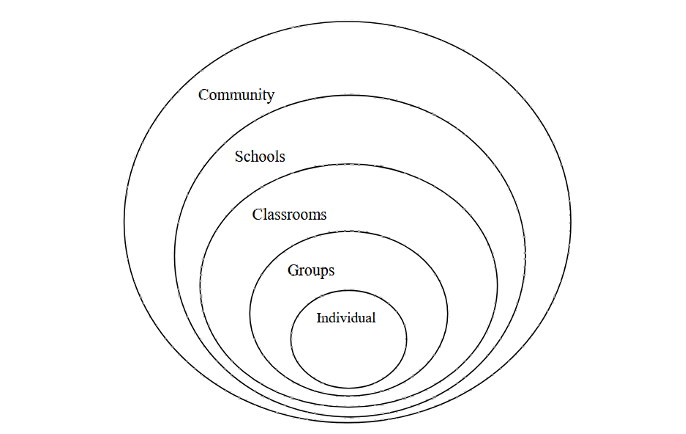
After developing the series of tools in the Faculty of Science which influence the individual (EDIT-STEM), teams (DEAP for student, staff and research & instructor teams) and the next level of organization (Academic units), we immediately identified its parallel with the experience of Stringer as a teacher, school principal, teacher educator, and international consultant.
As an educational institution we find important parallels with Stringer’s approaches that engage educators and communities in cycles of reflection and action. Stringer’s work (including Action Research (2007) and Action Research in Education (2008)) with Indigenous, racialized, and equity-deserving group communities informs the concentric-circle model, illustrating how action research connects individual experience, collaborative inquiry, institutional practice, and broader community change via these concentric circles of action research.
Impact of the DEAP Program
DEAP Program expands the institution's approach to EDI beyond equitable recruitment by supporting inclusive research, teaching, student-led environments. It provides researchers, instructors, staff members and students with practical mechanisms for translating institutional EDI commitments into their functional teams and instructional practices, while encouraging continuous reflection, goal-setting and accountability through a periodic review process.
The DEAP Program Officer is continuously engaging users to expand the impact of different versions of DEAP Tools with different groups of researchers, educators, admins and students. A diverse array of support resources are found in our repository: e.g. a case study from the Physics & Atmospheric Science Department experience with the DEAP Tool, discipline-specific EDI resources and DEAP Program report 2025-2026. The initiative therefore contributes to a culture in which diverse experiences, perspectives and approaches can be meaningfully incorporated into our academic environment.
Equity, diversity and inclusion (EDI) resources
Find links to a variety of EDI-related organizations, resources and opportunities.
Accompanying DEAP Tool resources
- DEAP Tool Personal Journey Resources (myDal login required)
Resources for everyone
- Indigenization, Diversity, Equity, Inclusion & Accessibility (IDEIA) Education Collective with over 60 course/workshop offerings and more resources from Dal's Office for Equity and Inclusion
- Chairs for Inclusion in Science and Engineering Atlantic (CISE-Atlantic)
- Canadian Black Scientists Network
- Imhotep's Legacy Academy
- University of Guelph eBook: Building Community: Introduction to Equity, Diversity and Inclusion
Graduate students
- BIPOC Graduate Student Mentoring Academy (Dalhousie University)