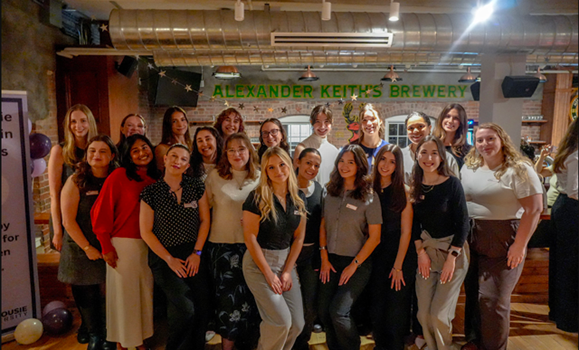

Kristina Forrer was still digesting the outcome of the U.S. mid-term elections last Wednesday when she attended the Dalhousie’s Women in Politics (WIP) fall social.
Surrounded by fellow politically engaged classmates, professors, and local politicians, the fourth-year Dalhousie student felt that the results offered a reason to feel hopeful about the future of political participation.
“Sometimes when we're seeing negativity, whether it's in social media, or whether it's just consuming the news on the daily, I think it can feel very heavy and just hard to feel motivated that the actions you take, especially politically, will make a difference,” Forrer said.
But she hopes the election results will encourage young people to see that political participation can produce meaningful change. The Democratic Party made significant gains across the U.S. in last week's elections for Congress, including in areas that have traditionally voted Republican.
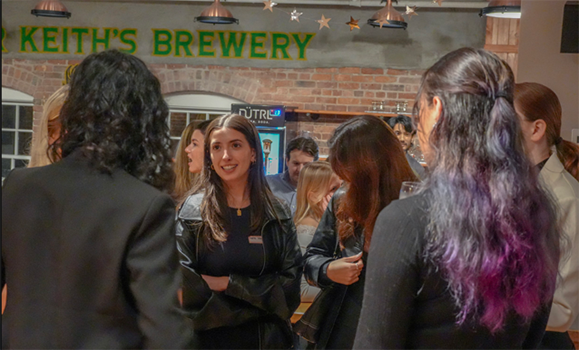
At the gathering, the conversation turned to what the outcome could mean for political participation, representation, and the future of democracy.
Democracy an 'absolute privilege'
For Marley Price, former president and co-founder of WIP and current president of Dalhousie’s Political Science Society (DPSS), the growing attention surrounding American politics has created an opportunity for young people to get more involved in civic life.
Despite the election taking place outside of Canada, Price said that many midterm watch parties were occurring among students, demonstrating that students’ interests in American politics can display a broader willingness among young people to engage with political issues.
She contrasted the enthusiasm to voter turnout in Nova Scotia’s last provincial election in 2024. That November, according to Elections Nova Scotia, only 16.6 per cent of voters between the ages of 18 and 24 cast a ballot.
We need to engage with this, because if not us, who is gonna stand up for our rights when they're infringed upon?
“So I think at this point, we're kind of seeing the pinnacle of democracy as an absolute privilege that not everyone has access to,” Price said.
She added that young people need to recognize that democratic participation cannot be taken for granted.
“We need to engage with this, because if not us, who is gonna stand up for our rights when they're infringed upon?” She said.
Rejecting the status quo
For Gabriellel Conrad, WIP’s Co-strategic growth coordinator, representation is another important part of encouraging political engagement.
She said that seeing candidates from underrepresented backgrounds elected can make political institutions feel more accessible for younger generations, particularly when they see people like themselves elected and represented in government.
“Many people talk about the decline in voter participation among Gen Z, but I have a feeling this election may change that,” Conrad said. “Politics may no longer be an old white man’s game but rather a game of the people.”
This optimism was also reflected in comments by Iain Rankin, MLA for Timberlea-Prospect and interim leader of the Nova Scotia Liberal Party.
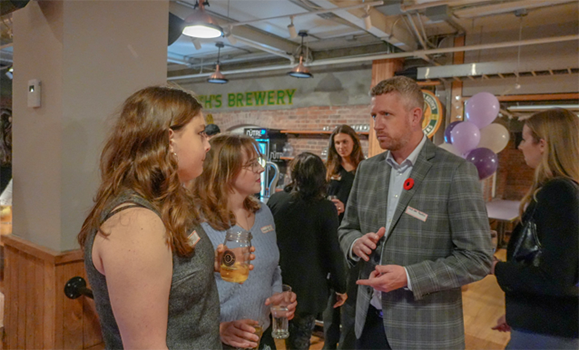
Iain Rankin (right), MLA for Timberlea-Prospect and interim leader of the Nova Scotia Liberal Party, chats with students at the event.
Rankin described the results as positive for progressive politics, arguing that the outcome demonstrates voters still have a voice and the ability to challenge established political interests.
“People really do have a voice,” said Rankin. “There actually is an avenue to reject the status quo.”
As the event wrapped up, Forrer left feeling hopeful that the feelings of motivation and ambition in the room would spread amongst young people nationally.
“I'm hopeful that the future generations and young people will be inspired and excited to take more action,” she said. “The right to vote and the privilege to vote is something that people should really internalize.”