
In January, Canadian Prime Minister Mark Carney described the state of international affairs as a “rupture of the world order.” With Canada shifting its reliance away from the United States amid democratic backsliding, alliances with the world’s other great powers, namely China and India, demand a closer look.
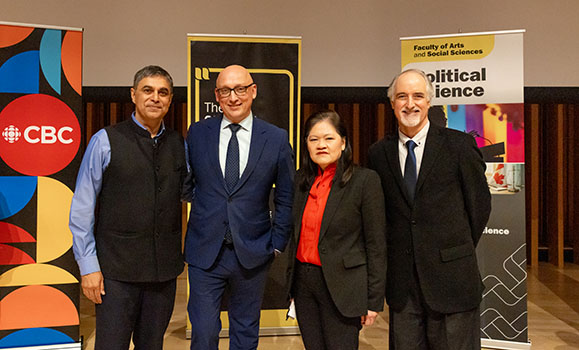
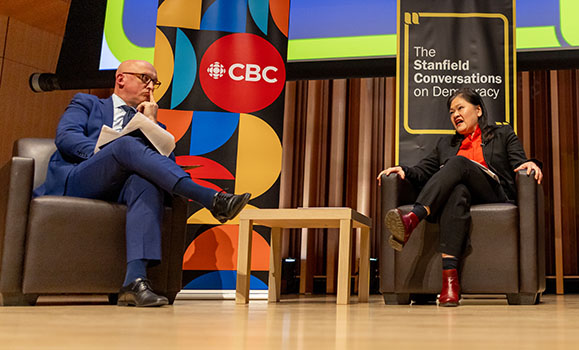
It was this idea that framed the sixth-annual Standfield Conversations panel, hosted on Thursday (Oct.15) by Dalhousiey’s Faculty of Arts and Social Sciences and the Department of Political Science with support from CBC. This year's theme, After the Rupture: Democracy and Diversification in a Post-Liberal World, prompted the panel to answer the question: is the fractured democracy at hand repairable? If so, how?
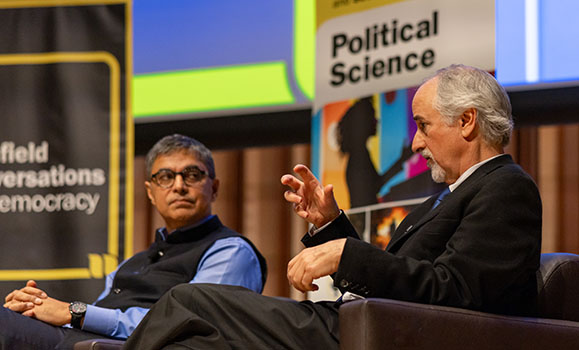
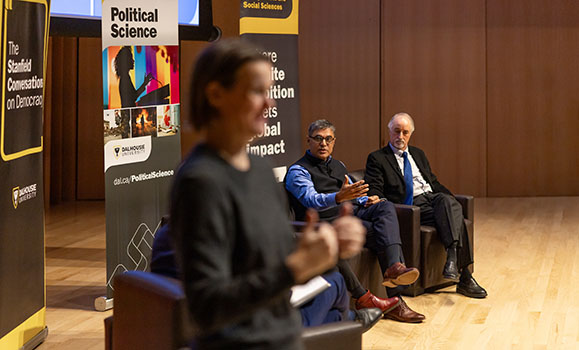
Moderated by CBC’s David Cochrane, host of Power & Politics, the panelists included:
Lynette Ong, professor of Chinese Politics and the University of Toronto
Maxwell Cameron, professor of Political Science at University of British Columbia
Sanjay Ruparelia, professor in the Department of Politics and Public Administration at Toronto Metropolitan University
Here are the main takeaways from the conversations. A recording of the full event can be found at the bottom of this article.
A rupture, defined.
The conversation opened by addressing the elephant in the room and whether “rupture” understates the scale of the U.S. departure from the post-war order.
"The global order we’ve relied on since the Second World War is eroding,” Cochrane said. The acceleration to democracy’s decline he attributes to President Trump “using 19th-century trade policy to pursue 20th-century industrial policy, while weaponizing access to the 21st-century’s most powerful economy to achieve his goals.”
“We see rising inequality within countries. Globally, we see growing polarization [with] social media [fueling] divisions,” Cameron said, “This is a dire situation for our democracies.”
How permanent is this state of affairs?
“We can say that a rupture has occurred, but what we don’t know is what the future system is going to look like,” Cameron said. The pressing question, then, is who will Canada ally with to preserve the critical elements of an international order that recognizes justice, inequality, and reinforces the international rule of law?
Cochrane posed a shared anxiety to the panel: Can Canada and the rest of the world simply wait out Trump? Once his term ends, can the old-world order be reinstated?
Cameron warned that it cannot. “The United States has lost hegemony in a way that is irreversible.”
The United States has lost hegemony in a way that is irreversible.
To that point, Ong agreed. “I think this rupture, even in the post-Trump era, is a permanent or semi-permanent thing,” she says, in part because there has been an erosion of institutional rules. “Those rules have been tweaked and distorted in such an extent it would continue even after the next presidency”
Between Washington and Beijing
Cochrane pointed out that pivoting away from one great power could mean running towards another. Yet Ong sees a flaw in framing the choice as a binary one — either the U.S. or China. “There are actually a lot of in-betweens,” she says.
But before dismissing the idea, what could China offer Canada? “A set of alternative institutions,” Ong said, including the Asian Infrastructure Investment Bank as well as the Belt and Road Initiative that brings Chinese investment around the world.
China, as a realist power, could additionally offer Canada an approach to model. China, as Ong describes, works with other countries on specific issues based on individual interest. While transactional at times, that pragmatism put into practice, may afford Canada the opportunity to diversify away from its overreliance on the U.S..
The problem with Canada’s prior partnerships she argues, is that “traditionally, [Canada] has conflated economic partnership and political partnership,” whereas other countries decompartmentalize the two.
However, the rupture, as Ong sees it, might just be the push Canada needs.
“[It] shakes us out of complacency,” she said. “And you don’t want to be complacent for too long.”
Variable geometry: a third path for middle powers
On next steps, the conversation turned to variable geometry: flexible, issue-by-issue coalitions with different partners, rather than reliance on permanent multilateral institutions. The panel saw its proponents as a possible third path for middle powers.
On political and security matters, Ong advised Canda to look to Europe as an entry point for diversifying key relationships, such as where Canada buys its military equipment.
There is a need to work with China, the second largest economy in the world.
On the economic side, she urged a broader approach driven by interest rather than shared values. “There is a need to work with China, the second largest economy in the world,” she said. The limits and risks of that partnership are foreseeable, she argued, but the transactional benefits to trading certain products may be worthwhile. Although political values should still guide who Canada fundamentally aligns with, she said.
Canada is not alone in feeling this jolt, Cameron added. Though he, too, believes Canada is well positioned to bolster multilateralism by working with partners in Europe, Latin America, Africa and India to strengthen the global rule of law, including international protections for human rights and democracy.
Those guarantees, he said, “Don’t depend on American hegemony.”
Lessons from the Global South
The bottom line that Ruparelia points out: Canada is in an uncomfortable situation, one not unfamiliar to what most countries in the Global South have experienced since decolonization. He suggests Canada has something to learn from working and listening to those countries.
“The easiest thing for Canada to do is double down on traditional allies in the West — other settler colonies including Australia and New Zealand,” he said. But a stronger, better, and more just world order will require reaching out beyond them and taking into account the critiques Brazil, India, South Africa, and Indonesia have made of the current order on pandemic preparedness, debt distress, and climate change.
Democracy as a way of life
Cameron closed the conversation with an optimistic reminder: citizens are at the forefront of democracy. He urged the audience to distinguish between democracy as a system of government and democracy as a way of life, arguing that the former cannot survive without the latter.
Ultimately, he suggested democracy’s future depends not on the actions of powerful governments alone, but on citizens’ willingness to defend their own agency.
“As long as we remain committed to the principle that we are a society in which we, the citizens, determine our own destiny, democracy will prevail,” he said.