
Kirsten Hillman never aspired to become Canada’s top diplomat in Washington, yet that’s the offer she found herself weighing as the country faced its toughest trade negotiations in a generation.
It was 2017, and Hillman — an experienced trade lawyer in Washington as lead on NAFTA trade renegotiation during Trump's first term — was appointed ambassador to the United States after the existing one left early.
Last December, more than eight years later, Hillman finally decided to return home.
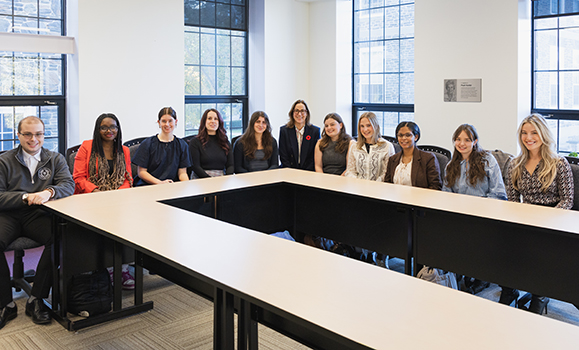
She has been visiting universities across the country this fall to get a sense for how young people — "the future leaders in our country" — feel about Canada and its changing relationship with the United States and the world.
Her tour brought her to Dalhousie this Monday (Oct. 24) where she participated in a symposium hosted by the MacEachen Institute for Public Policy and Governance with students from law, computer science, arts and social sciences, health and science. The discussion followed a luncheon earlier that day with Hillman at the Halifax Chamber of Commerce, which students also had a chance to attend.

Hillman discussed a range of issues in response to student questions, including Canada’s place in a changing world, civic engagement, diplomacy and the value of engaging respectfully with differing perspectives.
"Surround yourself by a diverse number of perspectives," she told students, noting how she worries about algorithms and people who just want to spend time with others who share the same views. "The best decisions are made by decision makers who have people with different backgrounds around the table."
The best decisions are made by decision makers who have people with different backgrounds around the table.
Finding common ground in divided times
Hillman’s tenure as ambassador to the U.S. took place during a period of immense political, economic, and cultural change, particularly since Trump’s second term as president began. She spoke about the degeneration of public discourse on social media and in traditional media but noted that this kind of public discourse often differs markedly from private discussions.
“Nothing makes up for talking to people face to face, ever,” she said, noting the value in seeing people’s body language. “It’s also a lot harder to be disrespectful when you're face-to-face with someone.”
She expects the tenor of public discussion to recover at some point (“I think people are just sick and tired of extreme behaviors, trolling behaviors, that kind of thing) but understands why Canadians are angry with the U.S., even if it’s unfair to attribute the behaviour of a specific cohort to a country of hundreds of millions.


The reality of Canada’s geography, its history and its economic ties with the U.S. mean we need to tread carefully, she said.
“No matter how challenging things might be right now, it is important that we maintain an effective relationship with Americans,” she said. ”I mean, it just is."
Canada's choices in a changing world
At the same time, Canada has begun to shift its own domestic priorities as it navigates changes to the world order and looks to build more autonomy and diverse trade relationships. One student wondered why Canada was cutting its budget in sectors such as the arts, Indigenous services, health care, and the environment when these are supposed to be areas of pride.
Hillman characterized Canada’s federal government as being in a “cycle of restraint” now, telling students that, ultimately, it’s their choice whether to accept it or oppose that direction. If you think it’s the “wrong track,” she told students to respond with advocacy through policy, voting, organizing, and other forms of civic action.
“Fight, fight, fight,” she said.