

A crowd of more than 100 people filled the McInnes Room of Dalhousie’s Student Union Building for the Faculty of Graduate Studies’ annual Killam Celebration last Thursday (October 15). The event, which brought together Killam laureates, alumni and their guests, marked another year of welcoming the university’s newest Killam award recipients and celebrating the lasting impact of the Killam Trusts at Dalhousie.
“For more than 50 years, the legacy of Dorothy and Izaak Killam has shaped the present and future of Dalhousie University,” says Dr. Graham Gagnon, Vice President Research and Innovation. “Their vision was remarkably simple and profoundly ambitious: invest in talented people, support their pursuit of knowledge, and trust that discovery will make the world a better place, both here at home and around the world.”
New scholars, new possibilities
This year introduced a new milestone for the Killam predoctoral program at Dalhousie, with increased investment and a renewed focus for outstanding doctoral students across disciplines. The university welcomed 43 new doctoral scholars into the program this year, who will join the ranks of their Killam peers and go on to tackle some of society's biggest challenges.
Three new ambitious postdoctoral fellows were also welcomed into Dal’s Killam community, which has now grown to include more than 2,100 researchers across generations.
“The next breakthrough is already taking shape in a laboratory, archive, field site, community partnership, or studio represented in this room. The next great idea belongs to one of the scholars we celebrate today,” says Dr. Gagnon.
Beyond brilliant research
Throughout the event, Killam scholars shared snippets of their research.
MSc candidate Anna Gleason took to the stage first. Her research focuses on how vitamin B₁₂ dynamics shape marine microbial communities, and her presentation highlighted that biological production of B₁₂ in the ocean can be collaborative. Anna aims to uncover the overlooked role eukaryotes play in this process, identifying to what extent and where they might serve as an unaccounted-for source of B₁₂ in the ocean.
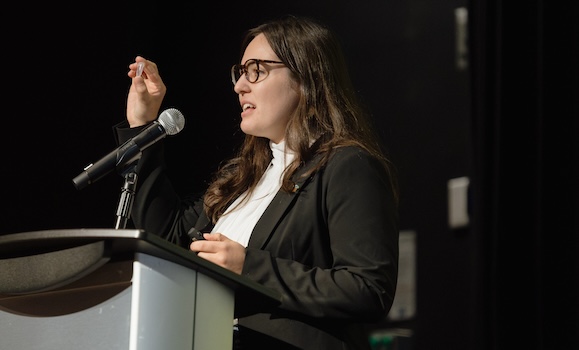
Anna Gleason.
PhD candidate Lindsay Johnston shared her research that explores the unintended consequences of stormwater management on freshwater systems. Her work considers how these practices may shift conditions in our urban lakes, allowing toxin-producing cyanobacteria to thrive.
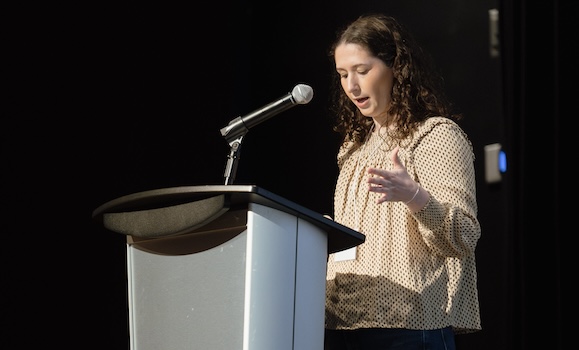
Lindsay Johnston.
PhD candidate Saisha Rankaduwa is studying how the brain processes language during conversation, using electroencephalography to measure brain responses to words. Her research will help build our understanding of how the brain processes language in social interactions and explore how language processing is influenced by different contexts.
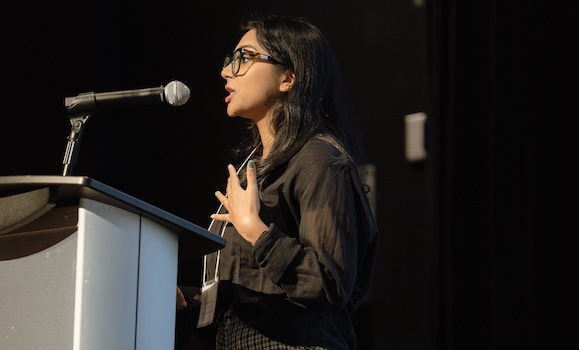
Saisha Rankaduwa
Killam Memorial Chair Dr. Frank Rudzicz shared how his team is making artificial intelligence safer, protecting personal information and reducing unfair treatment, with applications to healthcare and beyond.
"When AI is used in healthcare and other critical settings, failures can expose private data, lead to harmful advice, or mean that some groups receive worse outcomes than others. We develop and test methods to protect that information, reduce unfair differences, and make safety protections harder to undo," he says.
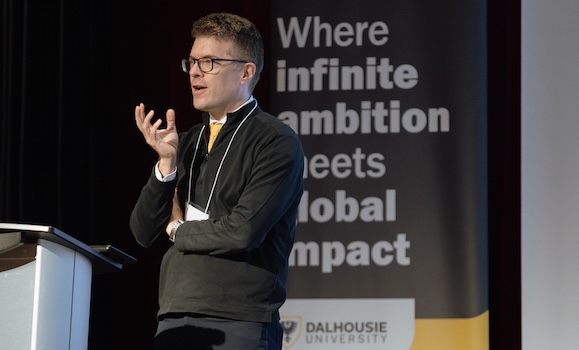
Dr. Frank Rudzicz
Bernie Miller, Managing Trustee of the Killam Trusts, notes, "Dorothy J. Killam had a mission to, in some measure, help build a better future for Canada and the world. It's inspiring to hear how Dalhousie's Killam scholars are aligned with this vision for building Canada's future as they undertake ground-breaking research and develop and expand the work of Dalhousie University, turning Dal's vision into action.”