

It’s World Menopause Day this Sunday, Oct. 18.
Dalhousie’s Dr. Shawna O'Hearn, a menopause leader, would be justified in taking a moment on Sunday to reflect on strides she’s made advocating for menopause support in workplaces—including Dalhousie’s. But there’s so much work in progress and to come that a moment to reflect may be all she can afford.
Dr. O’Hearn has co-founded the Menopause Society of Nova Scotia, launched the sold-out Atlantic Menopause Show, worked to establish Nova Scotia’s Menopause Centre of Excellence (opening in 2027), started Dal’s Menopause Support Group and helped launch its first conference, and recently shared her expertise with a House of Commons Standing Committee studying menopause in the workplace.
"We collectively, as a society, lack awareness around menopause," Dr. O'Hearn says. She’s on a mission to change that.
We collectively, as a society, lack awareness around menopause.
Dr. O'Hearn is currently interim chief operating officer in the Faculty of Medicine and a lecturer in the Department of Community Health and Epidemiology. She’s also an occupational therapist who completed her PhD in health geography, researching the experiences of physiotherapists and menopause. Both those disciplines, she explains, examine how our health and well-being are impacted by the environments in which we live, work and play.
“Specifically for health professionals, we have very little training in the space of midlife aging," says Dr. O'Hearn. Menopause “is just completely hidden." Only 7 per cent of Canadian Institutes of Health Research funding is directed toward women’s health (and mostly for breast cancer research), she shares, meaning menopause is one of many women’s health issues that are under-funded and neglected.
Building awareness and support in the workplace
Around menopause at work, Dr. O'Hearn says: “We don't know what the needs are. It's not an easy quick fix, like let's put a fan on everybody's desk.” In her view, it starts with conversations.
“It’s asking units, managers and individuals in the support group, what are the needs? What are the challenges you're facing? And how are those related to menopause?”
Dr. O'Hearn says it should be part of a leader's toolkit to recognize when there’s been a change within the team and probe further to understand and support. “Many managers, including men, will reach out to me to say, 'I think there might be something, but I don't want to ask. I feel uncomfortable and I don't want to make someone else feel uncomfortable.'”
Making menopause a national policy priority
In her presentation to the Standing Committee, she shared that an estimated one in 10 women leave the workforce during menopause when their symptoms interfere with their ability to work. Where workplaces have gotten better about supporting reproductive health, Dr. Hearn says it’s now time to do the same for menopause.
The three main points she emphasized in her presentation were:
- Canada needs a research strategy around menopause across the country and dedicated resources.
- There needs to be supports and structures in place for leaders, managers and all workplaces.
- Education needs to start in the school system. “My 10-year-old niece showed me a book she was reading about periods and asked me once they start, do they ever end? There was nothing about menopause in that book.”
She says the Standing Committee asked good questions and their attentiveness gave her hope. She looks forward to reading their report and seeing what comes of it.
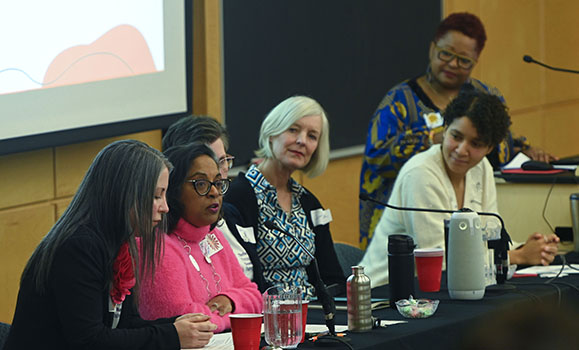
Panelists at a menopause confrence at Dalhousie last spring.
Here at Dalhousie, beyond the Menopause Support Group, other firsts have included creation of a Menopause Pledge employees were invited to sign at Dal’s menopause conference last spring. Dr. O’Hearn says Dal is now within a group of universities that have made menopause a priority within their employee support structures.
To continue the work at Dal, Dr. O'Hearn is establishing a Menopause Advisory Committee with People and Culture, " To start to look at what additional training we need for managers as well as for individuals going through the journey.”