

When Dr. Georgia Klein came to Canada from Germany in 2007, she quickly noticed something that bothered her. Students could memorize numbers and facts for exams, she says, but struggled to gain an actual understanding.
“I realized that students are forced to buy expensive textbooks and then regurgitate the facts and numbers in any type of exam,” Dr. Klein says. “And when I ask questions about the bigger picture, [the] holistic view, no one could give me an answer.”
This realization changed the direction of her career. Dr. Klein left research and in 2014 joined Dalhousie’s College of Sustainability, where she has since built a teaching approach centered on inclusion, experimentation, and student empowerment.
This year, Dr. Klein, a senior instructor and associate director in the College, was awarded with the President’s Award for Outstanding Contributions to Teaching and Learning for her contributions to inclusive, student-centred teaching and leadership in advancing innovative learning practices.
Enabling participation
For Dr. Klein, that means thinking about what students learn and how it can be accessible and engaging for all.
Her approach to HyFlex teaching grew out of the aftermath of the Covid-19 pandemic, when she saw how flexibility could make the classroom more accessible. Students could participate in person, join online, or watch recordings asynchronously depending on their preferences and needs.
It's really the question of how do we enable people to participate and allow them university education.
“For people who are neurodivergent, work jobs while studying, or are not able to attend campus everyday [they] can make the choice if they want to be online or not,” Dr. Klein says.
She also recalls a time she had a single mother with two children who would not have been able to sit in the classroom.
“So it's really the question of how do we enable people to participate and allow them university education?” she says.
From eco-grief to action
That same attention to students’ experience extends to the emotional challenges of studying sustainability.
Dr. Klein is a part of EcoHope, an initiative focused on addressing eco-anxiety and eco-grief among students while creating opportunities to turn those emotions into action.
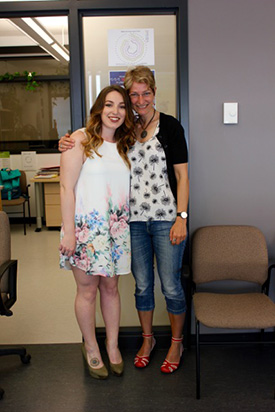 In her classes, she talks openly about the feelings of sadness and anxiety that comes with learning about environmental destruction and climate change rather than treating it as something students should keep to themselves. The initiative also includes planting native plants and creating green spaces around campus, giving students the opportunity to act together.
“We acknowledge and recognize that group eco-grief is a thing,” Dr. Klein says. “We make it a topic so it's not a covered-up elephant on the road.”
For Alexa Goodman, a Dalhousie alum who now works in the university’s Office of Sustainability and co-instructs the fourth-year capstone course alongside Dr. Klein, that balance is important.
“We talk about how those heavier emotions, anger, sadness are all part of it,” Goodman says. “You have to be able to name those emotions and recognize that as part of the work. Which is not a conversation we were having 10 years ago.”
Shown left: Goodman, left, with Dr. Klein.
Dr. Klein encourages students to acknowledge difficult emotions while also bringing “good news” into the classroom and highlighting solutions that are working out well.
Rethinking what learning looks like
Phoebe Seely, a 2025 Dal graduate who took three of Dr. Klein’s courses and worked as her teaching assistant, says the instructor’s ability to build community was equally important.
“She was so skilled at creating community within the College just by connecting students with one another, connecting students with staff,” Seely says.
Dr. Klein’s classrooms also challenge students to think beyond traditional academic formulas. Goodman remembers assignments without the traditional rubrics, designed to encourage students to think freely and critically, rather than searching for one correct answer.
Dr. Klein’s mantra is: “Fail, fail better. Fail again.”
I'm not changing humans, I'm just unravelling their potential.
For her, experimentation is a part of learning. And so is watching students discover what they are really capable of.
“What really motivates me is when I see my students grow,” Dr. Klein says. “I'm not changing humans, I'm just unravelling their potential.”