

Water vessel collisions and fishing gear entanglement are among the leading causes of human-made whale fatalities each year. Scientists have been working with the Canadian federal government to reduce these fatalities. One of these scientists is Dr. Sean Brillant.
Dr. Brillant, an adjunct in Dalhousie’s Department of Oceanography and a senior conservation biologist with the Canadian Wildlife Federation, spent his education studying marine biology and ecology. It was during his postdoc at Dalhousie that he started working with whales.
Prediction and innovation
Dr. Brillant’s current research involves tracking and predicting the movement of whales and how to reduce harm.
“I spend quite a bit of time coming up with ways of predicting where whales are,” he says. “I also try to figure out what are the things are that humans do that are really dangerous for whales, and how we can change the way we do things on the ocean.”
Dr. Brillant will be a guest speaker at the Beaty Centre for Marine Biodiversity’s Ocean Week Halifax Movie Night on Thursday, June 4. Visitors will get the chance to explore the centre, watch the Last of the Right Whales documentary, and hear from a panel of experts, including Dr. Brilliant. The event is limited to 50 spots.
For Dr. Brillant, working with the fishing industry is crucial for maintaining the safety of whales. Looking at where fishers work and advocating for new, innovative fishing gear that is safer for the whales is a large part of his work. New on-demand fishing gear is an example of this.
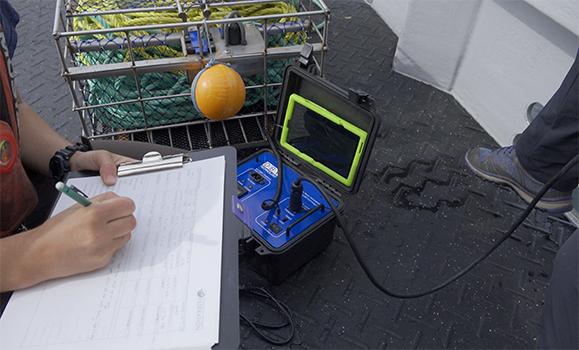 Data collection during a gear trial from the deckbox that is used to communicate with an on-demand unit on the sea floor. (Submitted image)
“For example, lobster traps have a trap on the bottom, and a line with a buoy to the surface,” he says. “That buoy line is the thing that whales often get entangled in. Companies have developed tools that get rid of that buoy line. Fishers can now send a signal to the bottom, and the device releases a buoy line so that they can pick it up, or it fills up an airbag that lifts the whole thing to the surface.”
Part of what makes this new technology so important is the ocean closures that happen when North Atlantic right whales show up. “The Canadian government closes parts of the ocean to fishing when a right whale shows up, and that can create a lot of hardship for fishermen. These new tools allow fishers to keep fishing in those locations, even if there is a whale nearby,” says Dr. Brillant.
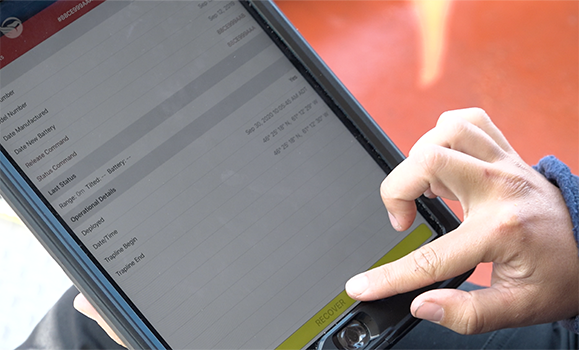 A tablet using an app that triggers the retrieval of bottom-set on-demand gear. (Submitted photo)
Policies and adaptations
The new technology and policies seem to help reduce the risk of lethality to North Atlantic right whales. According to Dr. Brillant, the population of right whales had been in a steep decline since 2010. Since then, due to measures put in place, it appears that the population has levelled off.
In 2017, the Canadian government shut down fishing in certain locations and slowed down ships to protect the whales. Every year since then, the government has been doing this.
In early 2026, the Whalesafe Gear Strategy was announced, which lays out a plan that will have more fisheries in Canada use gear that protects whales. Many fishermen are already using and testing out this gear. Dr. Brillant is actively working with the fishers to make these changes.
Ocean groups at Dalhousie
Dalhousie has a global reputation for excellence in ocean education and research. Our collective knowledge contributes to Nova Scotia’s blue economy and supports global ocean sustainability. The Steel Ocean Sciences Building houses several research groups, including:
- Canada Excellence Research Chair (CERC.Ocean) in Ocean Science and Technology
- Ocean Tracking Network (OTN)
- Marine Environmental Observation Prediction and Response Network (MEOPAR)
- Ocean Frontier Institute
- Aquatron Laboratory
These groups work together and with other scientific groups around the world to better understand the ocean and its resources.
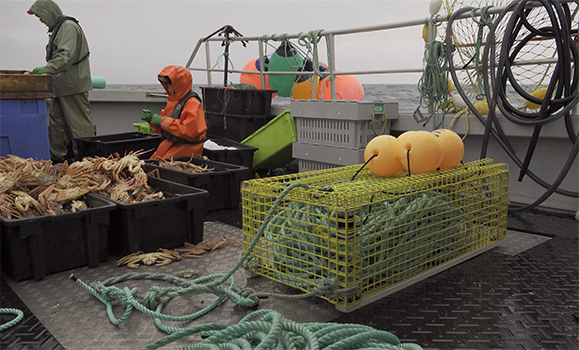 An on-demand unit containing a buoy line being used on a commercial snow crab fishery. (Submitted photo)
Inspiring the next generation
Dr. Brillant hopes that marine institutions, like the Beaty Centre for Marine Biodiversity, which just opened its doors in December 2025 in the Steele Ocean Sciences Building at Dal, will encourage ocean sustainability with younger generations.
“They bring a world that very few people can see. The blue whale skeleton at the Beaty Centre is something almost nobody would ever see, but now there’s an opportunity for anybody in the world to walk in there and see how big a blue whale is. I have no doubt that it creates memories and captivates imagination.