

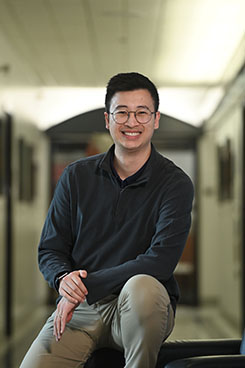
Dr. Adrian Chan, who was born in Hong Kong and grew up in Markham, Ontario from the age of two, never expected to end up on the East Coast of Canada. Nor did he expect he’d move there to enter medical school.
But an opportunity serving as a first responder with the Canadian Coast Guard in Mahone Bay, N.S., quickly changed that.
“I immediately felt something about the Maritimes, a particular warmth and character,” he recalls. “And for the first time, I pictured myself moving out east.”
I immediately felt something about the Maritimes, a particular warmth and character.
And move east, he did.
- Every graduate has a story. This is one of them. Follow along as we share more each day throughout Spring Convocation.
Dr. Chan graduates as part of Dalhousie Medical School’s Class of 2026 and will stay in the city and province he now calls home to complete his residency at Dalhousie University in Diagnostic Radiology.
The winding road to medicine
The path to medicine, however, wasn’t linear.
Dr. Chan completed a concurrent education program at Queen’s University where he earned both Bachelor of Arts (Honors) and a Bachelor of Education, specializing in geography and English. He spent a year in the classroom as a high‑school English teacher, where he thrived on helping his students learn, grow and be seen, before ever considering medicine as a career.
 During his studies, he volunteered with St. John Ambulance, providing first‑aid care at community events and later serving in a leadership role as a logistics officer. The work introduced him to the quiet rewards of community‑centred, first‑responder care, and ultimately led him to the Inshore Rescue Boat student program with the Canadian Coast Guard that first brought him to Nova Scotia.
Those volunteer experiences sparked an interest in a range of health-care pathways, including paramedicine and nursing. Having studied arts, rather than sciences, he assumed medicine was not an option, but a conversation with his cousin, a physician in Halifax, changed that, and he came to see that medicine offered what he’d been looking for in a career: the opportunity to serve his community in a meaningful and direct way, and the chance to keep teaching.
“Watching students grow, supporting families, and nurturing curiosity — those things would remain in my transition from being a classroom teacher to a physician, just in a different form,” he says. “It was that realization that ultimately made me decide to apply to medical school.”
Lessons carried forward
That foundation would continue to shape how Dr. Chan understood medicine once he entered training. He says his past studies gave him an early framework for thinking about the relationships between people, place, and environment — concepts that would later align closely with ideas like the social determinants of health. What didn’t feel medical at the time now feels essential: paying attention to context, resisting assumptions, and recognizing that every patient arrives with a story shaped by forces beyond the exam room.
He traces that mindset back to his time training as a teacher, when he completed a three‑week placement at the American Museum of Natural History in New York City. On one Saturday in particular, Dr. Chan helped run a free program that welcomed children and families from lower‑income communities, offering breakfast and full access to the museum’s exhibits. Later that same day, in the same building, he supported programming for children of wealthy donors attending a gala. The contrast was striking and enduring, reinforcing something that he now carries into every patient interaction: you don’t know what someone is carrying with them when they walk through the door.
As a teacher, I reminded myself not to make assumptions about my students' lives outside the classroom, and as a physician, I want to hold onto that same principle.
“As a teacher, I reminded myself not to make assumptions about my students' lives outside the classroom, and as a physician, I want to hold onto that same principle,” he says. “I want to be attentive and work alongside my interdisciplinary colleagues to provide care that accounts for the whole person.”
The power of mentorship
In medical school, Dr. Chan began to see those values mirrored in the mentors who guided his training, and in the kind of physician‑teacher he hopes to become. He was fortunate to work with faculty who took the time to explain not just what to do, but why — investing in him as a learner rather than simply a trainee.
One mentor in particular, a surgeon Dr. Chan worked with during his clinical rotations, stood out for the trust she placed in him, gradually increasing his responsibilities while remaining closely attentive. Though she encouraged him to consider surgery, she was fully supportive when he shared his decision to pursue diagnostic radiology. That balance of high expectations and respect for a trainee’s goals left a lasting impression, and reflects the kind of physician‑mentor Dr. Chan hopes to become.
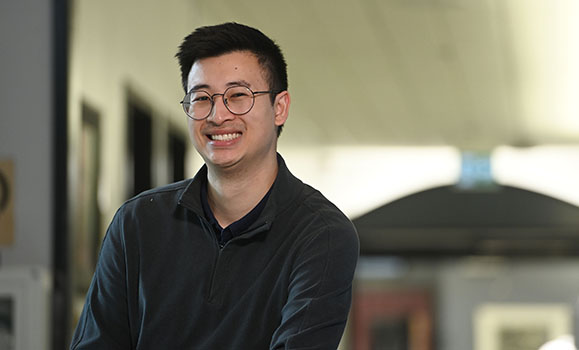
With education central to Dr. Chan’s identity, he hopes to contribute to a culture of teaching, whether that's working alongside medical students on rotation, or simply modelling the kind of curiosity and openness that he has valued in his own mentors.
“One day, as an attending,” he says, “I hope to be the kind of physician that a future trainee remembers and recognizes, the way I recognize my mentors now.”
As he looks back on his journey to graduation, Dr. Chan says the most meaningful realization has been understanding just how much his experiences before medicine have shaped the physician he is becoming.
Those years weren’t detours. They were foundational to who I am today.
“Those years weren’t detours,” he says. “They were foundational to who I am today.”
To students considering medicine from non‑traditional backgrounds, his message is clear.
“Everything you’ve lived and learned before has made you uniquely yourself, and that uniqueness is a strength,” he says. “Those experiences will surface in ways you don't expect, through how you communicate with patients, in how you notice what others might miss, in the perspective you bring to difficult conversations. Don't minimize that. It matters.”