

A Rising Tide rippled out to the Dal community on May 1, offering a window into the university’s strategic direction.
Focused on the distinct ways Dalhousie contributes to Nova Scotia and the world more broadly, it is a strategic document that looks and feels somewhat different from its predecessors.
Dalhousie President Kim Brooks, who led the process of gathering input from the Dal community and crafting the framework, says that's by design. A Rising Tide: Dalhousie's Promise to Nova Scotia and the World is meant to offer more directional guidance than prescriptions and targets, she says.
The aim: to encourage Faculties, Units and individuals to find inspiration and be pulled toward shared points of excellence, distinction, relevance, and impact.
Dal News sat down with President Brooks to explore the new strategic framework, how it was shaped by community voices, and what it asks of the university and its community.
Dal News: What does A Rising Tide intend to accomplish?
Kim Brooks: At its heart, A Rising Tide is about focusing our attention on how we might lift people, ideas, and communities by cultivating the ability to imagine better futures and bring them within reach.
It orients us externally, asking us to direct our attention to the difference that we make as an institution, whether through the kinds of programs and learning opportunities we offer, the kinds of research we undertake, or the communities and partnerships we help build.
At its heart, A Rising Tide is about focusing our attention on how we might lift people, ideas, and communities by cultivating the ability to imagine better futures and bring them within reach.
The title also speaks to what universities can fundamentally do. A university can change the trajectory of a student’s life. It can open opportunity, deepen understanding, strengthen confidence, and prepare people to contribute in meaningful ways. That is perhaps most obviously true for students, but it is also true for faculty and staff, alumni, partners, and the communities connected to us.
We also know that the research, teaching, service, and creative work we do here contribute to richer and more resilient communities in Nova Scotia, across Canada, and around the world. So the framework is both an internal compass and an external promise. It reminds us that Dalhousie’s success should be measured by the good we enable for others.
DN: Why is now the right time for A Rising Tide?
KB: This strategic framework has been, in some ways, a long time in the making. Our previous plan, Third Century Promise, was an important foundation for the work that followed. It helped guide Dalhousie through a period of extraordinary disruption, beginning with the early days of the COVID-19 pandemic. And it served as a strong template to take us through those years.
But the world has change profoundly since 2021. Universities are navigating technological change, the rise of AI, financial pressure, shifting expectations from governments and communities, increased concern about public trust and misinformation, and urgent questions about health, climate, sustainability, democracy, and social cohesion.

That is why we needed a framework that was more directional than prescriptive: one that clarifies our enduring purpose while leaving Faculties, units, teams, and individuals room to respond to new realities as they emerge.
A Rising Tide identifies areas where Dalhousie already has distinction, strength, and responsibility, and invites the community to align around the places where we can make the greatest contribution to our region, our country, and the world.
DN: How did the Dal community help shape A Rising Tide?
KB: I hope people who participated in one or more of the consultation sessions, responded to the virtual calls for input, or contributed in another way will see themselves in the framework and feel like it captures the spirit of the Dalhousie community.
More concretely, we posed a series of eight questions to faculty and staff and invited responses. We had several conversations at Senate and with the Board of Governors. We discussed the framework in three sessions during Dalhousie Engagement Day. We met with external stakeholders and alumni. We had conversations with student leaders and invited input through student questionnaires.
All of that input mattered. It helped us understand what people value about Dalhousie, where they see our greatest strengths, what they believe this university owes to the communities around us, and what kind of institution they want Dalhousie to become.
All of that input mattered. It helped us understand what people value about Dalhousie, where they see our greatest strengths, what they believe this university owes to the communities around us, and what kind of institution they want Dalhousie to become.
The final framework is not a transcript of those consultations, of course. But it is thickly informed by them. My hope is that people recognize their aspirations, concerns, and sense of possibility in the document.
DN: What did you learn about Dalhousie in working on A Rising Tide?
KB: I learned that we share a lot of common ground on our values as a university. We  held a session at last year's Dal Engagement Day on values and there were questions in all the surveys. We ended up with lots of material that wouldn’t necessarily be narrowly cast as a "value statement" but instead might be better described as priorities we’re committed to, or believe in, or care about.
That input became the eight compass bearings in the framework: the beliefs that guide our decisions and keep us on course. They speak to strong roots, students, curiosity, service, action and application, community, inclusive excellence, and the need to focus our efforts to maximize our impact.
What struck me most is that, while people describe Dalhousie in different ways depending on their experience, there is a strong shared belief that this university should be excellent, welcoming, useful, ambitious, and deeply connected to the public good.
I hope when people read the compass bearings, they see things they care about reflected to them.
DN: A Rising Tide centres the role of people and place in achieving excellence and impact. Why are these such powerful distinguishing characteristics for Dalhousie?
KB: In trying to map out the strategic framework in its early days, one of the questions we asked was “What are Dalhousie’s points of distinction and and what causes us to be excellent?”
When you look closely at universities, many of their greatest strengths can be traced to people and place. We are shaped by whom we are able to attract — students, faculty and staff, alumni, and partners — and by what those people contribute. We are also shaped by the distinctive characteristics of the place where we are located.
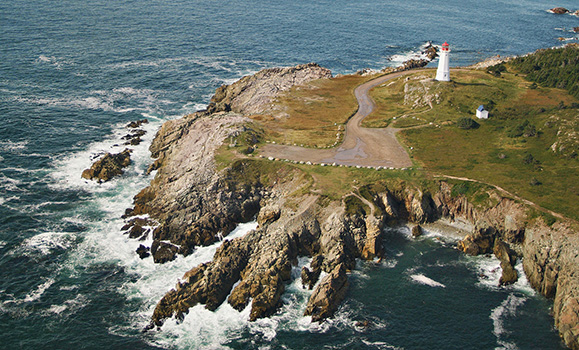
At Dalhousie, Nova Scotia matters. You can pick almost any discipline at Dalhousie and find something about this place that explains why particular areas of distinction or excellence have emerged. Oceans are an obvious example. We are located on the edge of the Atlantic, and that has made Dalhousie a natural home for people who are interested in studying oceans, climate, marine systems, coastal communities, and the connections among them from many disciplinary perspectives.
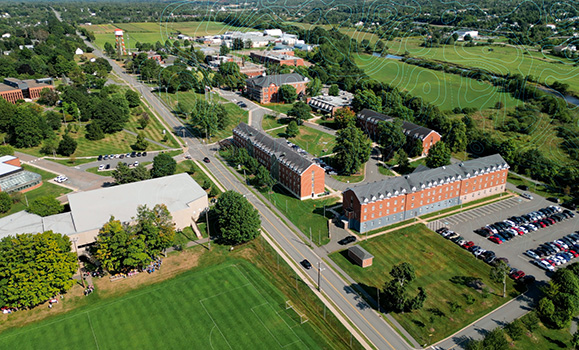
Similarly, if you have a working farm right on your campus, that’s going to animate the kind of study, research, and partnerships that are possible. It attracts people interested in agriculture, food systems, animal health, aquaculture, sustainability, and rural communities. The terrain of the university — literally and figuratively — helps shape the questions we ask and the contributions we make.
And then there are the people. Dalhousie’s excellence is animated by the students who come here with potential, the faculty whose research and creative work expand knowledge, the staff who make our campuses welcoming places where we can flourish, the alumni who carry our impact outward, and the partners who help us turn ideas into action.
The combination of those two — the people we draw here and what they bring, and the place they encounter when they arrive— helps explain what makes Dalhousie distinctive and what makes excellence possible.
DN: A Rising Tide is described as a "living document" without a defined timeline for implementation. What approaches are you considering for keeping the document top of mind for the Dal community?
KB: I see A Rising Tide as a long-term framework rather than a short-term operating plan. It means it should live in the choices we make, the priorities we set, and the way we align our energy and resources over time.
The most obvious way it will come to life is through Faculty and unit planning. As Faculties and units develop strategic or annual plans, the framework should help them ask: how does our work contribute to Dalhousie’s purpose? Which horizons are we helping advance? How are the compass bearings shaping our decisions?
But I hope it does more than guide formal planning. I hope that people across our campuses see something in the framework that inspires them to think differently about their daily work. That might come through one of the compass bearings or through one of the shared horizons. It might come through the simple idea that Dalhousie lifts people, ideas, and communities.
A framework is useful only if it helps us make choices. One of our compass bearings is that when we focus our efforts, we maximize our impact. So A Rising Tide should help us decide what to strengthen, what to align, where to invest our attention, and sometimes what not to do.
DN: Any final thoughts?
KB: What I hope people take from A Rising Tide is a sense of pride, possibility, and responsibility.
Dalhousie is already making an extraordinary difference — in the lives of our students, in Nova Scotia’s communities, in research and discovery, in health, culture, justice, innovation, and public life. But this framework asks us to be even more deliberate about that difference.
The true measure of a university is not only what we discover or teach, but what we make possible for others.
It asks us to see excellence and relevance as connected. It asks us to be grounded in this place and ambitious for the world. It asks us to remember that leadership is an act of service, that ideas live in action and application, and that our success depends on the people who make Dalhousie what it is.
Most of all, it reminds us that the true measure of a university is not only what we discover or teach, but what we make possible for others.