

A Killam Postdoctoral Fellow at Dalhousie who has led improvements in advanced materials production at the university and pushed to make science more accessible has been selected for two prestigious programs aimed at rising science stars.
Dr. Blaine Fiss's recognition began in March this year when he was one of only 30 early career scientists globally chosen for the CAS Future Leaders program. Then this week, the young scientist — whose work has been informed by his own experience navigating academia with cerebral palsy — was named a Research Corporation for Science Advancement (RCSA) Fellow, just the second person from a Canadian university to be selected for the influential program in its three-year history.
"Blaine combines scientific creativity with true leadership,” says Dr. Mita Dasog, an associate professor and Killam Memorial Research Chair in the Department of Chemistry.
He brings energy and a collaborative spirit to everything he does.
Dr. Dasog, a Scialog Fellow who has seen Dr. Fiss's work up close in her lab, nominated the postdoc for the RCSA Fellow program given his natural fit.
"In my research group, he initiated an entirely new direction in mechanochemical synthesis that has transformed how we produce advanced materials, making processes that once required high temperatures possible at room temperature in minutes," she says.
What's more, she says Dr. Fiss serves as an outstanding mentor, communicator, and advocate for inclusive science.
"He brings energy and a collaborative spirit to everything he does, and he already demonstrates the independence and initiative we expect from faculty members.”
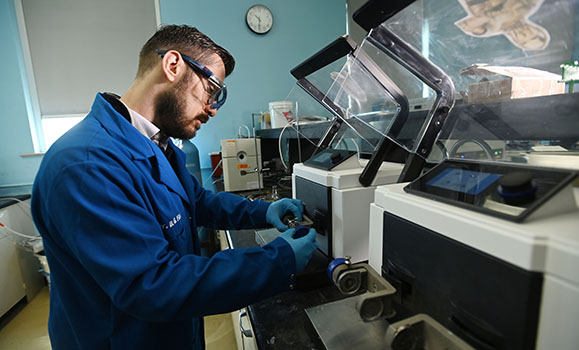
Dr. Fiss loading a milling jar into a shaker mill, used for fast and sustainable chemical reactions.
Backed for what's next
Dr. Fiss says having the support of these two new communities will be instrumental as he prepares to embark on the next phase of his career: finding a tenure-track faculty position, ideally in Canada.
The RCSA Fellows initiative supports young postdoctoral scholars in Canada and the U.S. as they transition to seeking and interviewing for faculty positions, while the CAS Future Leaders program offers opportunities for early-career scientists to grow their science leadership skills and engage in scientific discourse with peers around the world.
It really put the wind in my sails.
“When I got that initial RCSA announcement, I thought ‘Wow, there’s a cohort that not only believes in me like the people at Dal do,’ but now I have a further community that can help build me up,” he says. “It really put the wind in my sails.”
Journeying through academia
Born with cerebral palsy, Dr. Fiss’s early years growing up in Kitchener, Ont., were spent in a wheelchair. Cerebral palsy is a neurological condition that affects muscle movement, posture, and coordination.
While independently mobile as an undergraduate student, his initial post-secondary experience was nevertheless “jarring,” with difficulties taking notes, writing exams, and transitioning to university life.
“Being a first-generation student, I didn’t have any family members to give me a sense of what it was going to be like,” he says.
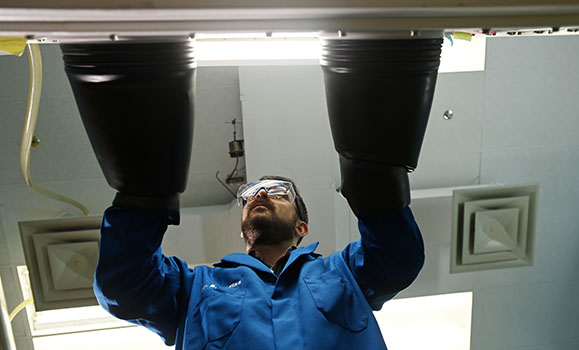
Dr. Fiss working in a glovebox, used to protect sensitive chemicals and samples from oxygen and water.
With the help of the University of Guelph’s “fantastic” student accessibility services, Dr. Fiss graduated with a BSc before moving on to a PhD at McGill. A postdoctoral position at the University of Western Ontario came next, followed by the Killam Postdoctoral Fellowship that saw him heading east to Dal.
“The Canadian chemistry community is rather small, but everything I heard about Dal was overwhelmingly positive,” he says of the decision to join Dr. Dasog’s research group in fall 2024.
Embracing change
While Dr. Fiss is keen to separate his work from his disability (“I consider myself a scientist first”) and aware that his lived experiences with cerebral palsy will differ from others, he is proud to advocate for equity, diversity, inclusion, and accessibility (EDIA) in science.
Those efforts can involve making pre-recorded lectures (with transcripts) available to students, as well as designing slides appropriate for colour-blind and dyslexic viewers.
It can also mean adopting new ways of working in his specialty, mechanochemistry, which involves grinding materials together, similar to a mortar and pestle. While faster and more energy efficient than creating chemical reactions through heat, mechanochemistry has traditionally involved manual processes difficult for those with physical limitations. New, more automated equipment greatly reduces those aspects for the benefit of all users.
Accessibility in labs or how we do more sustainable long-term science is understanding what students need.
To Dr. Fiss, the path to accessibility must start with a conversation and a willingness to change the status quo.
“Accessibility in labs or how we do more sustainable long-term science is understanding what students need and how do we, as mentors or teachers, best address those things,” he says. “The RCSA Fellowship will help me to hopefully continue the conversation.”