

Behind the Lecture pulls back the curtain on some of Dal’s most compelling courses, offering a closer look at the ideas and people that shape them.
Scrolling the latest headlines as a Canadian, it's tempting to buy into the view that we are living in a moment of unprecedented instability. Canada's closest alliance now feels under immense strain. The country’s politicos have been flirting with extremes. The world outside has grown more violent.
 Yet a popular Canadian history course at Dalhousie suggests this moment may not be as unprecedented as it feels. Many Canadas: Canada, 1930 to the present begins not at Confederation, but in the turbulent 1930s.
"The 1930s are an era defined by the 'politics of chaos,' as in, a time of uncertainty, precarity, and turmoil," says Dr. Kassandra Luciuk, an assistant professor of history who has taught the course for years.
Dr. Luciuk says the parallels students draw between the past and present shift organically depending on what's topical or newsworthy each year. What doesn't change? The course's power to encourage students to interrogate Canada's history in new ways.
We asked her how it does so.
The 1930s are an era defined by the 'politics of chaos.'
What inspired the design of Many Canadas, and why begin in the 1930s?
The Great Depression brings the anxiety of the 1930s to a head, but it’s not just that. Canadians are grappling with the last few decades of instability: the wide-ranging impacts of industrialization, the often-violent advancement of the nation-building project, a massive crackdown on labour, the rise of a political policing regime, a recession, a pandemic, the almost incomprehensible destruction of World War One — just to name a few examples. No ordinary Canadian really emerges from the 1930s unscathed; every facet of their lives is filtered through this collection of events and experiences.
This becomes a political catalyst, and we see the emergence of so-called third way political parties — provincial and federal — on both ends of the political spectrum. All of them, regardless of their specific ideologies, emphasized political and economic reform. But people also begin to think more capaciously about politics and to test its traditional boundaries. The Communist Party of Canada, despite being outlawed and under constant attack by the state, grew its ranks in this period. So too did the Far-Right; the domestic fascist movement increasingly attracted disillusioned and angry young men into the fold.
So, the 1930s might not be the obvious starting point — you might think of Confederation in 1867 or even the start of the twentieth century instead — but it makes a lot of sense if you see it in this context. It’s really a turning point for Canada’s socio-cultural and political identity.
Suggest a course for Behind the Lecture

Is there a course that changed how you see the world — or one more people should know about?
Students, faculty and staff are invited to share suggestions for future Behind the Lecture articles.
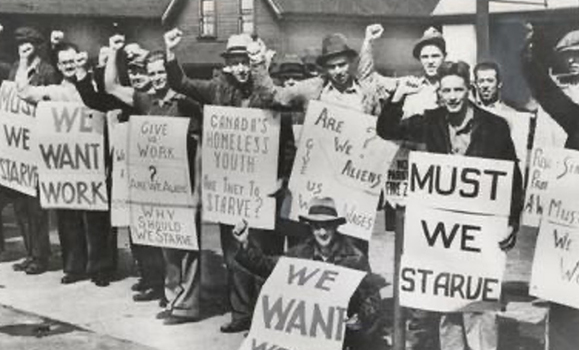
Unemployed Canadians during the Depression era.
How do the course’s major themes resonate with Canada’s current political and cultural moment?
The old saying goes that history doesn’t repeat itself, but it does rhyme. And this course really shows that because it continues to connect organically to the present moment even as what’s considered topical or newsworthy changes.
For example, in earlier iterations of the course, the phrase “OK boomer” was still in wide circulation. We were living in a particular moment where intergenerational tensions around economic but also social issues were at an all-time high. So, I heard a lot from those students that the weeks on the baby boom, the rise of the welfare state, and the golden age of capitalism were the most impactful on their thinking. During the pandemic, especially in 2022 when the government invoked the Emergencies Act, what really landed was our discussion of the historical use of emergency powers.
More recently, students seem to be enjoying the material on economic nationalism. I pay a lot of attention to Harold Innis’s staples thesis, which talks about how Canada’s development was a direct result of the extraction and export of staples (things like fur, fish, wheat, timber, and more recently oil and gas). One of the main arguments he makes is that this extraction-export dynamic turned us into a resource hinterland and made us hugely reliant on foreign markets and capital. Innis also talks about how the so-called staples trap shapes regional socio-cultural and political identities and exacerbates inter-provincial and/or provincial-federal tensions, which is another hot topic.
Quick facts about Many Canadas (HIST 2210)
Level and Typical Learners: 2000-level course that attracts a variety of students from different departments and Faculties.
Format: Lecture-based, sometimes in person and sometimes online/asynchronous.
Average Enrolment: Varies year to year depending on whether it's delivered in person or online. This winter, 150 students enrolled in the online version of the course.
Required or Elective: Elective. Taught as a survey course with broad overviews and general introductions that touch on key topics and don’t necessarily require much previous knowledge of Canadian history.
How often is it offered? Usually every year, sometimes in fall and sometimes in winter.
This is what I love most about teaching this kind of survey class — it’s always relevant but exactly how it’s relevant shifts, and I get to be part of that re-thinking and re-emphasizing with my students.
How do students react when course material reflects contemporary issues like polarization or extremism?
Students respond with a mix of emotions. They’re fascinated — and I think also occasionally comforted — to see the ways that previous generations dealt with and overcame many of the same things they’re dealing with now. They’re sometimes frustrated when they see many of the critical victories of the 20th century — particularly when it comes to Canada’s cradle-to-grave social security — eroded over time.
Students are fascinated — and I think also occasionally comforted — to see the ways that previous generations dealt with and overcame many of the same things they’re dealing with now.
There’s shock over the injustices of the past when it comes to our treatment of Indigenous peoples, racialized communities, and immigrants. But there’s also some amusement in their reactions. For example, they learn about the Mouseland speech made by Tommy Douglas of the Co-operative Commonwealth Federation. Douglas talks about how the mice in Mouseland kept electing cats: white cats, black cats, then half black and half white cats… but cats nonetheless! He’s criticizing the electoral system but he’s also pointing to what he considers a false dichotomy: this supposed choice between two parties that are ultimately still made up of cats. This resonates with students who, regardless of their political orientation, express similar feelings about the status quo.
What has stuck with me the most, though, is a recurring sense from students that the political system was designed at a time when “reasonableness” prevailed and it’s now failing because it did not safeguard against extremism. That’s not coming from a place of naivete or a romanticization of the past. It’s a very astute observation; students feel that they’re witnessing something unique happening right now, where the traditional mechanisms aren’t meeting the moment because the paradigm was different when they were created. It’s difficult to pinpoint exactly what that realization is leading to, but it’s notable.
Do Canadians today still experience tension between national identity and U.S. influence, and how does this compare historically?
The tension existed historically but the debate tended to be a lot more internal. In other words, Canadians weren’t necessarily reacting to overt American antagonism but rather to a broader observation of American dominance and a desire to advance Canadian interests instead. For example, in 1951, the Massey Commission warned that Canada was in a state of anemia and bordering on a permanent dependence on American culture. Effort is made to change that by investing in Canadian content and establishing a network of cultural institutions.
The push for economic nationalism was similar. People felt that growing foreign ownership in the 1950s was giving Americans outsized influence over Canadian politics, limiting the potential of Canadian workers and increasing dependence on American capabilities. Now, it’s important to point out that many of the efforts to nationalize the economy failed. The government disregards both the 1956 Gordon Commission and the 1968 Watkins Task Force, both of which recommended reversing the damage of foreign ownership. Instead, they double down on free trade. Most Canadians also ignored the pleas of various outfits and activist groups that called for the release of America’s grip on Canada’s economy in the 1960s and 1970s.
It's impossible to say yet how durable the current manifestations of Canadian nationalism are. In the past, even when things got tense, they didn’t seem to feel so existential.
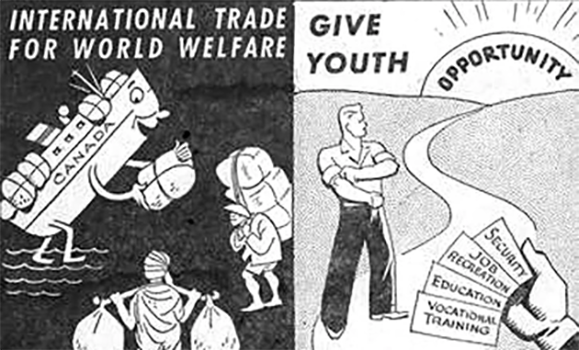
A portion of a A Co-operative Commonwealth Federation (CCF) poster demonstrating a “third way” political option.
What do you hope students understand differently after taking this course, and what common myths does it help challenge?
I’m of the mind that it’s not in the best interest of my students for me to have a set list of things I want them to think about differently. Part of that is because I want them to come to their own conclusions. But part of it is also that I’ve now taught this class enough times to understand that the cohort, and their collective frame of reference, determines it.
That being said, I try to challenge two central myths. The first is the idea that Canada is inherently “nicer” than America. In fact, Canada sometimes responded much more harshly to things or was much more brazen in our violation of civil liberties than our southern neighbours. For example, in 1945, Soviet defector Igor Gouzenko reveals that the Soviets were spying on their allies and that a network of Canadians were passing them classified information. In response, under the authority of the War Measures Act, Canada secretly detains those that Gouzenko names, denying them habeas corpus and the right to legal representation. They then haul them before the Kellock-Taschereau Commission, which demanded that they answer questions without protection from self-incrimination.
Canada sometimes responded much more harshly . . . or was much more brazen in our violation of civil liberties than our southern neighbours.
So, Canadians like to think of their country as an exclusively liberal and tolerant society that follows the rule of law and protects the rights of its citizens from the arbitrary actions of the government. We also tended to look sideways at America because of things like McCarthyism and the House Committee on Un-American Activities, believing that we were immune from these kinds of excesses. But this is an example of how Canada actually outdid America in prioritizing national security over individual rights.
I’m also committed to de-centering nationalist narratives of Canada that only make sense if you do a tremendous amount of ignoring or obfuscating of Indigenous dispossession, political repression and state violence, racism and xenophobia, class disparity, and so on. But my intention in doing this isn’t to entrench disillusionment or propel my students towards a perpetual defeatism. I know and convey that the best parts of Canada are direct outcomes of times of high civic engagement (with the existing system and outside of it through things like protest and strikes). In class, we identify elements of society that, when given the chance, try to erode things like social security, women’s rights, environmental protections, multiculturalism, and civil liberties. It’s important not to cede that territory and to actively commit to safeguarding the core tenets of democracy and progress. So, I strive to provide a roadmap – if not a practical one then at least one of hope that our shared community is worth fighting for.