

Being part of a 14-piece pop-music ensemble requires a lot of collaboration. Instrumentalists and vocalists learn to communicate with one another while workshopping arrangements, experimenting creatively, and trying new things.
 It’s a dynamic learning environment that asks students to bring vulnerability, empathy, and mutual respect to the process.
While Dal’s Bachelor of Music is often thought of as a predominately classical program, the DalPop Ensemble, led by instructor Zoe Leger, has attracted a wide range of students from first to fourth year.
“There’s no hiding in this kind of an ensemble,” says Leger. “Yes, there are a lot of people, but everyone has their own distinct part to play.”
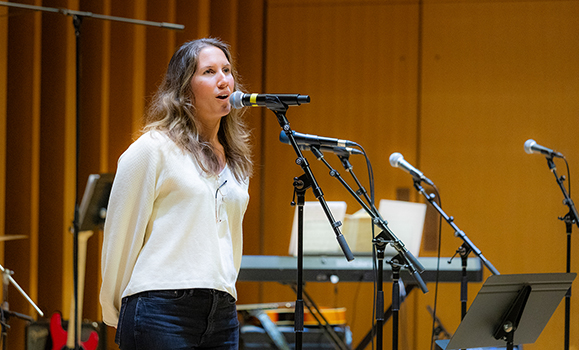
Shown left: Ensemble vocalist Ally Cribb.
DalPop Ensemble’s Unwritten: The Music that Wrote Us fills the Joseph Strug Concert Hall with a boatload of chords and earworm guitar riffs March 14, at 7:30 p.m.
Get tickets: dal.ca/artscentre
There's no I in ensemble
Being a Fountain School of Performing Arts ensemble member means exploring your individual passion while being immersed in group projects.
Nic Redmond, freshly transplanted from the Nova Scotia Community College’s two-year advanced diploma in Music Arts, is a self-proclaimed “third year first year Dalhousie student.”
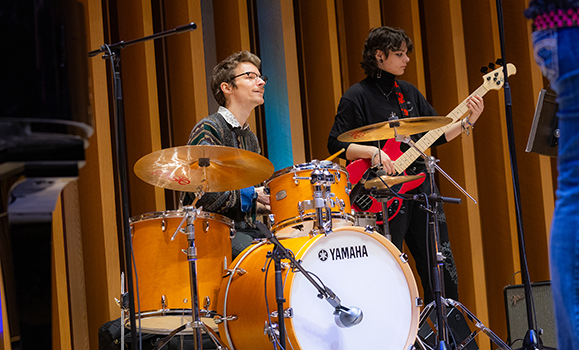 Drummer Nic Redmond, left, and bassist Nyx Matheson.
Nic has played in rock, funk, and Latin jazz ensembles, but being in a pop ensemble that brings together a variety of instruments and vocals is different.
“We’re all fairly confident in our own instruments individually, but as the school year has gone on, we now trust in one another.” says Nic, whose love of drums started with getting the Xbox 360’s Rock Band for Christmas in the late 2000s.
First-year Music student Nicole Anderson, who plays flute, piccolo, guitar — all self taught — and piano, lovingly accepts the role of “chord monkey,” providing clarity on timings and a strong pulse for the ensemble.
“We have our percussionists like Nic who do a great job on the drums and keeping us on track,” says Nicole. “But the singers especially, often look to the pianist or main guitarist for singing cues. We’re carrying most of the melody.”
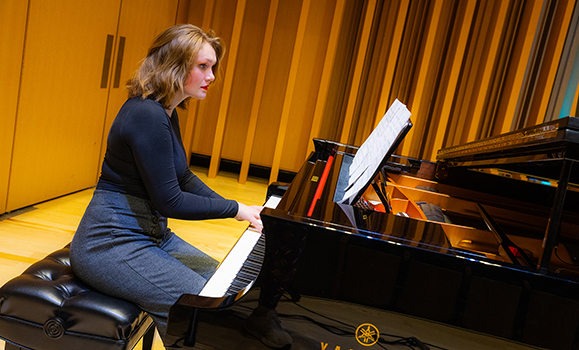
Nicole Anderson.
A set-list of guilty pleasures
While building the set list for their upcoming concert, Leger asked her pop students to suggest music connected to moments that inspired them to become artists. The exercise resulted in an eclectic mix that reflects the group’s broad-ranging influences.
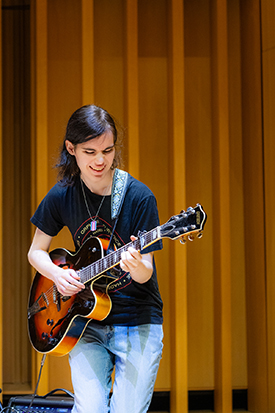 Top 40 music is often dismissed as less significant, but its instantly recognizable riffs become the soundtrack to people’s lives. Growing up with it on heavy FM radio rotation, George Harrison’s Set on You is Nic’s guilty pleasure, which they enjoyed learning for the concert.
“It’s such an infectious song, it may be one of my favourites.”
Shown right: Guitarist June Davis.
Nicole enjoys performing the concert’s namesake, Natasha Bedingfield’s Unwritten, a fun, uplifting piece. But then there’s Kenny Loggins. Yes, the Footloose and Danger Zone guy.
“Kenny Loggins creates melodies and sounds that are very much of the time, like saxophone solos for no reason and great guitar licks,” says Nicole. Whenever I call you a Friend, by Loggins and Stevie Nicks, challenges Nicole as the ensemble’s pianist with key changes and a “whack ton of chords.”
Playing the unwritten
Leger likes giving pop ensemble members as much creative control and autonomy as possible. While they are given sheet music, students are also doing a lot by ear.
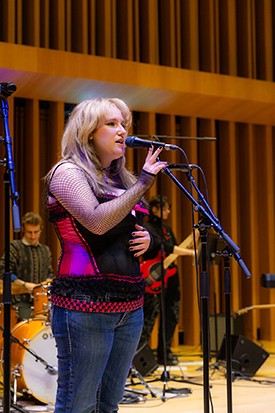 “The arrangement we decide on is seldom how it is originally written,” says Leger. “They have to learn how to listen to each other, and how to improvise.”
Some have more experience doing this than others.
Shown left: Vocalist Keira Tomietto.
“It’s a joke amongst drummers that nobody knows how to write drum parts. We don’t do a lot of reading music,” says Nic. “We may be following along with a lead sheet that has a piano melody and bass part, but we’re also picking up songs on the fly.”
Leger tells students that being a working musician means being a good reader, having a good ear, and really knowing your theory.
“When you are playing this kind of music at a high level, you’re not just a pop performer, you’re an arranger,” she says. “You’re composing on the spot.”
 Zoe Leger, DalPop Ensemble leader.