
Think of your favourite variety of apple. You can probably imagine it to the point of tasting it on your tongue: a crisp Golden Delicious, a juicy McIntosh, a tart Gravenstein. Now, try the same with your favourite wine: Chardonnay, Merlot, Pinot Noir.
These fruit cultivars you’ve enjoyed for years have been around for a long, long time.
“We’ve been drinking Pinot Noir for 1,000 years, for example, and it hasn’t really changed,” says Sean Myles, an internationally renowned fruit researcher in Dal’s Faculty of Agriculture. “We have a massive attachment to particular grapes and apples, way more than in other crops, and this leads to heritage varieties.”
We like what we like; what’s wrong with that?
“Pathogens continue to evolve and if our crops don’t, that’s a huge problem,” explains Dr. Myles, noting that diseases and pests are consistently becoming stronger, more threatening.
“Ramping up the arms race in agro-chemical weaponry isn’t the answer. Easier, more efficient breeding could be.”
Taking the guesswork out of farming
While his Faculty of Agriculture peers are based in Truro, Dr. Myles, the Canada Research Chair in Agriculture Genetic Diversity, works out of Kentville, in the heart of Nova Scotia’s apple- and grape-growing region. There, at the Atlantic Food & Horticulture Research Centre, his team maps out the genomes of apple and grape varieties.
The goal: to support and encourage the adoption of marker-assisted breeding, a process that dramatically reduces the cost and time in producing new, stronger varieties of apples and grapes.
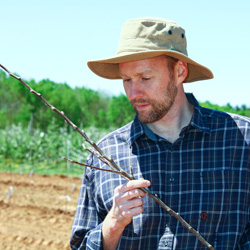 “When you talk to farmers, they’re keen to adopt new varieties that would require less input — pesticides and the like — but they’re hesitant to support breeding because it’s so time-intensive and expensive,” says Dr. Myles. “But marker-assisted breeding promises to be not just two or three times more efficient; we’re talking about a process that can be more like 1,000 times more efficient. The likelihood of finding what you’re looking for get astronomically higher.”
Dr. Myles is quick to note that this isn’t about genetically modifying fruit in any artificial way. Marker-assisted breeding is based on the same process by which fruit has been bred for thousands of years: allowing two different varieties to reproduce and create a new variety that, hopefully, contains desired traits.
The problem with that process, traditionally, is time and treasure. Breeders looking to evaluate a set of new cultivars have to plant an orchard (at a cost of $25,000 an acre or more) and wait three to five years to see if the trees produce the desired traits.
“The chance of finding what you want is so small,” says Dr. Myles. “So many farmers choose to support research efforts that have a more direct, immediate effect, like pesticide trials.”
Marker-assisted breeding has the potential to take the chemicals, and the guesswork, out of the process. Dr. Myles and his team map desired traits — fruit size, acidity, disease resistance — to the fruit’s genome. These data allow breeders to identify those traits in novel varieties as early as the seedling stage, selecting only the best varieties to grow to maturity.
“It’s all about taking unpredictability out of the game,” he says
Helping farmers
Interestingly, Dr. Myles’ background is in human genetics, not plants. But he switched focus during his post-doctoral studies after touring European wineries with his wife, Gina Haverstock — now a winemaker with Gaspereau Vineyards — and taking note of huge opportunities in applying genetic sequencing to agriculture.
“The diversity was so intense; at the genetic level, the difference between Chardonnay and Merlot is similar to the difference between a human and a chimpanzee,” he says. “Grape genomics was a good 10 years behind human genomics. I felt we could really knock it out of the park.”
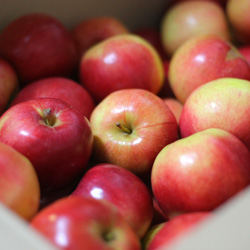 His lab in Kentville grows its own fruit, in collaboration with Agriculture and Agri-Food Canada. Their Apple Biodiversity Collection includes over 1,000 different varieties of apples, planted in duplicate, in a five-acre orchard. The lab itself contains a field component, a wet lab (molecular) and a dry lab called “The Hive” where the team analyzes the data by connecting to computer clusters around the world that assist with number crunching.
Dr. Myles’ work has generated international attention, and he’s always eager to connect both with the Nova Scotia farming community as well as with the general public.
“I’d love to have our lab contribute to improving apple and grape varieties around the world. It’s that possibility that excites me. I’m not one to overpromise and underdeliver, but the possibility of identifying all of a plant’s traits before it grows is incredibly cool, and I want Dal to be a leader in that field.”
For more on the Myles Lab, visit http://www.cultivatingdiversity.org/