

Christie Webb's fascination with firefighting began as a teen when she learned about it through her older brothers, who were both volunteers in their local fire department near Halifax.
She was so intrigued by their experiences that one evening she decided to stop by the department herself with an application. She was just 16 years old at the time.
"I fell in love with firefighting after my first training night," she recalls.
Christie promptly enrolled in a diverse youth first responder camp and, following high school, completed a Fire Rescue program at Memorial University. She volunteered in Kippens, a small village in Newfoundland close to where she studied, and later in Charlottetown, P.E.I.
Despite her drive, it took Christie nearly a decade to break into the profession in a more career-oriented role. Now 30, she’s been a career firefighter with Halifax Regional Fire & Emergency for three years and wants to support the next generation at a time when the sector is evolving and becoming more diverse.
I fell in love with firefighting after my first training night.
"There are more females in the fire service now. It's not just a male-dominant field anymore,” says Christie, who serves as co-chair of Halifax’s Fire Outreach and Inclusion Committee and an instructor with career and volunteer recruitment programs.

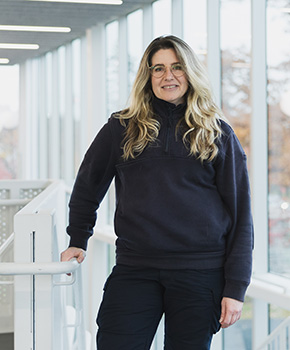
Christie Webb.
She applied to Dalhousie’s new Nova Scotia Fire Service Leadership Certificate to hone her leadership skills. Roughly 100 firefighters sought admission to the program and 43 were selected through a blind-evaluation process, with names, departments, gender and other information removed during assessment. Students were selected from all corners of Nova Scotia and range from young volunteers to experienced leaders in rural and urban departments.
Dal's Faculty of Open Learning and Career Development (OLCD) created the certificate to focus on the fire service context and needs in Nova Scotia. The provincial government funded enrollment for the program's first two cohorts, beginning in 2027.
The goal: to modernize fire departments at a time when fire-sector leaders are increasingly executives, HR professionals, culture-builders, communicators, and public-sector managers.
Learning beyond emergencies
If you ask instructor Les Karpluk, that evolution has been years in the making.
Karpluk, a retired fire chief with more than 37 years’ experience and two decades of teaching with Dal's fire service program, says fire leaders today must build public trust in their services and develop a workplace culture that encourages both retention and recruitment.
"If your fire department has a good reputation, you're not going to have a recruitment problem. But if your fire department has reputation problems, you're going to have a retention problem," he says.
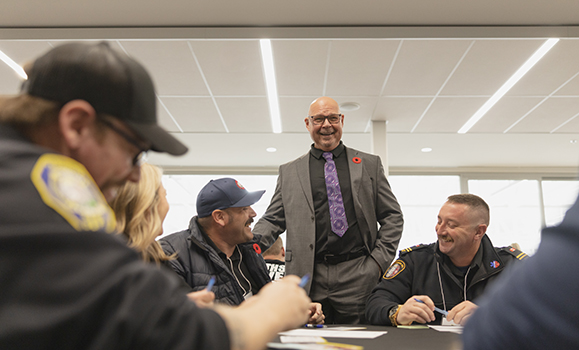 Les Karpluk, centre, chats with incoming students in the fire leadership program.
Webb says she’s seen firsthand how leadership style can impact both emergency response and workplace culture.
It was the way he said, 'You guys are it. I want you guys to get the experience that you need because you haven't really been exposed to it.'
A few months ago, a call came in about a chemical spill in a busy area of Lower Sackville. Rather than tapping one of the Halifax's more experienced hazardous materials (hazmat) units, the chief managing the scene called up Webb’s less experienced Fall River team that had been keen to develop its hazmat skills.
"It was the way he said, 'You guys are it. I want you guys to get the experience that you need because you haven't really been exposed to it.' His leadership style and the way he went about it, I'm like, 'Okay, that's a good leader. That's who I want to be.'" she recalls.
Learning through experience
In small volunteer departments such as the one in which student Wayne Skinner serves in rural southeastern Cape Breton, leadership often means having a more collaborative mindset.
Skinner, a 25-year volunteer, says resources can be tight during incidents as they were at a recent fire at a seniors’ residence. First on the scene in his personal vehicle, Skinner took charge of the early response.
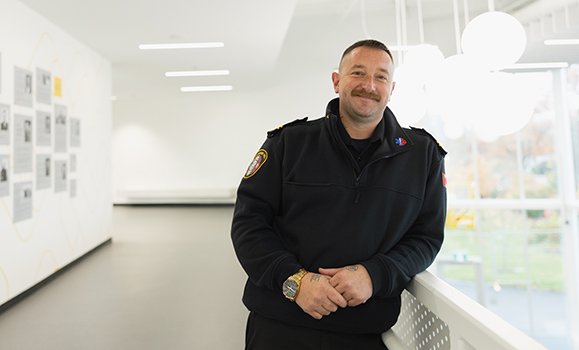
Wayne Skinner.
Other volunteers arrived shortly thereafter as did the deputy fire chief, who took over command from Skinner. With help from two other neighbouring departments, the firefighters evacuated the residents, contained the fire to the furnace room, and saved the building.
As Skinner puts it, “Building’s still standing.”
He says he’s looking to mentor new members coming in and build trust and an enthusiasm for training, all while recognizing the importance of humility in leadership.
“You’ve got to have respect for the members, new members, senior members. Your idea's not always the right way,” he says.
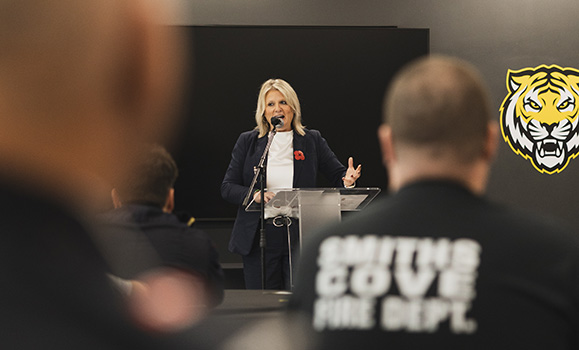
The Honourable Kim Masland, Nova Scotia's Minister of Emergency Management speaks to incoming students at Dal.
Preparing who's next
In Shelburne County, in southwestern Nova Scotia, Dwayne Hunt and Jennifer Bell offer a compelling example of the power of intergenerational mentorship in the fire service.
They both now serve in senior leaderships roles in the county’s two municipalities, Hunt as fire services coordinator in Barrington and Bell as administrator of protective services in Shelburne across the river.
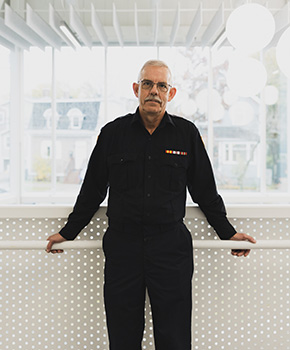
Dwayne Hunt, left, and Jennifer Bell.
Years ago, Bell took an interest in leadership when she was a volunteer member on Hunt’s Barrington team. She says the supportive culture there made a huge impression on her, motivating her to pursue training and grow in her career.
Now a leader herself, she sees a greater need to prioritize succession planning.
"We need to train who's going to replace us, not be so irreplaceable that we don't know who's going to fill that void,” she says.
We need to train who's going to replace us, not be so irreplaceable that we don't know who's going to fill that void.
Even Hunt, who spent 35 years as a volunteer and is well-versed in municipal finance and operations, remains committed to learning. He says he’s particularly interested in broadening his human resources skills, calling fire service “a never-stop learning profession.”

Fire service professionals share ideas during a program launch at Dal earlier this month.
Instructor Karpluk’s aim will be to ensure each student in the certificate program emerges with the well-rounded skills needed to lead effectively in today’s fire service.
"The job is not just putting out fires,” he says. “The job is prevention as well and being part of the community."