

It's Convocation season at Dalhousie, with hundreds of graduates crossing the stage Oct. 20 and 21 in Halifax. Meet one of our newest grads, Phillip Jackson.
Learn more about Convocation and view webcasts of all the ceremonies at dal.ca/convocation
Phillip Jackson is one of 36 students in Dalhousie's first Africentric Bachelor of Social Work Cohort, all of whom graduated on October 20, 2026.
In 2023, it was announced that the Province and Dalhousie University would invest in training to help address under-representation of Black/African Nova Scotians in the social work field and ease pressures on the healthcare and social service systems. The Africentric Bachelor of Social Work (ABSW) program was funded through a generous partnership among the Department of Advanced Education, the Department of Health and Wellness, the Department of Opportunities and Social Development (then Community Services) and Dalhousie’s Faculty of Health.
On Tuesday, October 20 all 36 students in the cohort crossed the stage to receive their degrees, including Phillip Jackson of Toronto, and Nova Scotia’s Krista Drummond, both of whom have secured jobs in social work in Nova Scotia. This is Phillip's story.
Social work in action
Growing up in Toronto's Jane and Finch neighbourhood, Phillip Jackson saw social work in action long before he knew it would eventually be his calling. His family made dinner for a man who was unhoused. Friends shared with him when he went without. Those small acts of kindness made him want to give back to the community that raised him.
"I wanted to make a difference and challenge the dominant negative narrative of my neighbourhood," he says. "Essentially, I saw and experienced aspects of social work, although I did not know what it was at that time."
On October 20, Jackson crossed the stage at Dalhousie University as one of the first graduates of the Africentric Bachelor of Social Work (ABSW) Cohort. Three years ago, 36 Black and African Nova Scotian learners sat down together for the first class of a program unlike any other in Canadian social work education and now all will graduate together.
That full retention rate is a milestone in itself. The part-time pilot was designed to remove the barriers that keep many Black learners out of the profession, and to build a social work sector that reflects and understands the communities it serves.
"When I think about the people and circumstances that made this opportunity possible, it reminds me of the strength of my ancestors, who endured generational hardships and made countless sacrifices so their dreams could continue through me. Crossing the stage is beyond words." — Phillip Jackson, ABSW Class of 2026
A career focused on helping and community
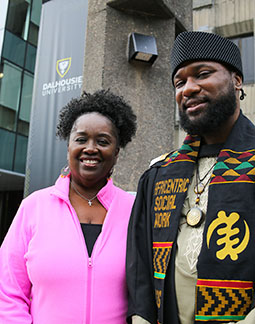 Jackson lived in Jane and Finch until he was 13, then in Rexdale until he was 32. In both communities, he saw how poverty, crime, drugs, gangs and over-policing shaped daily life for people of African ancestry. He also saw neighbours come together to support one another through hard times.
Those experiences pointed him toward a career focused on helping and community, but it was a family member who named the path. Several years before the cohort began, his aunt Kimberly Bernard, a social worker, sat him down to talk about the profession.
Right: Phillip with his aunt at his Convocation ceremony Tuesday.
"Aunt Kim first planted the thought of being a social worker in my head. I remember our discussion vividly," Jackson says. "She shared her thoughts about social work and highlighted why she felt I would be good, and needed, in the profession."
Learning together, as a community
Cohort-based learning meant all students moved through their courses together, as a group, for three years. They learned from Dalhousie faculty members of African Nova Scotian and African ancestry, using a curriculum developed by a community-based advisory committee.
For Jackson, learning through an Africentric lens was "comforting and empowering." Students explored cultural and spiritual approaches to social work practice, including the principles of Nguzo Saba, Ubuntu, Sankofa and Ma'at, and examined how those principles challenge Eurocentric practices.
"By challenging Western norms, we learn to apply a social work framework that is more holistic, client-centred and culturally affirming," he says.
It was also the first time Jackson had been in a classroom that treated lived experience as a form of expertise. "I experienced a sense of safety, validation and a sense of belonging," he says. "In other learning spaces, we constantly had to explain and defend our experiences as people of African ancestry."
What stays with him most is the cohort itself. His classmates came from across the African diaspora, including African Nova Scotian, Caribbean and continental African students, and over three years they became something closer to family.
"I genuinely have love for the cohort and admire the love they gave me and each other. This same love offered peace, healing and support, and created a sense of family. Within education, I never knew love like this before and experiencing it will always be close to my heart."
A program built to remove barriers
The program’s part-time schedule made it possible for many mature students, often balancing jobs and families, to complete a degree they might otherwise have set aside. The program also reached beyond Halifax. Six of the 36 students live in rural communities, and classes were held both on campus and in the community at the Delmore "Buddy" Daye Learning Institute.
In the cohort's second year, a mentorship program was added to connect students with support from outside the classroom. It has given students guidance from practitioners and community members as they moved toward the profession.
The results are already showing up in the field. Several students have secured new jobs in social work since starting the program, bringing an Africentric lens into agencies and organizations across the province. Jackson is one of them. Throughout his studies he worked as an African Nova Scotian Student Support Worker with the Halifax Regional Centre for Education. Having completed his degree requirements, he has now joined Anchor Youth Space in Halifax's North End as its Community Outreach Worker.
A shared achievement
The ABSW Cohort is a partnership between Dalhousie University and the Province of Nova Scotia, through the Department of Opportunities and Social Development, the Department of Health and Wellness, and the Department of Advanced Education. Dalhousie's Faculty of Health and many community organizations and agencies have also contributed to the cohort's success.
The curriculum was shaped by a community-based advisory committee. It includes the African Nova Scotian Decade for People of African Descent Coalition; the Delmore (Buddy) Daye Learning Institute; Dalhousie's School of Social Work, Faculty of Health, Transition Year Program, African Nova Scotian Community Engagement, and Promoting Leadership in Health for African Nova Scotians; the Association of Black Social Workers; the Nova Scotia College of Social Workers; the Africadian Empowerment Academy; and the provincial partner departments.
Jackson is quick to credit that community. "I am forever grateful to my people and my community, especially the African Nova Scotian community, for creating the opportunity for me to graduate," he says.
For Jackson, graduation is a beginning. He plans to pursue a Master of Social Work, and he is already thinking about how to put his skills to work for the people who supported him.
"My community paved the way for me to get my degree. I look to pay it forward by giving back."