

As kids, Kristian Lethbridge-Hall (BEng’23) and Maria MacDonnell (BEng’25) were fascinated with space — and inspired by Canadian astronaut Chris Hadfield. Now, they both work at Galaxia, a Halifax-based company that designs and builds intelligent satellites for space missions.
Kristian grew up with “the whole Chris Hadfield craze” and wanted to be an astronaut. He says that interest eventually dwindled, but doing his Electrical Engineering co-ops at Galaxia, and later being hired by the company “reignited” his passion for space. Today, he is Galaxia’s vice-president of engineering, running projects across a number of disciplines.
Meanwhile Maria, an electrical engineer in training at Galaxia, also grew up with a strong interest in space and “at least flirted with the idea of being an astronaut.” At 15, while living in P.E.I., she wrote the winning entry in an essay contest. The prize? Meeting Chris Hadfield. (“We talked about playing guitar in space, and he gave me a guitar pick,” she recalls.)
Building smart satellites
Galaxia was founded in 2020, by Dalhousie University Mechanical Engineering alumnus Arad Gharagozli, with the goal of designing and building satellites that are “intelligent systems that could process information in space, make decisions, and respond instantly to what they see,” Arad said in a May 2025 interview. “We didn’t just want to send satellites into orbit — we wanted to give them a mind of their own.”
Kristian started at Galaxia as a co-op student in late 2020, just two months after the company had been founded. One of the reasons he returned for his later co-ops was the combination of training and responsibility it offered.
There's not a lot of opportunity for space technology in Nova Scotia, so having the opportunity to work in space tech — that's what I really liked.
“I felt a lot of ownership over what I was doing, and I felt a lot of respect in how I was working. I wanted to keep coming back because I really felt like what I was doing was important to the company, and I was also learning a lot,” he says. “There's not a lot of opportunity for space technology in Nova Scotia, so having the opportunity to work in space tech, do something I'm interested in, and then having that kind of autonomy at 19, 20 years — that's what I really liked.”
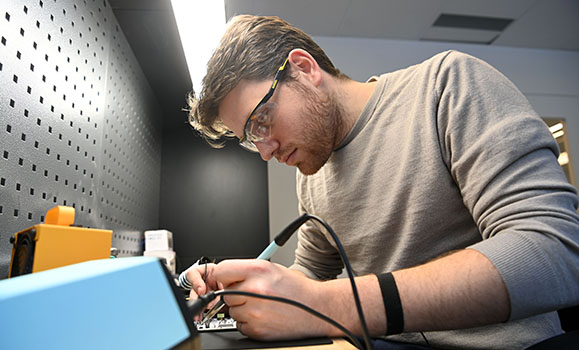
Today, Kristian supervises co-op students, and he wants to make sure they get the same opportunities he had to work independently and make real contributions. “The philosophy that we try and carry on is giving co-op students a ton of responsibility from the top. Obviously, there's training and everything that goes along with that, but we really value letting people take control of a project, learn in their own way, and approach problems in their own way,” he says.
That fits with Maria’s co-op experience at Galaxia. “I really had an interest in embedded systems, and Arad essentially let me fall into a role that matched my curiosity for embedded systems, and programming, and the electronic side as well,” she says. “It was a really special and unique thing, being able to pick what I worked on, but also being given the freedom and the trust to approach it however I liked. It was very freeing, because I felt like there were no restrictions on whatever approach I wanted to take.”
A future in space
After she graduated in Electrical Engineering from Dal in 2025, she was hired by Galaxia, where she continues to work in embedded systems — a field she describes as “the place where software and hardware meet.”
One of the projects she’s working on is building a networking layer for Galaxia satellites. It “allows all the different computers to talk to one another over a standardized interface, and then communicate with different computer peripherals,” she says.
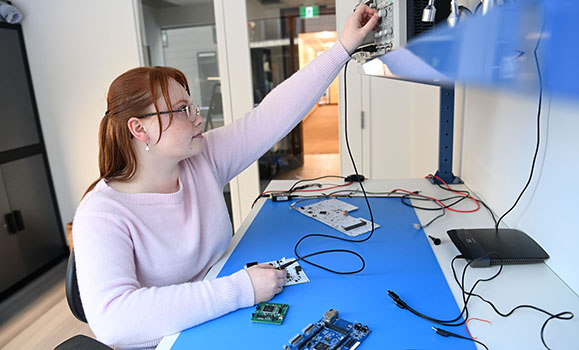
Kristian adds, “making sure everything can talk to itself internally, and then can also talk to other parts of our satellite, whether it be the camera or the antennas or anything like that — the communication systems.”
When Kristian started at Galaxia, he was one of the first employees. Now, the company has grown to nearly two dozen staff, many of them Dalhousie Engineering grads. And it continues to offer co-op opportunities to Dal students.
“We've found a lot of value out of Dalhousie's co-op program specifically,” Kristian says. “Three new co-op students from Dal just started at Galaxia, and they are going to be with us for the next eight months. We find a lot of value there.”