

What started as an idea around a grant proposal is now taking shape in the form of 20 wooden nesting boxes that could support research, conservation, and hands-on learning at Dalhousie’s Agricultural Campus.
The idea came from Dr. Paul Manning, an entomologist interested in how insects connect to the wider health of ecosystems. While planning a research project exploring the relationship between insects and birds that feed on them, Paul realized the campus could offer an ideal place to study those connections.
“Voila… the seed of an idea was born,” Dr. Manning says.
Tree swallows are aerial insectivores, meaning they catch flying insects for food. With open areas and foraging habitat near the Salmon River, Dr. Manning saw an opportunity to provide nesting habitats while creating new opportunities for research and education.
Hands-on learning for Shad students
The office of Community Education helped turn the idea into a hands-on experience when Shad students visiting campus were invited to build the boxes. Shad is a prestigious, month-long summer enrichment program in Canada for high-achieving high school students in grades 10 and 11. The curriculum heavily integrates STEAM (Science, Technology, Engineering, Arts, and Mathematics) with entrepreneurship, leadership, and hands-on real-world design
The students worked together in the woodshop, learning to use tools, solve problems collaboratively, and create something that will remain on campus long after their visit.
Community Education Manager Jessica Fogarty says the students quickly became invested once they realized their work would become part of an ongoing project.
“There was a real sense of ownership and curiosity,” she says.
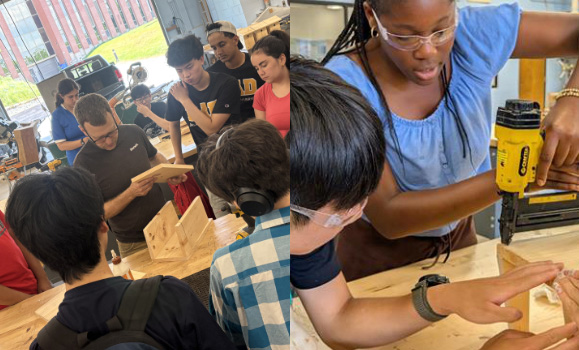
For Senior Instructor Chris Nelson, who led the Shad students during their time in the woodshop, that enthusiasm was one of the highlights of the experience.
“They actually surprised me in that many had limited shop skills but were far from timid and in fact were keen to get stuck-in and learn,” he says. “It took everything I could do to keep up with them.”
Connected learning
The project also gave the students a chance to see how different areas of learning can come together. Biology, environmental science, engineering, and community education all play a role in creating and studying the nesting boxes.
For Nelson, that is part of what makes hands-on learning experiences so valuable.
“Students can see a creation materialize in front of them and they almost don’t realize they are learning,” he says. “There’s a lot of satisfaction that comes from making something tangible, and they acquire physical and mechanical skills that are invaluable in many areas of life.”
The boxes are only the beginning. Once installed around campus, they will provide great opportunities to collect data on tree swallow activity, including arrival dates, occupancy rates, and the number of fledglings. The hope is the project will support lesson plans that help K-12 students explore the connection between farming and the health of the wider environment.
A long-term resource
Fogarty sees the boxes becoming a long-term resource for both research and community education, with future opportunities for 4-H clubs, Girl Guides, school groups, Shad students, and campus visitors to participate in bird monitoring and biodiversity activities.
“The boxes can become an outdoor classroom where students participate in real scientific observation and see how research is conducted over time,” she says. “If these nesting boxes inspire youth to become future researchers, conservationists, or agricultural leaders, then the project will have had a lasting impact.”
What happens next will unfold over the coming years, as the boxes become a living resource for research, education, and a deeper understanding of the campus ecosystem. Keep an eye out as the boxes are painted and installed across campus in the coming weeks.