

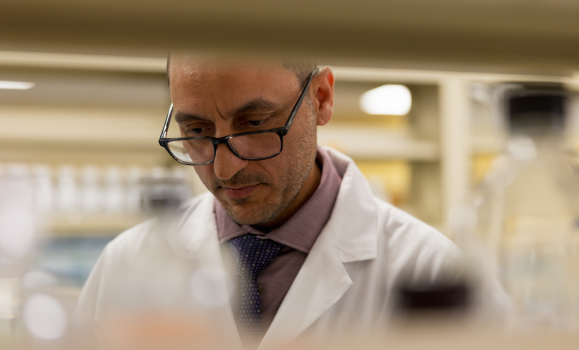
As a pediatric infectious diseases physician, Dr. Bahaa Abu-Raya has cared for infants hospitalized with vaccine-preventable illnesses. As a researcher, he has dedicated his career to understanding how to better protect them.
That commitment to translating clinical questions into real-world vaccine solutions has earned Dr. Abu-Raya the 2026 Gairdner Early Career Investigator Award, a prestigious international honour recognizing exceptional emerging leaders in biomedical research.
Dr. Abu-Raya was selected by the Gairdner Scientific Committee and then hand-picked by Gairdner laureates Drs. John D. Clemens and Jan Holmgren. He is recognized for research that helps reshape how vaccines are used to protect some of the world's most vulnerable populations. His research focuses on maternal and infant immunization, vaccine development, and the immune responses that protect against infectious disease.
This recognition confirms that the work we are doing is important and has the potential to transform vaccinology research.
When he learned he had been selected as a recipient, he reread the email several times before believing the news.
“I was honoured and humbled,” says Dr. Abu-Raya, a clinician-scientist and researcher at the Canadian Center for Vaccinology (CCfV) in Halifax. “This recognition confirms that the work we are doing at the CCfV is important and has the potential to transform vaccinology research.”
Protecting infants before birth
Over the last decade, a major focus of Dr. Abu-Raya's research has been maternal pertussis immunization. Because newborns have the highest risk of severe complications from pertussis — more commonly known as whooping cough— but are too young to be vaccinated themselves, immunization during pregnancy helps provide protection by transferring antibodies from mother to baby before birth.
Dr. Abu-Raya and his colleagues helped demonstrate that administering the pertussis vaccine early in the third trimester produces a stronger immune response and greater antibody transfer than the previously recommended timing. Their findings, later confirmed by research groups in the United States and Australia, helped establish early third-trimester immunization as the optimal approach and continue to inform vaccination policies worldwide.
Building on that work, Dr. Abu-Raya is now applying the same approach to another major threat to infant health: respiratory syncytial virus or RSV, the leading cause of respiratory-related hospitalizations among Canadian infants. Through a recently announced Canadian Institutes of Health Research (CIHR) grant, he is leading a multicentre clinical trial to determine whether RSV and pertussis vaccines administered during the same prenatal visit are as safe and effective as when they are given separately.
“As a clinician, again and again I saw babies suffering from whooping cough, and today, I still see babies suffering from RSV disease,” he says. “If we have vaccines available, we need to understand how to use them most effectively to provide the greatest protection.”
While pertussis vaccination during pregnancy has been recommended in Canada since 2018, maternal RSV vaccination was only introduced in 2024, creating new opportunities to protect infants against two serious respiratory infections before birth. Administering both vaccines during a single visit could simplify care, improve uptake, and reduce health system costs, but researchers do not yet know whether giving them together affects their efficacy.
As a clinician, again and again I saw babies suffering from whooping cough.
Funded through CIHR's highly competitive randomized controlled trials program, the study will bring together research sites in Halifax, Vancouver, Winnipeg, Ottawa, and Montreal. The findings are expected to inform vaccination guidelines in Canada and internationally.
“We now recommend more vaccines than ever before, but we still do not fully understand how these vaccines interact with one another when given during pregnancy,” says Dr. Abu-Raya. “This new project will help us answer some of those questions.”
Preparing for future pandemics
Though much of Dr. Abu-Raya's research aims to answer translational questions related to vaccination during pregnancy and early life, the same approach can be applied to pandemic preparedness.
“The same tools can help us understand which antibodies are protective against bird flu and this knowledge can be used in a clinical trial taking place in Halifax and across Canada co-led by Dr. Joanne Langley and myself,” he says. “We can use these methods to determine the best dosing intervals between bird flu vaccines and whether additional doses are needed.”
For Dr. Abu-Raya, that work is about ensuring public health systems are better prepared for future threats before they emerge. By generating evidence on optimal vaccination strategies in advance, researchers can help guide decision-making when a new pandemic arises.

“We do the science today and hope we never need it,” he says. “But if a pandemic does happen, we will be ready. We will have evidence-based guidance available to help inform decisions and protect populations more effectively.”
Collaboration and global impact
Dr. Abu-Raya credits the advances to collaboration with colleagues. At the heart of his work is a simple goal: to make a meaningful difference in people's lives through research.
“That is one of the most rewarding aspects of science,” he says. “You can conduct research in Halifax, but people across the world can benefit from the knowledge and discoveries that result from it.”
This fall, Dr. Abu-Raya will join fellow Early Career Investigator Award recipients and 2026 Gairdner laureates at Gairdner Science Week, an opportunity to learn from and collaborate with some of the world's most influential scientists.
“I am looking forward to connecting with leaders in vaccinology, learning from their experiences, and building lasting relationships with them,” he says. “The global impact of their work has been extraordinary.”