

Dalhousie joined universities and businesses last week in signing a new Atlantic Canada Prosperity Charter — a commitment to expanding work-integrated learning opportunities for students and helping address the region's workforce needs.
The initiative was co-launched by the Association of Atlantic Universities (AAU) and the Atlantic Chamber of Commerce (ACC) at a luncheon Wednesday (July 15) at Pier 21 in Halifax.
The charter commits signatories to championing university talent, building stronger pathways between students and employers, strengthening university-business collaboration, and aligning more closely on workforce priorities and skills needs.
Dalhousie President Kim Brooks signed the charter on behalf of Dalhousie, saying it recognizes that the Atlantic region’s long-term prosperity depends on universities, businesses and governments working together.
"Dalhousie is proud to be an active partner in connecting student learning with the needs of employers and communities across Atlantic Canada,” she says. “Work-integrated learning gives students the experience, confidence and relationships they need to build meaningful careers here, while helping employers develop the talent they need to grow.”
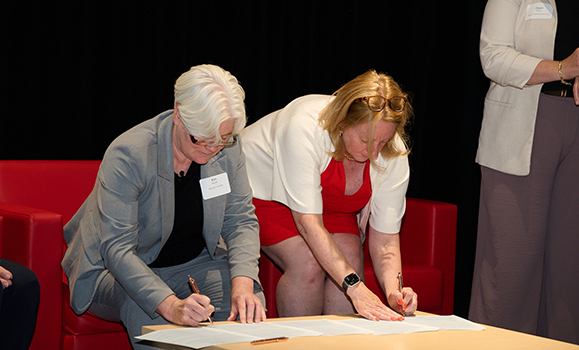
President Brooks, left, signs the Prosperity Charter.
President Brooks also participated in a panel with Mark Patterson (executive director of Magnet), Ifeanyi Emesih (founder and chairman of My East Coast Experience) and Dalhousie Engineering student Kirsten Griese, who is currently completing a work term with the Halifax International Airport Authority’s Planning & Development Department.
Moderated by Rhonda Tulk-Lane, ACC president and CEO, the panel discussed the role of work-integrated learning opportunities (like co-ops) in helping more students enter the Atlantic Canadian workforce.
Working alongside experienced professionals who encourage me to ask questions has given me the confidence to take on new challenges.
"My co-op experience has bridged the gap between the technical knowledge gained in the classroom and the professional skills developed in the workplace," says Griese, who is heading into her fourth year of a Bachelor of Engineering in Civil Engineering. "Working alongside experienced professionals who encourage me to ask questions has given me the confidence to take on new challenges."
Deepening efforts
Dal's signing of the charter signalled a deepening of its long-standing commitment to work-integrated learning, which stretches back decades to when it offered its first co-op programs in 1969.
Since then, Dalhousie has vastly expanded the opportunities available to its students. Dal students completed 2,864 paid work terms during the 2025/2026 academic year, up nearly 4 per cent year over year — more than any other academic institution in Atlantic Canada.
Co-op, internships, and work-experience programs are now offered in 31 programs across five Faculties and one college.

The benefits of work-integrated learning are felt by students and employers alike. Students gain work experience while building agency, professional networks and workplace skills & competencies. Employers gain access to emerging talent, leadership development for junior employees supervising co-op students, and can reduce onboarding costs when students move into roles post-graduation, which happens frequently.
Most of Dalhousie's opportunities are facilitated through two units: Work-Integrated Learning & Co-operative Education (WIL -Co-op) and Management Career Services (MCS). About 70 per cent of work terms organized through WIL Co-op and about 55 per cent of MCS opportunities were based in Nova Scotia, according to data from the 2024/2025 academic year. Similar numbers are expected for the most recent year.
Renewed momentum
The launch of the Prosperity Charter this week provides renewed momentum to help students build meaningful careers while ensuring Atlantic Canadian employers have access to the talent they need to grow.

"The majority of our graduates remain in the region and enter the workforce here," says Dr. Andrew Hakin, chair of AAU. "Through a variety of experiential learning opportunities, universities partner with employers to ensure graduates are well prepared for employment.”