

For years, scientists studying bowhead whales have relied on a simple idea: if a whale makes a long, square or U-shaped dive, it’s feeding time. A new study demonstrates that assumption may not hold water.
Using high-resolution biologging tags equipped with video cameras, researchers from Dalhousie tracked the whales in the Arctic and discovered that dive shape alone could overestimate feeding activity. Instead, the clearest signs of feeding came from something far subtler: changes in speed, body angle, and movement.
The findings, published in the recent study “Bowhead whale foraging dives are defined by speed and body orientation” in the journal PLOS One, offer a new, close-up look at how one of Earth’s largest animals hunts in an Arctic ecosystem being rapidly reshaped by climate change.
This changes how we identify when bowhead whales are actually feeding.
“This changes how we identify when bowhead whales are actually feeding,” says senior author Dr. Sarah Fortune, who studies whale ecology and conservation at Dalhousie. “A whale can make the kind of dive we’ve traditionally associated with foraging and not be feeding at all.”
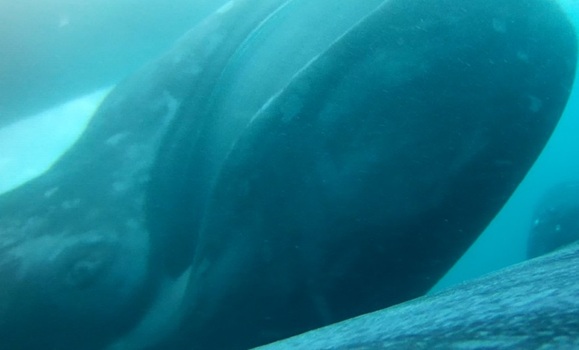
A bowhead with its mouth open.
To capture the data, Dalhousie graduate student Manon den Haan, Dr. Fortune and a team of researchers, attached sophisticated sensor tags with cameras to bowhead whales in Cumberland Sound, Nunavut. The tags recorded depth, spatial positioning, and three-dimensional movement, while the cameras caught the corresponding swimming paths underwater, allowing scientists to match whale behaviour with body mechanics.
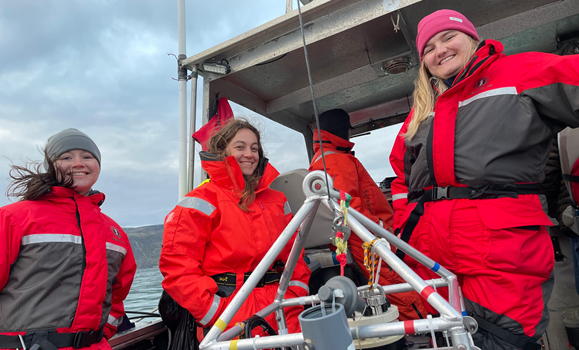 From left to right: Conor Mackie (Dartmouth Ocean Technologies), Hayley McLennan (University of St. Andrews) and Manon den Haan (Dalhousie University), a lead author on the study, getting ready to deploy the oceanographic cage to collect images of zooplankton, measurements of physical ocean conditions and eDNA samples.
While various movements had been theorized as part of baleen whale feeding behaviour in previous studies, the Dalhousie team were the first to confirm it with video and kinematic data.
Their research provides the first visual documentation of the range of feeding movement, allowing people to see how feeding whales slow down, tilt slightly downward and roll subtly to the side as they filter prey-rich water through their baleen.
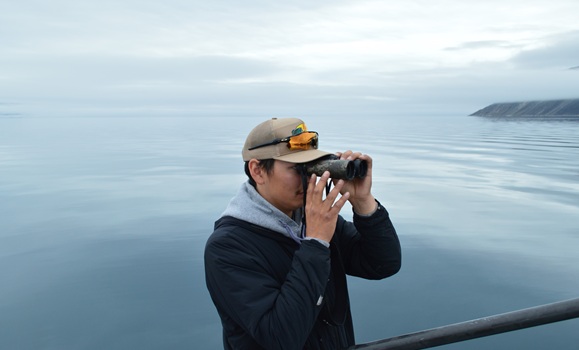
Inuit partner and co-author Eric Kilabuk looking for bowhead whales. (Image taken by Sarah Fortune)
The team also discovered a previously unknow variation in the whale’s swimming behaviour, documenting for the first time that they swim faster in the shallows than in deeper waters to combat the tides. They additionally found that many whales were feeding surprisingly close to the surface in shallow, tide-driven prey layers, not only in the deep dives scientists once thought defined bowhead foraging.
If we have a better foundational knowledge on how bowhead whales move, we can accurately calculate their feeding efforts as well as their energy expenditure.
“If we have a better foundational knowledge on how bowhead whales move, we can accurately calculate their feeding efforts as well as their energy expenditure,” says den Haan. “This will help in understanding their survivability in the ever-changing Arctic.”
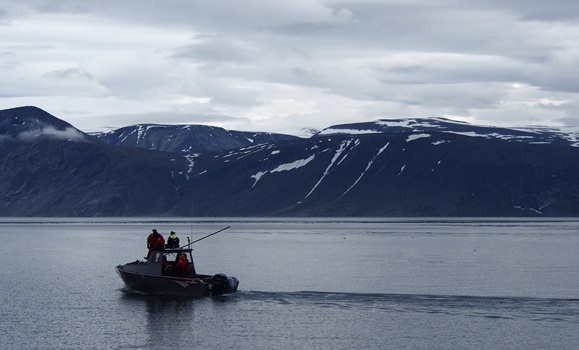 The research team’s vessel in Cumberland Sound, NU (Image taken by Rhyl Frith)
They note that these new findings matter because bowhead whales depend on dense patches of tiny zooplankton to survive. As warming Arctic waters disrupt where that prey gathers, scientists need to understand how whales feed and whether they can still find enough food.
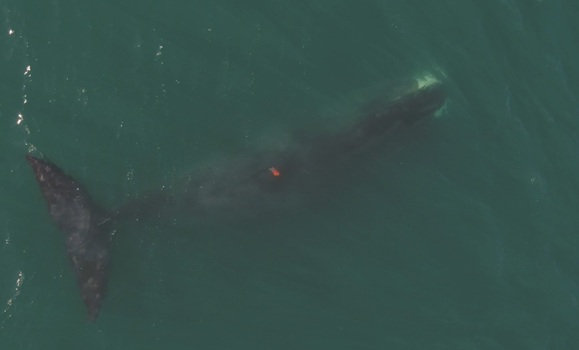
Drone picture of bowhead whale with tagged with Customized Animal Tracking Solutions tag. (Image taken by Katherine Pyne)