

The concept behind Dalhousie’s annual robotics design competition may seem simple at first: build a rig that can navigate a physical course on its own with no remote controls or second chances.
In practice, however, the process is far more complex. Teams of third-year students from electrical and computer engineering spend weeks designing, coding, and building their robots, testing every variable in the hopes of coming out on top.
On the day of the competition, weeks of preparation are reduced to a single performance.
“We had to severely limit our scope of what we could do,” said participant Alexandre DesAulniers, describing the constant negotiation between ambition and feasibility.
The Peter Gregson Robotics Design Competition, now in its 34th year, provides a unique testing ground for students in the Faculty of Engineering where theory and a semester of late nights in the lab meet in a hands-on way.
Robots face the course
This year, 22 teams competed in the challenge on Wednesday (April 25), each bringing a different approach to the same problem. Performances are judged on whether a robot functions and how effectively it accomplishes the goal of completing the course.
Hopeful anticipation filled the air in the Richard Murray Design Building at last week’s competition as the student teams waited for their turn to compete in this year’s contest. Some hovered over laptops and checklists, making last-minute adjustments with their eyes fixed on machines carrying weeks of effort in their circuitry.
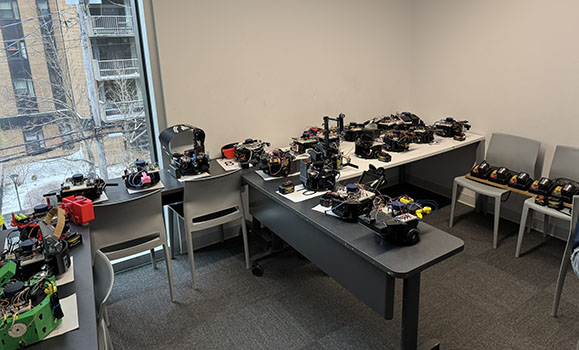
Student designs.
Teams were awarded points for each task their robot could complete. These included whether the robot could reach its target location, pick up and drop off the cargo within the course, and if it could do so in under 3 minutes.
One by one, robots were placed at the starting line. Some drifted forward, using LiDAR sensors to avoid the walls of the maze. Others hesitated, veering off course, revealing last-minute issues that cost the students points.
According to the final standings, the top three teams all finished with a score of 90 per cent, with placement dictated by completion time.
- First place: Team 18 A.N.C.H.O.R. — 1 minute, 19 seconds
- Second place: Team 15 Dave — 1 minute, 26 seconds
- Third place: Team 17 Dr. Eggman — 2 minutes, 59 seconds
Winning teams were rewarded with cash prizes, recognizing both technical achievement and execution. First-place received $50 per student.
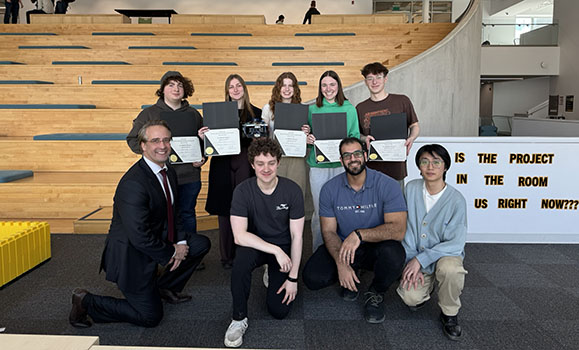
The winning teams from this year's competition.
More than winning
Liam Berthiaume, a third-year electrical engineering student, explained that even though they knew of the issues their robot faced, they “were unable to complete certain criteria under the time constraints of the semester.”
His team's robot, the Black Puuuurl, appeared promising at first, but failed to rescue the object placed in the course that would have granted them more points.
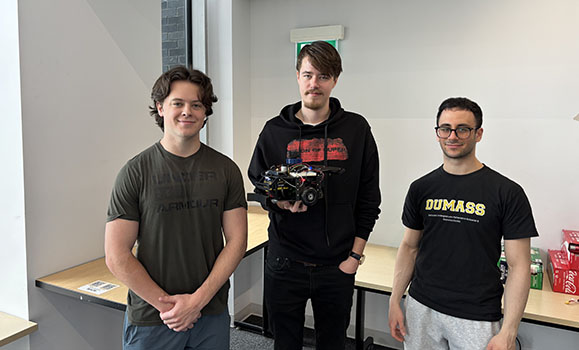
The student team behind Black Puuuurl.
For many participants, the competition itself offered more than just a chance to test their skills, it provided a glimpse into the future of their engineering careers.
Liam said the challenge “reinforced practices that are harder to experience from additional coursework.” Meanwhile, Alexandre said the challenge aligned well with industry standards he expects to see after graduation.
Although their designs failed to place in the top three, Alexandre and Liam’s teams were able to learn important lessons from making their designs functional. They, like the other participants, left not just with a new experience, but with a deeper understanding of what engineering demands.