

What if every farm animal had a digital twin that could anticipate illness, interpret behaviour, and even estimate climate‑damaging methane emissions before they rise?
That is the challenge at the centre of Digital Livestock Intelligence: AI-Driven Digital Twins for Planetary Food Security and Animal Consciousness, an upcoming international workshop led by Dalhousie's Dr. Suresh Raja Neethirajan under the Canadian Institute for Advanced Research’s Arrell Future of Food initiative.
The workshop — happening March 2-4 in Calgary — brings together global research leaders in AI, animal behaviour, systems engineering, environmental accounting, and ethics to brainstorm how artificial intelligence can transform livestock farming. The goal of the workshop is ambitious and practical: build the blueprint for intelligent, climate-smart livestock systems.
If we want resilient food systems, we must move beyond isolated data streams.
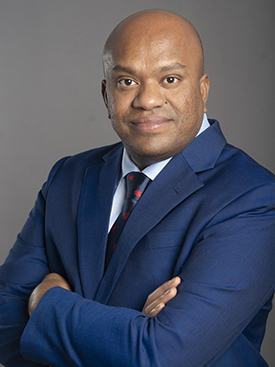
“If we want resilient food systems, we must move beyond isolated data streams,” says Dr. Neethirajan, Dalhousie University Research Chair in Digital Livestock Farming. “Digital livestock intelligence connects animal health, farmer decision-making, and climate accountability into one integrated framework.”
More than a monitoring tool
Digital twins are dynamic virtual replicas of real-world systems that update continuously using live data. They are widely used in aerospace and manufacturing. Now, researchers are adapting them to living biological systems.
 In livestock production, that means integrating barn sensors, sound patterns, thermal imaging, behavioural signals, and methane measurements into intelligent computational models that mirror individual animals and entire farms in real time.
“A digital twin is not just a monitoring tool,” says Drl Neethirajan, as associate professor cross-appointed to the Faculties of Agriculture and Computer Science. “It is a learning system. It interprets signals, predicts risks, and supports better decisions that improve animal welfare and environmental outcomes.”
The workshop agenda moves from foundational questions to frontier debates. What does a digital twin truly mean in a living system? How do we translate raw multimodal data into meaningful welfare insights? Where can livestock AI fail, and how do we guard against bias and overreach? What are the moral implications of modelling animal consciousness? How do we build trust, governance, and green AI frameworks that account for methane and climate impact?
Supporting responsible innovation
Participants will also visit a working dairy farm to see how theoretical discussions fit into real-world production realities.
CIFAR’s Arrell Future of Food initiative supports bold interdisciplinary collaborations that address global food system challenges. Dalhousie’s leadership of this workshop positions the university at the forefront of a rapidly evolving field that merges artificial intelligence, agriculture, and planetary sustainability.
The objective is not abstract speculation. It is responsible innovation.
Dr. Neethirajan’s research focuses on multimodal machine learning and trustworthy AI systems designed for high-stakes environments. In agriculture, those stakes include food security, animal welfare, and greenhouse-gas mitigation.
"The objective is not abstract speculation. It is responsible innovation," says Dr. Neethirajan.