

A new partnership between Dalhousie and two of India’s elite research institutions will create a flagship innovation campus linking graduate training and research with industry to drive innovation and expand market opportunities for Canada and India.
The Tirupati Tri-Institutional Global Innovation Campus will be established in the eastern Indian city of Tirupati, close to the existing campuses of IIT Tirupati and IISER Tirupati — Dal's counterparts on the initiative.
The campus will be developed in phases over the next decade starting with collaboration on programming and industry sponsorship and scaling towards shared physical spaces.
“We’re proud to be working with exceptional partners in IIT Tirupati and IISER Tirupati to build a collaboration that connects research, talent, and industry in ways that support shared prosperity in both Canada and India,” said Dalhousie President Kim Brooks.
Plans for the collaborative research campus were announced Saturday afternoon in Mumbai at an event with Canadian Prime Minister Mark Carney and Minister of Foreign Affairs Anita Anand. Dalhousie and three other U15 universities (UBC, U of T, and McGill) were invited to join the prime minister’s delegation, which is seeking to build deeper economic ties between the two countries.
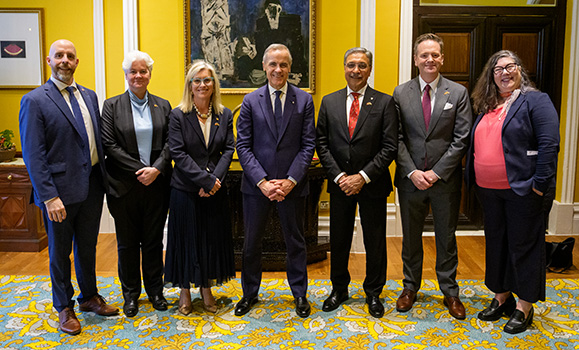
University leaders with Canadian Prime Minister Mark Carney. L-R: Benoit-Antoine Bacon, UBC President; Kim Brooks, President and Vice-Chancellor of Dalhousie Unviersity; Melanie A. Woodin, President U of T; The Right Honourable Mark Carney, Prime Minister of Canada; Deep Saini, President and Vice-Chancellor McGill; Gabriel Miller, President and CEO of Universities Canada; and Pari Johnston, President and CEO of Colleges & Institutes Canada.
Accelerating innovation across borders
Each partner contributes distinct but reinforcing capabilities, enabling the campus to move ideas from fundamental science through applied engineering and into scalable solutions — supported by industry engagement, talent development, and pathways to global adoption.
The initiative will include the establishment of centres of excellence around areas of shared expertise, unlocking new opportunities across a range of sectors, including:
- clean energy, critical minerals and electric mobility
- digital and precision agriculture
- health technologies and biomanufacturing
- digital systems and applied AI
Highly skilled learners will gain access to industry-embedded professional master’s programs, co-supervised doctoral training, and executive education on the campus, which will also enable Canadian and Indian firms to find new opportunities to collaborate and access each other’s markets and supply chains.
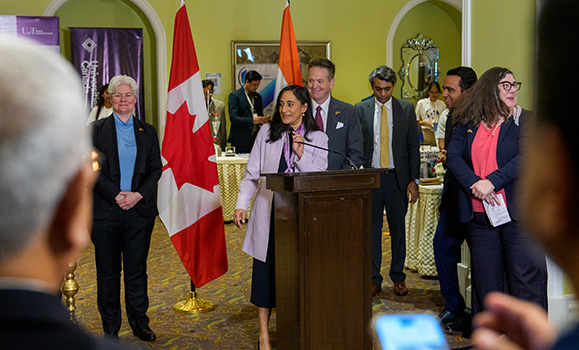
Minister of Foreign Affairs Anita Anand speaks during the event in Mumbai.
Innovation training will be embedded in graduate programming, and learners will have access to IP, regulatory and market-entry support as well as industry-sponsored applied challenges.
On the academic side, the partnership will enable joint-degree delivery and hybrid learning, executive and professional education, short courses and leadership programs, and faculty, student, and professional mobility.
Celebrating 100 years of relationship with new model

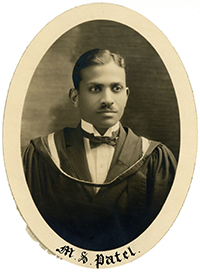 The partnership with IIT and IISER Tirupati comes a century after Dal first cemented its relationship with students from India. Manilal Shankerohai Patel (MD,CM 1926) and Simon Tholath Paul (MD,CM 1926), the first two Indian students to attend Dal, graduated as part of the medical school's Class of 1926.
Dal's post-secondary collaborations in India includes existing partnerships with 23 universities and nine joint-degree programs. Dal researchers have co-authored 429 publications with colleagues in 320 Indian institutions over the past five years alone.
What makes this new partnership unique, though, is that it moves beyond simple exchange, mobility, and co-authored research into a model of co-created, co-located two-way exchange. Additionally, the partnership is explicitly designed to bolster economic and innovation infrastructure and to support shared prosperity.
"IIT Tirupati is excited to build a collaborative ecosystem with Dalhousie University and IISER Tirupati that aligns innovation, research, and graduate education with industry needs for emerging global markets," says Dr. K. N. Satyanarayana, director at the Indian Institute of Technology (IIT) Tirupati.
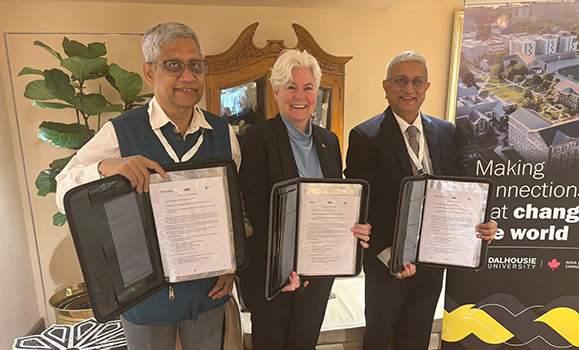 Signing ceremony for innovation campus. (Balakrishnan Prithiviraj photo)
Locating the campus in Tirupati enables better integration of science and engineering between the two Indian universities and offers immediate proximity to an international airport. Available land nearby will ensure plenty of space for pilot facilities, industry that might want to co-locate, and long-term expansion.
Dr. Santanu Bhattacharya, director of the Indian Institute of Science Education and Research (IISER) Tirupati, said the proposed campus marks a significant milestone in Indo‑Canadian cooperation aimed at advancing academic and research excellence.
He said the initiative will focus on areas of strategic importance to both nations and seamlessly integrate science, technology, and industry, nurturing young innovators as they grow into globally competitive scholars.
"The launch of this collaborative campus stands as a testament to the shared commitment of the governments of India and Canada to address global challenges through knowledge, innovation, and industrial partnership," he said.
New pathways for student mobility
Dal's collaboration with India will be further bolstered by a new $520,000 investment under the Government of Canada’s Indo-Pacific Scholarships & Fellowships for Canadians (IPSFC). Global Affairs Canada announced the funding on Monday, which which will enable more than 30 Dalhousie faculty, graduate students, and research personnel to build in-person research partnerships with leading institutions across the Indo-Pacific region over the next two years.
The project was developed in partnership with six of Dalhousie’s partner institutions in India and the Philippines — including IIT Tirupati — complementing the vision of the innovation campus. The first call for this funding envelope is planned for spring 2026.
Dalhousie also recently signed two Memoranda of Understanding (MOUs) with separate Indian institutions.
An MOU with the SRM Institute of Science and Technology commits to establishing a Nursing Dual Degree Program, including Indian Nursing Council-approved supernumerary seats, dual credentials, and embedded clinical experience in Canada. The commitment extends to academic cooperation, student mobility, and creating a pathway to nursing practice in Nova Scotia.
Meanwhile, an MOU with the Indian Council of Agricultural Research (ICAR) supports collaboration in digital agriculture, climate-resilient agriculture, horticulture, aquaculture, and animal husbandry. The agreement also focuses on joint research and broader academic cooperation across these priority areas.