

An article by a team of Dalhousie University researchers about the environmental assessments of Canadian mines has been named FACETS's most read paper of 2025, an achievement that reflects the strong interest their research generated within the scientific community and general public.
"I was very excited to learn it was the most-read piece in 2025!" says Dr. Alana Westwood who co-led the paper with Ben Collison, both with Dal's School for Resource and Environmental Studies.
 "It only came out in November, and I doubt people are reading many scholarly articles over the winter holidays, so it's quite surprising given that the other articles had an 11-month head start."
As of Jan. 25, the article had been downloaded 6,500 times and was covered by several national media outlets.
The article — Unearthing trends in environmental impact assessments for mines and quarries across Canada — contains the first database of mine and quarry projects subject to environmental impact assessments across Canada over a 50-year period. The authors found significant gaps in transparency, data availability and regulatory consistency.
Assessment gaps exposed
Despite assessment information being required by law to be provided to the public in many jurisdictions, it was unavailable or incomplete for 20 per cent of projects on average. It also determined that 60 per cent of assessments submitted to provincial and federal regulators for the same project showed significant discrepancies in proposed project sizes, footprints and durations.
 The study includes 266 impact assessments of 227 mining and quarrying projects in 13 jurisdictions proposed from 1974 to 2023. The projects represent everything from coal, peat and oil sands in the 1980s to today's growing interest in metals, like gold and silver, and critical minerals, such as copper and nickel.
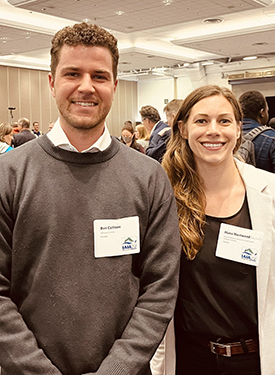
Shown right: Ben Collison, left, with Dr. Westwood.
The researchers conclude that as governments across Canada roll back impact assessment regulations, strengthening these processes would have enormous potential to facilitate data sharing and societal co-operation on new industrial developments, like mines.
Dr. Westwood says she is continuing her work of examining Canadian assessments.
"We have a study coming down the pipe about the quality of impact assessments for predicting the impacts of mines on groundwater resources, which are critical for clean drinking water, fish habitat, and healthy watersheds," she says.
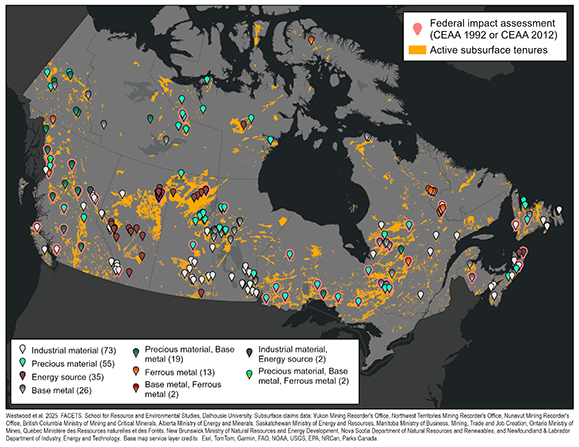
Above, a map in the report shows locations of impact assessment (IA)-assessed projects within the database of mines, categorized by the material class of each proposed development “active” in each jurisdiction, as of Dec. 31, 2024. See article for full details. (FACETS)