

The following memorial message was shared by President Kim Brooks with Dalhousie faculty and staff following the passing of Chancellor Emeritus Sir Graham Day.
It is no easy feat to capture the measure of a life — particularly one lived at such velocity and with such verve. In the case of Sir Graham Day, Dalhousie’s fourth Chancellor, the task borders on the impossible.
How many business leaders were also military reservists? How many lawyers counted chorus work and musical direction among their credits? Who else has left their fingerprints on shipyards and chocolate bars, automobiles and banks — and still found time for the occasional well-aimed letter or apple delivery? And how many sons of Canadian shopkeepers become so trusted by the British Prime Minister that they are drawn into her inner circle and knighted for their service?
Sir Graham passed away last week at the age of 92. (Campus flags are being lowered in his honour.) By the time I met him in 2010, when I served as Dean of the Schulich School of Law, he had already lived a few distinct Dalhousie lives: a determined law student in the 1950s; an unconventional but magnetic teacher in the business school in the 1970s; an honorary degree recipient in the 1980s; and, in the 1990s, a Chancellor who brought both ceremonial grace and strategic counsel to the university during a time of challenge and change. By the time I crossed the street from the law school to the Faculty of Management, he was a trusted friend, ever-ready advisor, and generous benefactor — lending his name and support to a lecture series on ethics, and to scholarships that continue to shape student journeys.
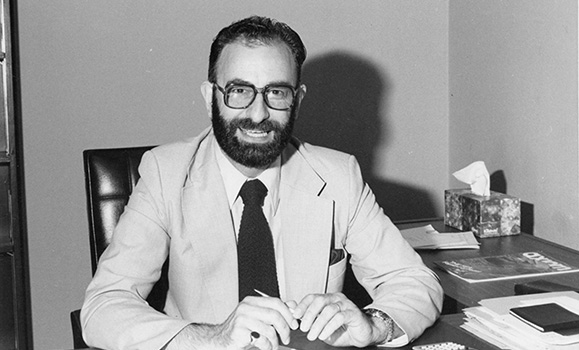
Graham’s counsel, like his character, was never offered lightly — but when it came, it was freighted with insight, shot through with humour, and often wrapped in the kind of maritime metaphor that somehow made hard truths easier to hear. To receive a note from Sir Graham — typed, deliberate, and gently arch — was to feel yourself seen, challenged, and encouraged in equal measure. His reliance on Latin in much of his correspondence left me feeling like Ancient Rome was touchable and that building great things was always possible.
One member of our Dal community with whom he was particularly close was Professor Emeritus Mary Brooks, who first encountered him in the late 1970s when he returned to Halifax in what might have seemed, to the casual observer, a transitional lull. But for Sir Graham, lulls were merely staging grounds.
Already a seasoned corporate lawyer, a fixer for Canadian Pacific, and a restorer of derelict shipyards in the UK (not to mention the musical director of the beloved TV show Singalong Jubilee), he was briefly teaching in Dal’s business school and toying with an academic path like the one Dr. Brooks pursued (perhaps becoming, like her, a renowned global scholar of transportation and the shipping industry). But industry, as it often did, called him back.
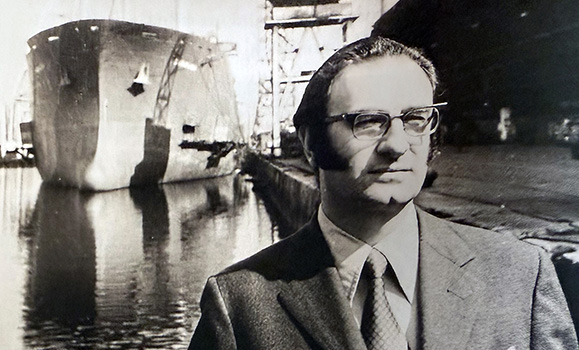
Under Prime Minister Margaret Thatcher, the U.K. was privatizing major public assets and seeking out leaders with the capacity to steer through stormy waters. Graham’s decade-long second stint in Britain, serving at the helm of British Shipbuilders and later British Leyland (renamed the Rover Group during his tenure), was marked by just such navigational skill — steering between policy and politics, efficiency and empathy.
Famously, it was under his watch that the Mini — a British cultural icon teetering on the brink of extinction — was spared the axe. For his service, he was knighted in 1990. “The last Canadian knight,” he would later quip — providing an apt title for his 2017 biography.
Back home in Nova Scotia, he resumed a life of consequence but never of pomp. Board appointments, legal counsel, corporate leadership — these roles were undertaken not as trophies but as opportunities to shape institutions for the better. Lydia Bugden, CEO and Managing Partner at Stewart McKelvey, recalls his kindness, clarity, and unwavering investment in others’ growth.
“He had such a deep curiosity,” says Bugden. “He just wanted to know people and understand them, and help them understand their opportunities… I often ask myself, ‘Am I doing enough to support the next generation like he did, with his kindness and thoughtfulness?’ I think he’s left me with that same sense of duty to pay it forward. He’s left all of us who knew him asking, ‘What would Graham do?’”
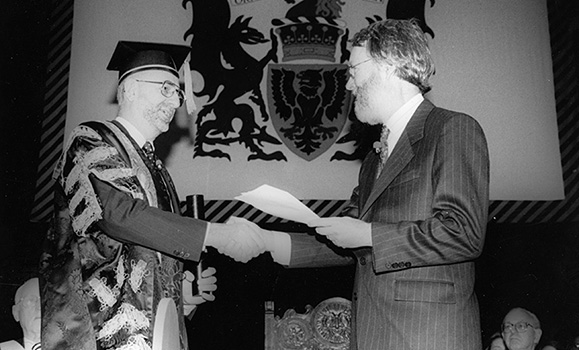
At Dalhousie, we were grateful to be among those he invested in — whether through scholarships supported alongside his friend and fellow Nova Scotian John Bragg (a man with whom he proudly shared a birthday) or through his steady presence in lecture halls, boardrooms, and Chancellor’s robes.
President Emeritus Tom Traves, whose early presidency overlapped with Sir Graham’s tenure as Chancellor, remembers him as someone who combined wisdom and wit with a genuine affection for students. “He was quite approachable to students and families and very loyal to Dalhousie. He was someone I could call upon from time to time about matters at the university and I always appreciated his input and wisdom.”
I will miss him. I’ll miss the spark of his intellect, the music of his sentences and the sonorousness of his voice, and the clarity of his advice. I’ll miss our long chats — on campus, over lunch, and occasionally in Hantsport — and the feeling that, when you were speaking with Sir Graham, he was wholly present, unhurried, and still deeply committed to the betterment of you, Dalhousie, Nova Scotia, and the world all at once.
He believed, fiercely and vocally, in the power of education. In his Chancellor’s installation address, he called on our universities to lift the province — to fuel its economy, to expand its ambitions, to ready its people for the complexity of tomorrow. “Education,” he reminded us, “while costly, is not an expense. It is, rather, an investment — for both individuals and the province.”
Dalhousie is better for Sir Graham's investment in supporting what we do. I am better for it. And come harvest, when the apples from Hantsport no longer appear at the Faculty of Management — delivered by a giant with a dry sense of humour and a sharp eye for policy — we will feel his absence in ways both profound and sweet.
Yours aye, Graham.
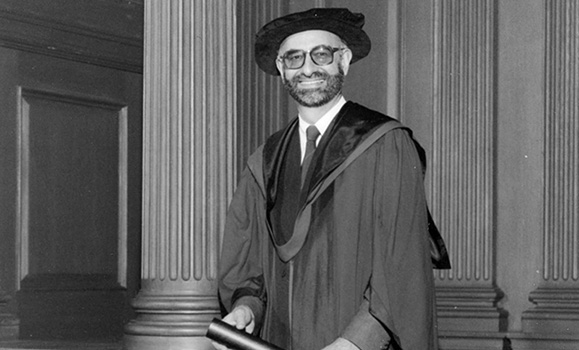
Sir Graham's family is directing memorial donations to the Sir Graham Day Scholarships in Law and Business.