
A third dimension in printing - now at the Killam Library

Meet the MakerBot Replicator 3-D printer

Kevin Hartford - June 7, 2012

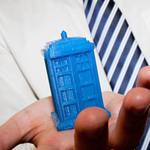
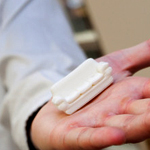
Michael Groenendyk shows off a small Taj Mahal made with the new 3-D printer. (Bruce Bottomley photo)

They’ve been used to build food, architectural models, ice sculptures, and even human tissue, but what can 3-D printers do for Dalhousie?

It’s a question Michael Groenendyk and Riel Gallant, two students in Dal's Master of Library and Information Studies program, wanted to answer. And thanks to support from Dalhousie Libraries, students and staff at Dal can give 3-D printing a try and answer it themselves.

A MakerBot Replicator 3-D printer is up and running at the Killam Library, which can transform three-dimensional STL files into small, plastic models. It does this through fusion deposition printing, which Mr. Groenendyk describes as using "hot end or cold end extrusion to slowly place quickly-hardening layers of material one on top of the other like a glue gun. The hot end extruders generally use plastic filament."

A typical printed object uses between 25 and 50 cents worth of plastic, so it’s an affordable process. Users who want to try out the printer during its pilot project phase will be able to make use of the service for $1 an hour — or about the time it takes to print an object about the size of a one-inch cube.

The next revolution in printing


The students’ interest in 3-D printing was sparked by an NPR article on high-tech hacker spaces in public libraries, one of which featured a plastic-model-producing 3-D printer.
“[We] began to think of 3-D printers as something that could be implemented directly inside a library setting much in the same way photocopiers have been," says Mr. Groenendyk, "but supplemented with a catalogue of digital 3-D objects students could download, manipulate, and print."

“We realized this was going to be something much bigger than an assignment or a thesis paper,” adds Mr. Gallant. “We believe that 3-D printing will completely revolutionize library services, perhaps even more dramatically than the Internet has already done."

Seeing an opportunity to facilitate collaboration between students in Dal's Faculty of Engineering and the Faculty of Architecture and Planning, the two began carving out a business proposal and implementation plan, and connected with their professor, Joyline Makani, who is also a subject specialist librarian in management and economics at the Killam Library. They pitched the idea to Dal Libraries, including University Librarian Donna Bourne-Tyson, who responded by contributing the funding necessary for the purchase of the printer and scanner.

An opportunity for self-education


The products will be made available for student use on the main floor of the Killam Library, where designated staff members will act as support mechanisms assisting students in the use and understanding of these new technologies. Dalhousie Libraries will also create an open access repository of 3-D models created by students and faculty. Once this online database is accessible, users will be able to classify and share the immense amount of data generated by digital objects.
"3-D printing provides opportunities for self-education,” says Mr. Groenendyk. “Engineering and architecture students will be able to create and manipulate 3-D designs in programs like AutoCAD and then print extremely cheap prototype versions of their designs, which they can review and rework as they see fit."

“I think we’re just currently touching upon what this technology is capable of,” says Mr. Gallant. “We are very excited to begin developing its potential.”

For more on the printer, including step-by-step instructions on how to turn an idea into a 3-D model, visit the Dalhousie Libraries website.

Readers Say

Thank you Kent Lane and CBCL Ltd. Consulting Engineers for supporting this project through its initial development phase as well.
If the project is targeted at engineering and architecture students, why is it going to be in the Killam? Would it not be better utilized on Sexton Campus?
We have some awesome 3D printers on Sexton already, but I'm sure it could be neat.
We're encouraging students from all disciplines to try the 3D printer. To give just one example, theatre students could use it for building set models. The possible applications are only limited by the imagination!
The project itself isn't targeted at engineering and architecture students, they were just identified as the user group most likely to take advantage of the technology. It's open to everyone, which is why it was installed in the Killam.
Some of us study small insect brains and use these also in 3rd year student labs. We can make serial optical sections through these structures with images from a camera on a confocal microscope, which software then assembles as an image stack. Has anyone investigated what it would take to convert such a confocal stack image into the STL format mentioned here? This could be a useful adjunct in teaching a lab class. At the output end, it would be better for us and aesthetically superior if the model were fashioned in a fully transparent plastic like Plexiglas/ Lucite/ acrylic, rather than the opaque stuff featured here. Is that possible? I have a bee brain model like that made in a university facility in Berlin, but I think in that case it utilized a laser etching process on a block of clear plastic.
Wowsers! This is extremely cool, hopefully it costs less than printing in color!
This, plus the laser scanner, is an amazing step forward! I'm completely impressed with Dal on this one.
Kudo's to Mike and Riel for their hard work on bringing 3D printing technologies to Dal. If anyone hasn't seen their printer yet, you must - it really is incredible!
Too bad it can't make out of sustainable material rather than plastic. Just a thought.
SMK:

From the Library's website.

"The Makerbot Replicator is located in the Help Desk area of the Killam Library Learning Commons. It uses PLA plastic: an organic, eco-friendly, corn-based plastic."

SMK:

"Too bad it can't make out of sustainable material rather than plastic. Just a thought."

-----------
Great point SMK. We chose PLA over ABS plastic mainly due to odor issues. PLA is virtually sent-less (as opposed to ABS--Lego plastic). The facts that it's eco-friendly (corn-based, breaks down after 6 month exposure to the sun) is a major plus. The downside is that it's not as reliable as ABS plastic when used to print 3D models, but sometimes it's unnoticeable.

I share the same concerns as those who see this technology and think: if plastic 3D printing catches on, how will it disrupt the environment? Will people abuse this technology? Or could it cut shipping costs and encourage people to recycle? (check out www.filabot.com -- create your own plastic filament of 3D printing by grinding down plastic bottles -- but this technology is still very raw).

Here are other things to consider if 3D printing/scanning infiltrates the home and small business market in 5 to 10 years:
-What does it mean for importing/exporting?
-What does it copyright?
-What does it mean for materialism in general?
-Which companies will lead this industry?
-How will they teach 3D printing/3D design in schools? at work?
-Will libraries fully embrace this technology?
Steve Shaw:

The best PLA can offer is the translucent "natural" coloured PLA. We don't have any at the Killam right now. You can see an example of it at http://www.thingiverse.com/image:88878

There are experiments going on with polycarbonate (http://hackaday.com/2011/12/30/printing-with-clear-polycarbonate/), but due to the nature of the printing process, it likely wouldn't be anywhere as nice a model as someone who had carved out out of a solid block as you mention.
Fascinating 21st-century technology. It's a pity the payment method is from the 19th century:
Picking up Your Model
Go to Help Desk in the Learning Commons of the Killam Library to claim your model. You will be given a receipt for your model listing the print cost. Take this receipt to the Circulation Desk to make your payment. Return to the Help Desk with your signed receipt from Circulation to receive your printed model.
http://grabcad.com/

This website has some cool inspiration for 3D modeling though I think you would need to convert the files. It gives you an idea of how detailed 3D prints can be made.

Join the conversation, but keep it clean, stay on the topic and be brief. Read comments policy.

Characters remaining: 2000

(optional)