
Take the taste test
By Melissa Hennigar - January 27, 2011
![]() |
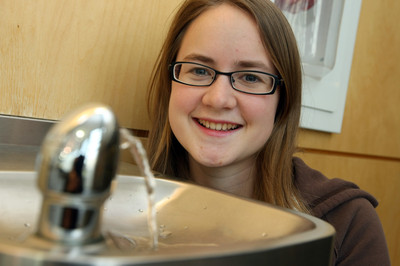
| Health promotions student Gillian Pritchard is investigating more sustainable options to bottled water on campus. (Nick Pearce Photo) |
Unconvinced that tap water really is as good, if not better, than bottled water? Why not take part in a blind tasting that compares bottled water and tap water. Drop by the main lobby of the SUB on Friday, January 28 from 10 a.m. to 2 p.m. and taste for yourself.
The event is hosted by the SustainDal water committee, a student group interested in exploring more sustainable sources for water on campus. Eventually, SustainDal would like to see Dalhousie join a growing list of universities that have banned the sale of bottled water on campus.
The SustainDal water committee is led by Gillian Pritchard, a fourth-year health promotions student from Elgin, Ont. Ms. Pritchard was struck by the environmental impact of single use plastic water bottles after attending a Sierra Youth conference in 2008. She would ultimately like to see Dalhousie ban bottled water on campus.
'More sustainable options'
Ms. Pritchard is quick to clarify, “it’s not like we’re going to be policing this policy and ripping plastic water bottles out of people’s hands or anything! We just want to ban the sale of bottled water on campus and provide more sustainable options.”
SustainDal has already made some impressive strides in this direction.
In 2008, the water committee conducted an independent assessment of all 117 water fountains on the three Dalhousie campuses. The results were widely varied, from pristine, clean-tasting water in some buildings, to fountains with water hot enough to brew tea with in others.
SustainDal took its study on campus water fountains to the President’s Advisory Council on Sustainability. As a result, a sub committee was formed to look at campus water issues more closely. Currently, the sub committee is working with Halifax Water to test every fountain and tap on campus to ensure the water is safe to drink. So far, the results have been very encouraging.
The SustainDal water committee also took its results to Facilities Management who they have been working with to install new fountains and clean up existing ones around campus.
“We see it as working to eliminate the amount of plastic bottles in the waste stream of the university. The new fountains we’re installing have a counter on them. Every time a bottle is filled, that is one less plastic bottle and we can keep track of those numbers,” says Lewis MacDonald from Facilities Management.
Starting the conversation
Eliminating bottled water on campus is not as simple as not stocking it in vending machines and food services outlets. Viable alternatives need to be made available to ensure everybody on campus can still access clean drinking water.
“We are working to start the conversation on bottled versus tap water at different levels around campus,” says Ms. Pritchard. “This is already being addressed at an institutional level with the sub committee, but it is a conversation that needs to be happening everywhere.”
Presently, of the 117 fountains on campus, none are located near food service outlets on campus. To this end, SustainDal has partnered with The Blue W, a non-profit organization that supports municipal water. Participating organizations display a Blue W decal which means they will provide fresh, clean tap water without pressure to make a purchase. Currently, there are six locations on campus that display the Blue W decal.
“We’ve got some of the best water in North America, so why not take advantage of it?” says Ms. Pritchard.
Twitter
Readers Say
January 27, 2011 6:27 PM
January 27, 2011 6:52 PM
January 27, 2011 8:36 PM
January 27, 2011 9:57 PM
Also, according to unews.ca article on the issue, the plan is to stop the sale of bottled water THEN get to fixing the issues with the water fountains on campus. That sounds a bit backward to me. I don't know which water fountains have been tested but my experience has been very poor. I've had classes in the LSC, Rowe, McCain, Tupper and the Killam and all have issues. Ex: Foul tasting water, warm temperatures, poor water pressure, inconvenient to downright gross locations (the water fountain behind the LSC Tim Hortons for example is always surrounded by trash and there's only a single water fountain in the entire Rowe). Fix these issues first THEN start talking about banning the bottles.
I believe that banning water bottle sales from campus is not the most effective way of going around this. I, for example, would prefer to see if the DSU could change it's deal with Pepsi Co. and limit sales to those of cans only, which are 100% recyclable. There's a new patent which Pepsi Co. might pick up that leads to a resealable can, which is the biggest disadvantage compared to bottles.
At any rate, good luck with your project. While I disagree with it, your heart and mind is in the right place and are actively doing something about an important issue. For that you have my utmost respect.
January 28, 2011 8:19 AM
January 28, 2011 9:54 AM
January 28, 2011 9:58 AM
January 28, 2011 10:32 AM
Good work Gill & co.!
January 28, 2011 11:10 AM
Where are they?
Also, for those of us who can't consume sugared drinks, water is the only option available in the vending machines when you have to buy - for those days when you forgot your refillable bottle.
If you make clean, cool good tasting water available free, the shift will happen on it's own.
January 28, 2011 1:39 PM
We have perfectly good water in our taps and around campus, it simply is beyond me why people can't get through their head that we are so lucky to have this. Yet, we spend our money on buying plastic bottles that end up in landfills.
January 29, 2011 10:12 PM
January 30, 2011 10:24 PM
January 31, 2011 3:31 PM
January 31, 2011 4:23 PM
This sounds like a great start and I look forward to watching this develop!
February 2, 2011 6:23 PM
The big issue here though is banning the sale of bottled water on campus. The sale of bottle bottled water is a global environmental problem. Water is taken out of ecosystems (having negative effects on the flora, fauna and people surrounding the water supply), enclosed in plastic bottles, and shipped far distances to you the consumer to possibly fill up a few times then recycle or through in the trash/litter. That looks like a whole lot of avoidable pollution/energy usage if we just fill up a reusable bottle with local water. Also avoidable habit destruction and negatively impacting human water supplies in other communities. But don't take my word for it there are many ways to research this on your own if you have the time or elective space i recommend taking a first year sustainability course which overviews the the true environmental cost of thought to be everyday actions. If you have less time read blue gold, and if you have even less time check out the movie flow: for the love of water.
I also agree with the removal of coke and pepsi products from the vending machines unless they are 100 percent fruit juices (not from concentrate). But they would probably be heavily marked up (like the water) and I wouldn't buy t anyways.
February 4, 2011 10:34 PM