

Phytoplankton in retreat

By Melissa Hennigar - July 28, 2010

Use of the Secchi disk, ca. 1910. Historical Secchi disc data are one of the two main data sources in our analysis (Yonge, C.M., Scientists measuring the water transparency with a Secchi disk, Queensland, ca. 1928, Part of Album of the Great Barrier Reef Expedition in the Low Islands region, Queensland, 1928-1929. (Photo courtesy of the National Library of Australia).
Research collected for more than a century is helping Dalhousie University researcher Daniel Boyce in his quest to examine the health of the world’s oceans.

A simple tool known as a Secchi disk as been used by scientists since 1899 to determine the transparency of the world’s oceans. The Secchi disk is a round disk, about the size of a dinner plate, marked with a black and white alternating pattern. It’s attached to a long string of rope which researchers slowly lower into the water. The depth at which the pattern is no longer visible is recorded and scientists use the data to determine the amount of algae present in the water.

More specifically, the research is focused on a particular type of algae known as phytoplankton. This is the first time that significant research has been complied and examined to study the algae levels in the world’s oceans.

It is hard to imagine this tiny photosynthetic plant may be one of the most urgent indicators of the declining health of the world’s oceans. “Phytoplankton provides food for basically everything in the ecosystem, from fish right up to human beings,” says Mr. Boyce, a PhD candidate with the Department of Biology at Dalhousie. “Phytoplankton is also important in maintaining sustainable fisheries operations and the overall health of the ocean. We need to make sure that the numbers do not continue to decline.”

The researchers found that the number of phytoplankton has been decreasing by a rate of about one per cent per year, for the past 110 years. While this might not seem like a large number, this translates into a decline of about 40 per cent since 1950. In total, just under half a million observations were compiled to be able to estimate phytoplankton levels through the years.
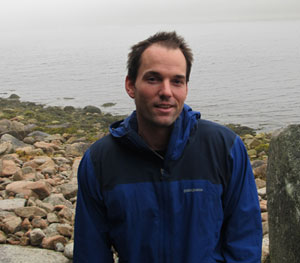
Daniel Boyce is a PhD candidate at Dalhousie.
The two main objectives of the research were to examine global trends in phytoplankton over time and to determine what might be driving these trends. Preliminary conclusions suggest that rising ocean temperatures are the leading cause of the decline. “As the water temperature rises, the ocean becomes more stable which limits the nutrients present in the water. This in turn limits the amount of phytoplankton,” explains Mr. Boyce.

Based on the research collected, phytoplankton levels have decreased in eight out of 10 ocean regions.

“Unfortunately, we as scientists don’t fully understand what exactly the effects of a decline in phytoplankton will be. We need to do more research into the effects of less phytoplankton. Obviously, doing whatever we can to lower the temperature of the world’s oceans is an excellent start,” says Mr. Boyce.

The full report, Global phytoplankton decline over the past century, appears in the journal Nature on Thursday, July 29. The report is co-authored by oceanographer Marlon Lewis and marine biologist Boris Worm.

SEE THE ARTICLE: Global phytoplankton decline over the past century in Nature

Readers Say

The link to Nature produces only the abstract; the article text is behind a pay-wall and costs US$32 (!) for nonsubscribers, i.e. almost everyone. While the BBC writeup is informative (you might link to it: www.bbc.co.uk/news/science-environment-10781621), better still would be to make the full text of the article freely available. No doubt publication in Nature is of great value to Mr. Boyce's career and to Dalhousie, but the actual text and numbers of this important story are effectively invisible to the internet at large.
What about all the pollution from they vast array of waste we dump in there. Surely, its not only about the temperature that seems to be doing all the damage. Considering they discovered even sunscreen left on your bodies when swimming near coral can bleach and kill them.. I wonder what the other chemicals are doing
David Cortesi makes a good point. If Harvard can adopt an open-access policy for the publications of its faculty (Harvard Gazette story, 2009/09), perhaps the Harvard of the Maritimes (or at least southwest Halifax) can do the same...
The report and abstract do not mention the type of phytoplankton. I have not yet read the full report.

Algal blooms and Dead Zones due to algal blooms are very much in the news. These indicate an increase in phytoplankton in lakes and coastal waters, this is to be contrasted with the decline in oceans.

My view is that Cyanobacteria and Dinoflagellates blooms have increased and Diatoms have decreased.

Species specific data is required to draw any real conclusion on why there is an overall decline in phytoplankton and why harmful and nuisance algae are blooming.
Have/has the phytoplankton moved a bit deeper?

If I understand correctly, ocean water near the surface is getting more transparent. That may mean there is less phytoplankton in the ocean, but couldn't it simply mean that the phytoplankton have moved to deeper water? Phytoplankton need to stay near the surface to get light, but if ocean water is getting clearer (as measured by how deep human eyes can distinguish that pattern on a Secchi disk) that almost surely means the light that phytoplankton need is penetrating deeper into the ocean. The human eye is sensitive to just about the same colors of light that power photosynthesis.

I apologize for posting a comment without having read the whole article in Nature; since I'm 40 years past most of my biology education I didn't spend $32 just to see if I could understand it.
So they start measuring 110 yrs ago, at the peak of a phyto bloom, right after a century of volcano eruptions. Which puts iron and fertilizer in the ocean for plankton. Then they wonder why plankton levels are going down - the water is getting cleaner you dolts - and blame it on global warming.

NASA says that plyto takes up 100 million tons of CO2 out of the air every day right now.

If phyto has been reduced by 50%, then that's 100 million tons of CO2 each day that phyto is not taking up any more, which completely explains all of the rise in atmospheric CO2.


look at the volcano dust index for 1800-1900
www.fmap.ca/ramweb/media/phytoplankton_decline/home.php
I guess the question is, is it the chicken or the egg? Or a combination?

Scientists say that there's strong evidence that carbon emissions contribute to global warming. Don't they factor in the supply of nutrients that eruptions provide?
In response to David Cortesi's comment about accessing the full text of the article in Nature: the Dal Libraries subscribe to Nature, but the publisher's license restricts access to Dalhousie users only. We appreciate this can be frustrating for others!

Join the conversation, but keep it clean, stay on the topic and be brief. Read comments policy.

Characters remaining: 2000

(optional)