
 |
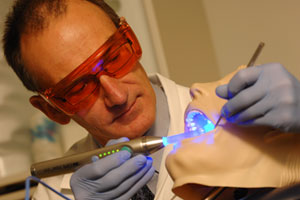
| Dr. Richard Price and MARC®. (Danny Abriel Photo) |
The trick to baking a perfect birthday cake lies in temperature and duration. If the oven is too hot, the cake will overcook. If the cake is removed too soon, it will be uncooked in the middle.
The same goes for the tooth-coloured resin fillings dentists use to fill cavities. These fillings are put into a tooth in a soft, malleable state, after which the dentist shines a bright blue lighton the white filling to harden it. Too much light and it will overcook — not only the tooth but surrounding tissues and nerves. Too little light and it won’t harden properly and probably won’t last.
But how can a dentist know how much light to apply so the filling is just right? Just ask MARC®.
MARC® (Managing Accurate Resin Curing) is the brainchild of Dr. Richard Price, a practicing dentist and professor with the School of Biomedical Engineering and the Faculty of Dentistry at Dalhousie, and his assistant Christopher Felix. Using custom-designed computer software, the invention — a simulatedpatient head complete with realistic teeth, tongue, cheeks and lips — accurately measures the amount of total energy being delivered to a filling in the mouth.
Dalhousie’s Industry Liaison and Innovation Office has licensed MARC® to a new spinout venture called BlueLight analytics inc. based in Halifax. In addition, MARC® is already being used to teach dental students and practicing dental professionals at the Faculty of Dentistry.
“MARC® can tell you how long you need to cure the fillingso it will get sufficiently hard,” explains Dr. Price. “It all depends on such things as where the cavity is in the mouth, the design of the curing light and the type of resin being used — all these factor into how long you need to shine the light for.”
The same problems did not exist years ago when dentists primarily used silver amalgam fillings. But these days, the preference is for composite resin fillings that are the same coloras teeth. “The majority of the fillings put in today in Nova Scotia are white fillings,” says Dr. Price. “Some dentistry schools don’t even teach about the other ones anymore.”
The energy is delivered to the filling using a pen-shaped curing light. Some manufacturers say the dentist only needs to shine thelight for five seconds, others for more than a minute. Testing using MARC® — who bears a passing resemblance to Don Draper on Mad Men — showed Dr. Price that the effectiveness of the lights varied greatly depending on their strength, ergonomic design and even how they were held.
“MARC® is the closest thing to clinical reality you can have,” says Mr. Felix, as MARC® opens wide on the countertop beside him. “We’re able to say how much light is needed in the most clinically-relevant setting – the mouth.”
BlueLight analytics is receiving financial support from Atlantic Canada Opportunities Agency.