
 |
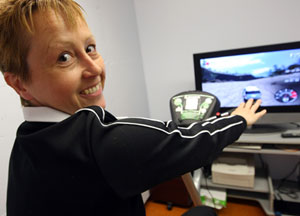
| Professor Melanie Keats takes the exerbike out for a test drive. A study by fourth-year student Abby Jakob showed participants enjoyed playing the gaming systems and were so keen that they wanted to keep playing. Her research also showed that they were having so much fun, they didn'trealize how hard they were working. (Nick Pearce Photo) |
As a two-time survivor of cancer, Melanie Keats is convinced that being a fit and active person is what saved her life.
At the age of 12, she was diagnosed with spinal cord cancer, with a nasty tumor sitting at the very base of her spinal cord and getting entangled with spinal nerves.
It was serious. The girl who ran, shot hoops, blocked her brother’s slapshots, dribbled soccer balls and just loved to play was facing major surgery and the knowledge that she may not fully regain function of her lower extremities. Worse, she learned that she may not live to celebrate her 14th birthday.
Dr. Keats was facing a tough road of surgery, radiation treatment and physical therapy. But six months after difficult tumor debulking surgery, she was learning to walk again. Before long, she was running and jumping and back trying to keep up with her older brother.
“I went into my surgery being very, very active,”says Dr. Keats, 38, assistant professor in the Department of Health and Human Performance. “I am convinced that is the reason that I am as strong and as healthy as I am now.”
On track to become a nurse—just one course shy of her degree—the Calgary native was again diagnosed with cancer, this time bladder cancer. Although this time surgery and recovery was a “piece of cake” in comparison with the first go-around (which subsequently involved more surgery to fuse and straighten her spine), she had spent enough time in hospitals to know she didn’t want to work in one. Her focus changed to kinesiology and she found her niche in an exercise psychology class, investigating the value of exercise for special populations, namely young cancer survivors like herself.
“C’mon, seriously?” says Dr. Keats, who was 19 at the time of her second diagnosis. “I don’t drink. I don’t smoke and I’m active. I’m not even 20 and I’ve had cancer twice.”
MILESTONES
Arriving at Dalhousie in 2008, Dr. Keats has embarked on a major research initiative called MILESTONES. The primary goal of the research is to optimize the quality of life of childhood cancer survivors by getting them active, whether they were active or inactive prior to their diagnosis.
Over the past 30 years, there has been a dramatic decline in the number of childhood cancer-related deaths. But as the population of pediatric cancer survivors continues to grow, a new set of health concerns, commonly referred to “late-effects,” has emerged. Ranging from physiological to psychological, there is an increasing need for supportive interventions that target risk reduction and promote healthy behaviors from diagnosis and beyond. As cancer survivors are more susceptible to long-term health problems than their “healthy” peers, health risk behaviors, such as physical inactivity and poor diets, prove to be of even greater significance.
“The treatments for cancer are very intensive and they can have long-term implications,” she explains, in her office in Dalplex. “Chemo, for example, can reduce muscle mass, bone mass; it can impair the hearth and lungs; it can affect balance, all kinds of things. Then there are the emotional problems—you’re suddenly different from your friends.
“As a childhood cancer survivor, it’s always a part of you. It’s always there.”
'Exergaming'
The key to recovery and a good quality of life, she believes, is early intervention, right in the hospital. With the help of a grant from the Canadian Foundation for Innovation (CFI) and matching funds through the Nova Scotia Research and Innovation Trust, she wants to get kids on bikes: having races, smashing vehicles and steering through congested corridors at breakneck speeds. So to speak. The bikes power video-games; pedaling controls the action on the screen.
“With the CFI money, we can bring the bikes right to their rooms in the IWK,” she enthuses. “And, if the child doesn’t have the strength, they can stay in bed and pedal with their hands. It’s a start.”
The other part of MILESTONES is a community component and that involves setting up an “exergaming” fitness centre at Dalplex where kids can come to play and regain strength and confidence once they’re out of the hospital. The centre will be set up with interactive activities such as exercise bike game consoles, the music video game Dance Dance Revolution, and dozens of Wii units, to use at the centre or to borrow and take home.
“The equipment they’re coming out with now, is, as they kids say, sick,” she says with a laugh. “We want to get people excited about activity so that they’re motivated to start being active, and once they get active, to sustain that physical activity, to move from a virtual bike to areal bike.”