
 |
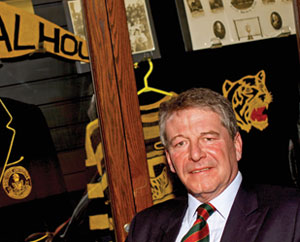
| James Ramsay, Lord Dalhousie, visited campus last week. He spoke to students about investment banking and dropped by the Dalhousie Art Gallery where Lord Dalhousie: Patron and Collector is on display. (Bruce Bottomley Photo) |
The current Lord Dalhousie peers upward at the portrait of his ancestor hanging over the fireplace in University Hall.
“We have a copy of this as well. It’s hanging in the Long Gallery at Brechin Castle, along with portraits of his father and his mother,” says James Ramsay, the 17th Earl of Dalhousie.
“You see his neck is very long,” he observes, pointing. “His head doesn’t quite fit with the rest of his body. We believe that the painter did the face and head and then turned the works over to his studio to do the uniform.”
The 9th Earl of Dalhousie continues to gaze impassively downward, as his descendent poses for a 21st century portrait photographer.
Eight generations separate the current title holder and his ancestral uncle. George Ramsay, the university’s founder, was the Governor of Nova Scotia from 1816-20 and Governor-General of British North America until 1828.
'Call me Jamie'
While formally known as the 17th Earl of Dalhousie, the 6th Baron Ramsay of Glenmark, the 18th Lord Ramsay of Dalhousie, the 17th Lord Ramsay of Carrington, and Lord Steward to HRM Queen Elizabeth II, he extends a hand and says “Call me Jamie.”
Jamie Ramsay is in Halifax for an exhibition at the Dalhousie Art Gallery recognizing his predecessor’s legacy. Lord Dalhousie: Patron and Collector was organized by the National Gallery of Canada.
“It’s a beautiful show of landscapes and drawings,” he says. “You can see how the skills of the military mapmakers flourish. Also, it’s interesting historically because you can see the type of paddle boat that was used, and you can assess the construction of a bridge and observe the mode of transport by sledges and horses.”
He doesn’t have a lot of the 9th earl’s artifacts himself, since a subsequent generation “raided Dalhousie castle of belongings.” However, an old sword, a snuff box and the Order of Bath have survived the generations. Jamie Ramsay has read George’s diaries extensively and is fascinated by his family’s history.
As the Chief of Clan Ramsay, this past summer he entertained relations from Canada, Finland, Sweden, the United States and the United Kingdom at the ancestral home, Dalhousie Castle. The 13th century fortress near Edinburgh is now a luxury hotel, complete with spa and falconry.
“Up until the 1920s the family lived there part-time, but it was big and cold,” he says. “It’s no longer in the family.”
Today, he prefers to live in Brechin, on property in Angus that has been in the Maule-Ramsay family since the 12th century. Dalhousie Estates is a family business providing employment for over 90 staff who work in “… farming, forestry, property letting, shooting, fishing and deer stalking.” Brechin Castle opens for a month each year to the public.
So, what’s it like to be Lord Dalhousie?
“Well, I spend most of my time working, so it doesn’t really feature most of the time,” he replies. “People are very kind and invite me to interesting places, like this university. But most of the time, I just get to live in a big old house and I’ve got to pay for it.”
Investment banker
The majority of his career has been devoted to investment banking and he described his experiences during a lecture peppered with references to Conrad Black, Rupert Murdoch and Reuben Cohen, at the Kenneth C. Rowe Faculty of Management Building. The talk was organized through the Douglas C. Mackay Chair in Finance at Dalhousie University.
Students responded with questions about the viability of a career in the financial services industry.
“It’s the best time to get involved, with all the banking problems — learn as much as possible about what has gone wrong. You’ve got to see it and experience it in the real world to learn,” he advised.
Students exiting the classroom chatted about their guest speaker.
“I knew we were having a guest lecturer, but I didn’t know he was going to be a Lord.”
“Yeah, but I kind of liked him.”