
 |
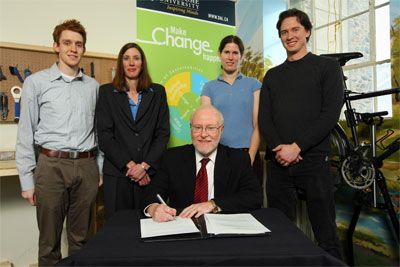
| Dalhousie students Will Horne (far left), Catherine Joudrey and Peter Rogers and Rochelle Owen, director of the Office of Sustainability, (second from left) pose with President Tom Traves at the Campus Bike Centre. (Nick Pearce Photo) |
With a stroke of the pen, Dalhousie President Tom Traves signed his name to the University and College Presidents' Climate Change Statement of Action.
Signing the document commits Dalhousie to significantly reduce emissions of greenhouse gases. Further, the university must complete an inventory of greenhouse gas emissions with a year; set targets and develop an action plan within two years; and take a leadership role within the community to educate about global climate change. Most of the actions agreed to are already underway at Dalhousie.
“The environment is already an area of concern in our research and teaching,” said Dr. Traves. “Now it’s time for us to walk the talk and commit our institution to good environmental stewardship.”
Rochelle Owen, director of Dalhousie’s Office of Sustainability, looked over President Traves’s shoulder as he signed the statement at the newly opened Campus Bike Centre in the Studley Gymnasium. Since coming to Dalhousie two years ago, Ms. Owen has been spearheading efforts to inspire a new culture of sustainability and environmental protection at the university.
“We can totally do this,” says Ms. Owen. “We can meet or beat provincial standards. We’ve got a number of strategies already started to do this.”
Will Horne was one of a handful of students on hand for the signing and came away impressed. “It turned out to be pretty simple,” he says of the commitment shown by Dalhousie leadership. “I hope it’s just a sign of many more things to come.”
According to a greenhouse gas inventory completed for the university, Dalhousie emitted approximately 109,777 metric tonnes of carbon dioxide emissions.
Most of Dalhousie’s emissions derive from the process of heating the university’s 4.8 million square feet of indoor space in winter and cooling the buildings in the summer. Dalhousie uses Bunker C heavy fuel oil to feed two boilers, which heat water to create steam. In 2007, Dalhousie used almost 14 million litres of bunker oil, one million litres of furnace oil and 69 million kilowatts of electricity.
The other primary draws for energy at Dalhousie are lighting systems, office equipment including computers, photocopiers, phones and other electronic devices, and research needs. Research at the university can rely on energy-intensive devices such as High Performance Computing (HPC) systems, and the hundreds of fume-hoods used to ventilate chemical fumes. The Killam and Sexton Data Centres are the hub of Dalhousie’s information technology systems, featuring 250 servers and supporting 5,000 computers across the campus.
Moving forward, Dalhousie will switch from bunker sea oil to natural gas—a conversion slated to take place next year. Other energy savings are expected from the retrofit of the Life Sciences Centre, a 450,000 square foot building which hasn’t been upgraded since it opened more than 40 years ago, and a campus-wide lighting conversion to energy efficient CFLs.
As well, the Office of Sustainability has been taking a look at how people come and go from campus. According to a transportation survey conducted by students for the Office of Sustainability earlier this year, 60 per cent of faculty and staff and 13 per cent of students drive to Dalhousie. The office is encouraging environmentally friendly commuting by promoting car pooling and cycling. It is also in discussions with Metro Transit to initiate a U-Pass for faculty and staff.
Further, the office has launched its Rethink program, a behavioral change program designed to encourage more environmentally conscious decisions at work.
“Behavioral change programs like Rethink are really the foundation,” says Ms. Owen. “If we can impact the decisions we make everyday, that’s so important. That’s learning that impacts in our homes too.”
Efforts on campus complement Dalhousie’s academic offerings on sustainability. In September, students flocked to the new Environment, Sustainability and Society (ESS) program, the first program of its kind in Canada. The program is offered through Dalhousie’s new College of Sustainability, which blossomed from idea to reality in just one year.
According to the province’s Environmental Goals and Sustainable Prosperity Act, passed in 2007, the target is for a 10 per cent reduction in greenhouse gases below 1990 levels by the year 2020. As well, the act decrees 18.5 per cent of the province’s electricity must be obtained from renewable energy by 2013 and 12 per cent of its land mass legally protected by 2015.
LINK: University and College Presidents' Climate Change Statement of Action