
 |
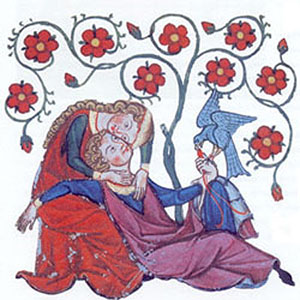
| Knights and ladies in medieval Europe lived by codes of chivalry and virtue. |
You may love it or hate it, but you can depend on it—every February 14, nestled neatly between Groundhog Day and Mardi Gras, Valentine’s Day rolls around. Is it a testament to the high value modern society places upon love? An excuse to cozy up on the couch with a box of chocolates? Or just an embarrassing love letter to consumerism?
Wait, wasn’t it Saint Valentine’s Day at one point? How did an obscure religious holiday become a tribute to all things heart-shaped? With Valentine’s right around the corner, Dalnews has set out to conduct a cross-Dalhousie study of love in honour of this deceptively enigmatic, red-and-pink holiday.
It turns out love wasn’t much simpler in days of yore.
“The medieval Christian understanding was that love ultimately comes from God,” says history profesor Cynthia Neville. Western European medieval society is just one of her varied research interests.
Medieval people believed the love of God bound the universe together. It was also the medieval era that gave rise to the tradition of chivalrous courtly love. “Courtly love… was the knightly expression of a divine, ideal love,” explains Dr. Neville, “And that love was offered to a beautiful noblewoman.” To love in the “courtly” tradition was seen as an ennobling, refining endeavour.
It was also time-consuming and generally limited to the aristocracy. Less wealthy classes had other ideas about love. “The common people struggled with the difference between lust and love,” says Dr. Neville. “Lust is one of the seven deadly sins. That’s not something you want to engage in.”
Things may not have changed much. “Literary scholars can trace the influences of these early writings about love… well into the modern period,” says Dr. Neville, giving supermarket romance novels as an example. “Those are really just 20th century versions of the same kind of literature… people back then knew the difference between romance and reality, just as we do today.”
It’s thoroughly modern affairs which concern Marina Adshade, who teaches “Economics of Sex and Love” at Dalhousie. The course premiered this year and the class of more than 100 students has been wildly successful; students discuss the pricing of prostitution, risky sexual behaviour and HIV prevalence. “The attendance in the class is really high… students are really engaged.”
Good news: despite the recession, courtship rituals have never been cheaper. “The cost of dating has fallen… you can sit on your computer at home and you can meet a hundred people in one night… it’s more efficient and less costly.” Dr. Adshade also covers the economics of what happens after you meet that special someone. “We’re going to talk about marriage systems. Why do we have monogamy in Canada? Why not polygamy?” She asks, noting that women in Halifax far outnumber men.
Dr. Adshade says there are two main reasons for marriage: as an environment in which to raise children, and as a system of division of labour. “It’s easier to do (household) tasks if you have two people, each doing the tasks that they’re best at.” Viewing marriage as a small business can be controversial, but “I think we’d all have to be very wealthy for this not to matter.”
While Dr. Adshade’s course deals with money, it doesn’t skirt affairs of the heart. “When we talk about love,” says Dr. Adshade, “We will talk about the biology behind love… but I do think love is a real thing. It being biological doesn’t make it any less real.”
So… what is love? Looks like the jury’s still out. Between chivalry and computer dating however, this Valentine’s Day should give the university plenty of food for thought.