
Sherlock of rock

By Ryan McNutt - October 16, 2008

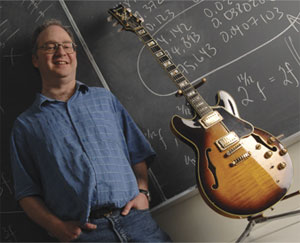
Math prof Jason Brown and his Ibanez guitar.(Danny Abriel Photo)

It’s the most famous chord in rock 'n' roll, an instantly recognizable twang rolling through the open strings on George Harrison’s 12-string Rickenbacker. It evokes a Pavlovian response from music fans as they sing along to the refrain that follows:

It’s been a hard day’s night
And I’ve been working like a dog

The opening chord to A Hard Day’s Night is also famous because for 40 years, no one quite knew exactly what chord Harrison was playing. Musicians, scholars and amateur guitar players alike had all come up with their own theories, but it took a Dalhousie mathematician to figure out the exact formula.

“I started playing guitar because I heard a Beatles record—that was it for my piano lessons,” says Jason Brown of Dalhousie’s Department of Mathematics and Statistics with a good laugh.  “I had tried to play the first chord of the song many takes over the years. It sounds outlandish that someone could create a mystery around a chord from a time where artists used such simple recording techniques. It’s quite remarkable.”

Four years ago, inspired by reading news coverage about the song’s 40th anniversary, Dr. Brown decided to try and see if he could apply a mathematical calculation known as Fourier transform to solve the Beatles’ riddle. The process allowed him to decompose the sound into its original frequencies using computer software and parse out which notes were on the record.

It worked, up until a point: the frequencies he found didn’t match the known instrumentation on the song. “George played a 12-string Rickenbacker, Lennon had his six string, Paul had his bass…none of them quite fit what I found,” he explains. “Then the solution hit me: it wasn’t just those instruments. There was a piano in there as well, and that accounted for the problematic frequencies.”

Dr. Brown deduces that another George—George Martin, the Beatles producer—also played on the chord, adding a piano chord that included an F note impossible to play with the other notes on the guitar. The resulting chord was completely different than anything found in the literature about the song to date, which is one reason why Dr. Brown’s findings garnered international attention. He laughs that he may be the only mathematician ever to be published in Guitar Player magazine.

“Music and math are not really that far apart,” he says. “They’ve found that children that listen to music do better at math, because math and music both use the brain in similar ways. The best music is analytical and pattern-filled and mathematics has a lot of aesthetics to it. They complement each other well.”

Readers Say

That's awesome. Dr. Brown is by far one of the best teachers I have ever had the pleasuring of having. He actually made calculus interesting and fun.
I just finished study of Fourier transformation and I found it as very powerful tool. Will some more mathematical paper on topic of this chord available. You know the TeX document with a plenty of integrals, sums etc. It is really interesting and I thing our teachers should use it as motivation for students.
Since Harrison used a 12-string, couldn't he have detuned a string to get the F note?
Has anyone contacted George Martin for confirmation?
Interesting, however there is one other possibility that came to my mind without knowing the exact notes. Is it possible that the 12 string was detuned or using and alternate tuning. Perhaps even as far as just detuning the larger low E string but leaving the smaller low E in the standard frequency. Just an idea.
So what is the chord?
As a musician and software developer, who also happens to have grown up listening to my mother's Bealtes records, I find this facinating.
As a long time Beatle fan and beginning guitarist, I found this article to be fascinating. It made me happy, broadly smiling, to hear about this fusion of math, music, and popular culture.
Hello Professor Brown,

Just curious (did I miss it somewhere?) - what is the chord? If I remember correctly (memory being stretched into the dark ages)we played A Hard Day's Night in G major. Congratulations on your research!! Kudos!
So, what are the chords? I liked seeing the technological solution to this puzzle, but I would like to see the answer.

If it still remains secret, I don't think there was a point to this.
Please link the actual article, for those of us interested in the solution:
www.mscs.dal.ca/~brown/AHDNSoloJIB.pdf
Brilliant! Math and music really are two sides of the same coin.

But, uh... what's the chord?
May I ask, then, what chord does Harrison play? And what chord does Martin play on the piano?
It's always great to see how we can find solutions to problems like this. I was amazed to hear Dr. Brown success with the Flux Capacitor.
So what's the chord? How about some audio?
So, what is the name of the constructed chord?
Yeah! What's the chord?
The chord is G minor
Sorry wrote too fast

The exact chord is an Fadd9 confirmed by Harrison during an online chat on 15 February 2001:[17]

Q: Mr Harrison, what is the opening chord you used for "A Hard Day's Night"?
A: It is F with a G on top, but you'll have to ask Paul about the bass note to get the proper story.
There are over 134,000,000,000,000 chords on a guitar. It would help if they had named the chord so we could see if it is possible to duplicate it. Maybe they didn't want to open a can of worms by placing a name on the chord because with seven notes (including the added F) there are several million possible names for the same chord, and everyone of them correct.
Today's teaser question: Which instrument had the most chords on it: A Piano or a Guitar? The answer of course is the guitar because it has 6 stings with 23 notes on each string making a total of 138 notes. There are only 88 notes on a piano. While there is only a finite number of chords possible there are more ways to make them on a guitar because of the extra 50 notes. Doing permutations starting with 138! far surpasses permutations starting with 88! Now that you have your mind wrapped around this concept why don't you start naming them all.
Simply use your finger to put a bar across the third fret.
Then strum.

That's the chord.
It is a G7sus4 most likely (G C D F) but I cannot be sure. I gleaned this from a tab page with the "known" chord name on it and adding the F.

It is interesting to note that this chord contains notes that are in perfect fourths (D G C F).

But the real solution is in linked in one of the above comments I hope I am right.
I believe that the chord is Gsus4 as seen on some guitar chord websites
It is irresponsible of Dr. Brown to spend so much time researching one chord when children are dying in Kenya because they do not have enough clean water. What are the priorities of a culture that funds this kind of research when humanity is in crisis? Anyway, now that Dr. Brown has found the chord, we'd all like to see him dedicate more of his efforts to helping people in genuine need.
You can find his paper by making a link of www.mscs.dal.ca and
~brown/n-oct04-harddayjib.pdf
I feel tricked! What's the cord?
the chord is detailed in his original paper, at the above web address
@Martin. Not quite. Remember that there are a lot of duplicate notes on the guitar. For instance, the 5th fret of every string (except for the 3rd string) is the same note as the "open" note of the string below it. And the 12th fret of the low E string is the same note as the high E string. You end up having (depending on how far up your fingerboard goes up the strings) less than 4 octaves or 48 distinct notes.
Duh, looks like getting that chord into spectral view of any decent sound editor program was too complex for the mankind... And you really do not need scientific paper to distinguish piano notes' spectrum from guitar one
Wrong wrong wrong !!! More proof that eggheads have no common sense! Paul McCartney played the F note on bass. You can tell by the tone.

1. This clip shows them doing the song live. No piano.

youtube.com/watch?v=q-rFgas5XnQ

2. In this clip you can clearly hear them count it off. You don't need a count if one person plays a chord by himself. It was so George and Paul could hit it together.

youtube.com/watch?v=HfO5v6fXWfs

3. I figured out his "lost" chord when I was in elementary school. How long did it take for you to get it wrong?
Not true, Frank. Raila Odinga already introduced 'Change we can believe in' to Kenya, after Obama campaigned for him. I refuse to believe it's not a paradise now.
Bagpipes are better than guitars -- no messy chords at all.
@Frank MacGill

Oh get over yourself. When's the last time you did anything for the children in Kenya? It's most likely that this research WASN'T funded, he just did it in his spare time. Fourier transforms don't require heavy technology, a pencil, paper, and slide rule will do, though he probably just used Mathematica on his home computer. Go get lost in the outback.
I should preface my remarks by saying I play piano, not guitar (or not well, anyway). So my remarks about guitar playing are limited.

I have a copy of "Lennon & McCartney 'Deluxe' Volume II". Publisher is listed as Maclen Music from the ARV-Kirshner Music Group, distributor is Warner Brothers.

In this version for piano and voice, with guitar chords noted, it shows nothing in the guitar chord. Here's what it shows in the piano part, and I'll note it from top to bottom:

C (third space of treble clef)
G
F
D
B flat
C (second space of bass clef)

The song is noted in the key of C major, and the Cs appearing in the chord are emphasized, being at the top and bottom. But I'm included to agree with the poster who said it's basically a g minor chord--Western music uses the I, IV and V chords a lot, and although it's funky to start on something other than the I chord, it's been done. g minor would be the minor version of the V chord for the key of C.

However, it's not a typical g minor chord: G, B flat and D are all there, but C and F are too. There are three types of minor scales, and it's possible in one of them to have F natural...for that kind of minor, G, B flat, D and F would be g minor 7th. But that C is the 4th of the scale for g minor.

I don't know why they'd want to record that chord with one note played on a piano. How would they do this in concert? Did they ever play this in concert?

It would've been easier to have one extra note played on someone else's guitar, or to detune a string.
Hello everyone, the guitar chord is G7sus4, George Martin also played two f notes ( an octave apart )on the piano as George strummed his Rick.

Barr the third fret, third string fifth fret with fourth finger, fifth string fifth fret with third finger.
If there's a piano handy get someone to press two f notes ( an octave apart ) presto !!!!!!!!!!!!!
I can't believe he didn't sum up his paper by saying exactly what he thought each of the four of them was playing on that opening chord! What's the point?

Anyway, it's still hard to tell exactly who's doing what, but if you to my ears, the overall effect is Dm7(add11).

Paul's on a D. The notes in the chord are a stack of fourths A D G C F (even though they are not all voiced in fourths) and this really makes it sound ambiguous and causes everyone to argue about it for years. Also, the harmonic motion of vm7 - I (rather than v7 - I) is unusual for a pop song, and I think that throws people too.

Gsus4 works ok, but it works better if the bass player is on a D.

@Kevin:
That video opens with John playing a Fadd9 (F with a G on top). I hear Paul playing a D underneath it on the bass, which makes it sound and function like a D chord... Dm7(add11).

@seb:
barring across the third fret is also close, and really easy to play, but that chord includes a Bb (played on the G string) that I don't hear in the Beatles version.
I've always thought that George's part on the original recording was played on a 12 string
tuned down a whole step and played in the "a"position.The first chord struck on all open
strings gives you the notes e,a,d,g,b and e an A9sus or em7sus which also fits with the old
myth that George dropped his lighter and accidentally found this chord.As far as the solo
goes it couldn't be tuned down an octave and sped up unless the Beatles had secret digital
recorders as it would be an octave higher and also tuning down a whole step is much
easier to phrase like the recording.
I think it is not a chord at all..it is a Gregorian chant from a thousand Monks....wow..we DO have too much time on our hands.
kevin, you are wrong. I listened to your link to the Houston YouTube version and Paul's bass is clearly playing a D note. You said it was obvious he was playing an F. There is no root F note played by any instrument. Even on the record, the piano is clearly a D. Therefore, you thought you figured it out when you were in Elementary, but like everyone else, you were wrong. It is formed by 4 guys playing different chords (notes) combined.
If you all read the article, it seems the recording in question was recorded at half speed. For this quote to make sense, realize earlier in the article (do read it, it's only 4 pages!) he says that pianos have 1 string on the low end of their range, 2 in the middle, and 3 in the upper range. Quote:
"When I analyzed the frequencies of largest amplitude (which correspond to the loudest pure tones), I got the following: three G3’s, with frequencies 195.181 Hz, 198.795 Hz, 202.41 Hz, and one G4, with a frequency of 390.361 Hz. Clearly one of the G3’s and the G4 were the notes played on GH’s 12-string, so the other two must come from GM’s piano. But if the solo was recorded at full speed, then the piano’s G3 should give three G3 frequencies, instead of two! This gave me the proof I needed that the tape speed must have been cut in half when recording the solo."
Sorry, I don't know anything about guitars I don't know what chord that is!

There's also some nice discussion about how recording at half speed involves playing things down exactly 1 octave, and how after enough practice George played the solo at full speed, using the same fingering shifted up one octave.
I've played this song for years in bands and Bob and Tony are quite correct. John and George are playing an F(add 9),this is accomplished by playing a simple F chord and adding a high G note with your little finger. Paul and the piano are playing a D note. By virtue of George's twelve string, several octaves of the same note can be heard which makes it sound richer. For guitar players out there, try playing a small version of this chord by strumming the top four strings of the guitar (strings D, G, B, high E) after placing your first finger(index finger)on the B string at the first fret--a C note; your second finger on the G string at the second fret--A note; and your little finger on the E string at the third fret--G note. Strum the open D and the other three notes and you will hear it. When I've played this song in a band both guitar players would play the F(add 9), the bass would play a D, and the keyboard would play two D notes on the lower octaves and it sounds exactly like the recording.
There is a missing A4 (438.358 Hz, 0.0286329), couldn't be JL playing also his 2nd string, 10th fret?
In my opinion the chord is the follower:

1st string F on first fret
2nd string C on first fret
3rd string G
4th string D
5th string B on second fret
6th string G on third fret

I don't remember the name of this chord, but I play it in this way at the beginning of the song.
I too have been perplexed by the opening chord in A Hard Day's Night. I have been a musician for over 40 years and have assumed it was the open strings on the guitar, but we all know that it was not quite right. The article needs to go a bit further and let all of us know what notes and frequencies are being played. I agree with the others who have said that it may include a detuned string or strings. The Beatles have been known to detune the entire guitar for some of their songs.

So spill the beans and give us the notes in order and their respective frequencies.

Join the conversation, but keep it clean, stay on the topic and be brief. Read comments policy.

Characters remaining: 2000

(optional)