
 |
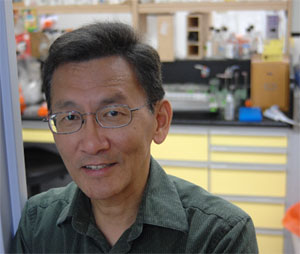
| Patrick Lee is a professor with Dalhousie Medical School's Department of Microbiology and Immunology. (Danny Abriel Photo) |
Virologist and Dalhousie professor Patrick Lee was on his way to the American Association of Cancer Research in San Diego last week when he decided to check out the in-flight movie I Am Legend.
The premise of the sci-fi horror movie is that a virus successfully used to fight cancer in clinical trials has gone out of control, pushing humankind to the edge of extinction. Early on in the movie, survivor Robert Neville (Will Smith) replays a three-year-old TV interview which foreshadows the disaster.
“So, Dr. Krippin, give it to me in a nutshell,” says the TV interviewer.
“Well, the premise is quite simple,” responds the scientist. “Um, take something designed by nature and reprogram it to make it work for the body rather than against it.”
In his airplane seat, Dr. Lee’s jaw is dropping. Not a movie-goer, he didn’t catch the movie in theatres when it came out last Christmas, although a colleague at McGill thought he should.
“That’s my research. I can’t believe it, that’s my research,” he says. “I was the first one to use a virus to target cancer cells.”
Dr. Lee has championed the development of the naturally occurring “reovirus” as a potential treatment for cancer. Reovirus, like all viruses, self-propagates and multiplies when it attaches itself to a host cell. With ordinary viruses, they can cause sickness due to infection. Reovirus, though, kills cancerous host cells and leaves healthy cells alone.
In 1998, Dr. Lee revealed that reovirus injected in mice shrank tumours from brain cancer significantly. Not only that, the reovirus would seek out other tumours and eliminate them as well. His discovery of a promising therapy for cancer was a worldwide sensation when announced in the journal Science.
In the decade since his breakthrough, Dr. Lee relocated from the University of Calgary to Dalhousie University, where he’s worked to understand how reovirus replicates in the host cell and seeks out other cancerous cells. In short, says Dr. Lee, “to know what makes the virus such a potent cancer killer.”
He’s recently received word of a $711,000 grant from the Canadian Institutes of Health Research (CIHR) which will support his laboratory for the next three years; the money is part of more than $4-million in grants from CIHR that are going to Dalhousie University researchers. Ten graduate students and post-doctoral fellows work on two cancer-related projects in Dr. Lee’s Cancer Biology Laboratory: one is the reovirus project; the other involves the function of p53, a tumour-suppressor protein.
Meanwhile, independent of Dr. Lee’s research, phase-one and phase-two clinical trials are taking place in the United States and in the U.K. to test the safety and effectiveness of reovirus in humans. Results have been promising so far, says Dr. Lee, but large-scale, phase-three clinical trials are still a few years away.
But clearly the movie is still bothering him. He wants to make it clear there’s no worry that the reovirus could run amuck.
“I thought the movie was very entertaining but the scenario it presents is highly unlikely, almost impossible,” he says.
With a pause, he adds: “Scientists don’t like to deal in absolutes, but in this case, I would say absolutely impossible.”
READ: Health research touching lives, Canadian Institutes of Health Research